| Record Information |
|---|
| Version | 2.0 |
|---|
| Created at | 2022-09-12 08:27:00 UTC |
|---|
| Updated at | 2022-09-12 08:27:00 UTC |
|---|
| NP-MRD ID | NP0326664 |
|---|
| Secondary Accession Numbers | None |
|---|
| Natural Product Identification |
|---|
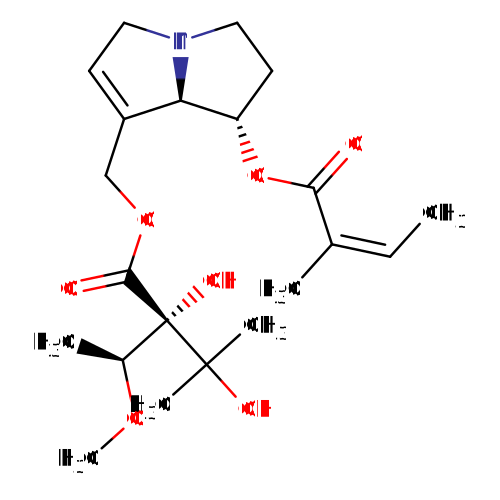
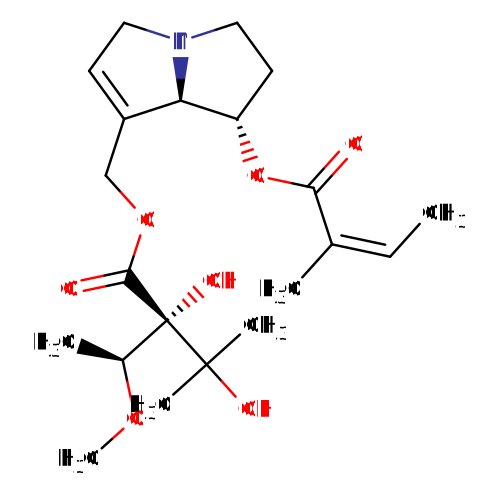
| Common Name | (1s,7ar)-7-({[(2s)-2,3-dihydroxy-2-[(1s)-1-methoxyethyl]-3-methylbutanoyl]oxy}methyl)-2,3,5,7a-tetrahydro-1h-pyrrolizin-1-yl (2z)-2-methylbut-2-enoate |
|---|
| Description | Lasiocarpine belongs to the class of organic compounds known as alkaloids and derivatives. These are naturally occurring chemical compounds that contain mostly basic nitrogen atoms. This group also includes some related compounds with neutral and even weakly acidic properties. Also some synthetic compounds of similar structure are attributed to alkaloids. In addition to carbon, hydrogen and nitrogen, alkaloids may also contain oxygen, sulfur and more rarely other elements such as chlorine, bromine, and phosphorus. They may act as prolonged, potent inhibitors of mitosis in hepatocytes, they are mutagenic in Drosophila and cause chromosome breakage in leukocytes. Lasiocarpine is a very strong basic compound (based on its pKa). Lasiocarpine is formally rated as a possible carcinogen (by IARC 2B) and is also a potentially toxic compound. The prominence of rough ER in enlarged hepatocytes is s a sign of increased metabolic activity. Lasiocarpine is toxic to liver cells but not to lung cells, which is unable to metabolize the pyrrolizidine alkaloids to pyrroles. One of the unusual results of chronic poisoning by lasiocarpine and other members of the pyrrolizidine alkaloids is progressive enlargement of liver cells to up to three times the normal diameter, with an accompanying proportionate increase in nuclear diameter. The application of lasiocarpine to human liver cells in culture is followed by inhibition of DNA, RNA and protein synthesis; vacuolation of the cells, the prevention of mitosis and the formation of giant cells (“megalocytes”). Effects on the liver include hemorrhagic necrosis of parenchymal cells, marked enlargement of parenchymal cells and of their nuclei and nucleoli, fibrosis or cirrhosis, depression of cell division, and possibly neoplasia. The inducibility of tryptophan pyrrolase activity by hydrocortisone, in the livers of rats treated chronically with lasiocarpine is an indication that translational mechanisms are intact. However, the increased uptake of 3H-thymidine by megalocytes, in the absence of observable mitotic activity, suggests that these cells are in the process of hypertrophy. |
|---|
| Structure | [H]\C(C)=C(/C)C(=O)O[C@@]1([H])CCN2CC=C(COC(=O)[C@](O)([C@]([H])(C)OC)C(C)(C)O)[C@]12[H] InChI=1S/C21H33NO7/c1-7-13(2)18(23)29-16-9-11-22-10-8-15(17(16)22)12-28-19(24)21(26,14(3)27-6)20(4,5)25/h7-8,14,16-17,25-26H,9-12H2,1-6H3/b13-7-/t14-,16-,17+,21+/m0/s1 |
|---|
| Synonyms | | Value | Source |
|---|
| Lasiocarpine sulfate, (1S-(1alpha(Z),7(2S*,3R*),7aalpha))-isomer | MeSH | | Lasiocarpine hydrochloride, (1S-(1alpha(Z),7(2S*,3R*),7aalpha))-isomer | MeSH |
|
|---|
| Chemical Formula | C21H33NO7 |
|---|
| Average Mass | 411.4892 Da |
|---|
| Monoisotopic Mass | 411.22570 Da |
|---|
| IUPAC Name | (1S,7aR)-7-({[(2S)-2,3-dihydroxy-2-[(1S)-1-methoxyethyl]-3-methylbutanoyl]oxy}methyl)-2,3,5,7a-tetrahydro-1H-pyrrolizin-1-yl (2Z)-2-methylbut-2-enoate |
|---|
| Traditional Name | (1S,7aR)-7-({[(2S)-2,3-dihydroxy-2-[(1S)-1-methoxyethyl]-3-methylbutanoyl]oxy}methyl)-2,3,5,7a-tetrahydro-1H-pyrrolizin-1-yl (2Z)-2-methylbut-2-enoate |
|---|
| CAS Registry Number | Not Available |
|---|
| SMILES | [H]\C(C)=C(/C)C(=O)O[C@@]1([H])CCN2CC=C(COC(=O)[C@](O)([C@]([H])(C)OC)C(C)(C)O)[C@]12[H] |
|---|
| InChI Identifier | InChI=1S/C21H33NO7/c1-7-13(2)18(23)29-16-9-11-22-10-8-15(17(16)22)12-28-19(24)21(26,14(3)27-6)20(4,5)25/h7-8,14,16-17,25-26H,9-12H2,1-6H3/b13-7-/t14-,16-,17+,21+/m0/s1 |
|---|
| InChI Key | QHOZSLCIKHUPSU-PNFBIMPKSA-N |
|---|
| Experimental Spectra |
|---|
|
| Not Available | | Predicted Spectra |
|---|
|
| | Spectrum Type | Description | Depositor ID | Depositor Organization | Depositor | Deposition Date | View |
|---|
| 1D NMR | 13C NMR Spectrum (1D, 25 MHz, H2O, predicted) | Wishart Lab | Wishart Lab | David Wishart | 2021-06-20 | View Spectrum | | 1D NMR | 1H NMR Spectrum (1D, 100 MHz, H2O, predicted) | Wishart Lab | Wishart Lab | David Wishart | 2021-06-20 | View Spectrum | | 1D NMR | 13C NMR Spectrum (1D, 252 MHz, H2O, predicted) | Wishart Lab | Wishart Lab | David Wishart | 2021-06-20 | View Spectrum | | 1D NMR | 1H NMR Spectrum (1D, 1000 MHz, H2O, predicted) | Wishart Lab | Wishart Lab | David Wishart | 2021-06-20 | View Spectrum | | 1D NMR | 13C NMR Spectrum (1D, 50 MHz, H2O, predicted) | Wishart Lab | Wishart Lab | David Wishart | 2021-06-20 | View Spectrum | | 1D NMR | 1H NMR Spectrum (1D, 200 MHz, H2O, predicted) | Wishart Lab | Wishart Lab | David Wishart | 2021-06-20 | View Spectrum | | 1D NMR | 13C NMR Spectrum (1D, 75 MHz, H2O, predicted) | Wishart Lab | Wishart Lab | David Wishart | 2021-06-20 | View Spectrum | | 1D NMR | 1H NMR Spectrum (1D, 300 MHz, H2O, predicted) | Wishart Lab | Wishart Lab | David Wishart | 2021-06-20 | View Spectrum | | 1D NMR | 13C NMR Spectrum (1D, 101 MHz, H2O, predicted) | Wishart Lab | Wishart Lab | David Wishart | 2021-06-20 | View Spectrum | | 1D NMR | 1H NMR Spectrum (1D, 400 MHz, H2O, predicted) | Wishart Lab | Wishart Lab | David Wishart | 2021-06-20 | View Spectrum | | 1D NMR | 13C NMR Spectrum (1D, 126 MHz, H2O, predicted) | Wishart Lab | Wishart Lab | David Wishart | 2021-06-20 | View Spectrum | | 1D NMR | 1H NMR Spectrum (1D, 500 MHz, H2O, predicted) | Wishart Lab | Wishart Lab | David Wishart | 2021-06-20 | View Spectrum | | 1D NMR | 13C NMR Spectrum (1D, 151 MHz, H2O, predicted) | Wishart Lab | Wishart Lab | David Wishart | 2021-06-20 | View Spectrum | | 1D NMR | 1H NMR Spectrum (1D, 600 MHz, H2O, predicted) | Wishart Lab | Wishart Lab | David Wishart | 2021-06-20 | View Spectrum | | 1D NMR | 13C NMR Spectrum (1D, 176 MHz, H2O, predicted) | Wishart Lab | Wishart Lab | David Wishart | 2021-06-20 | View Spectrum | | 1D NMR | 1H NMR Spectrum (1D, 700 MHz, H2O, predicted) | Wishart Lab | Wishart Lab | David Wishart | 2021-06-20 | View Spectrum | | 1D NMR | 13C NMR Spectrum (1D, 201 MHz, H2O, predicted) | Wishart Lab | Wishart Lab | David Wishart | 2021-06-20 | View Spectrum | | 1D NMR | 1H NMR Spectrum (1D, 800 MHz, H2O, predicted) | Wishart Lab | Wishart Lab | David Wishart | 2021-06-20 | View Spectrum | | 1D NMR | 13C NMR Spectrum (1D, 226 MHz, H2O, predicted) | Wishart Lab | Wishart Lab | David Wishart | 2021-06-20 | View Spectrum | | 1D NMR | 1H NMR Spectrum (1D, 900 MHz, H2O, predicted) | Wishart Lab | Wishart Lab | David Wishart | 2021-06-20 | View Spectrum |
| | Chemical Shift Submissions |
|---|
|
| Not Available | | Species |
|---|
| Species of Origin | Not Available |
|---|
| Chemical Taxonomy |
|---|
| Description | Belongs to the class of organic compounds known as alkaloids and derivatives. These are naturally occurring chemical compounds that contain mostly basic nitrogen atoms. This group also includes some related compounds with neutral and even weakly acidic properties. Also some synthetic compounds of similar structure are attributed to alkaloids. In addition to carbon, hydrogen and nitrogen, alkaloids may also contain oxygen, sulfur and more rarely other elements such as chlorine, bromine, and phosphorus. |
|---|
| Kingdom | Organic compounds |
|---|
| Super Class | Alkaloids and derivatives |
|---|
| Class | Not Available |
|---|
| Sub Class | Not Available |
|---|
| Direct Parent | Alkaloids and derivatives |
|---|
| Alternative Parents | |
|---|
| Substituents | - Alkaloid or derivatives
- Pyrrolizine
- Fatty acid ester
- Dicarboxylic acid or derivatives
- N-alkylpyrrolidine
- Fatty acyl
- Alpha,beta-unsaturated carboxylic ester
- Enoate ester
- Pyrrolidine
- Tertiary alcohol
- Pyrroline
- Amino acid or derivatives
- Carboxylic acid ester
- 1,2-diol
- Tertiary aliphatic amine
- Tertiary amine
- Azacycle
- Carboxylic acid derivative
- Dialkyl ether
- Organoheterocyclic compound
- Ether
- Organopnictogen compound
- Amine
- Organic oxide
- Hydrocarbon derivative
- Carbonyl group
- Organic nitrogen compound
- Organonitrogen compound
- Organooxygen compound
- Alcohol
- Organic oxygen compound
- Aliphatic heteropolycyclic compound
|
|---|
| Molecular Framework | Aliphatic heteropolycyclic compounds |
|---|
| External Descriptors | Not Available |
|---|
| Physical Properties |
|---|
| State | Not Available |
|---|
| Experimental Properties | | Property | Value | Reference |
|---|
| Melting Point | Not Available | Not Available | | Boiling Point | Not Available | Not Available | | Water Solubility | Not Available | Not Available | | LogP | Not Available | Not Available |
|
|---|
| Predicted Properties | |
|---|