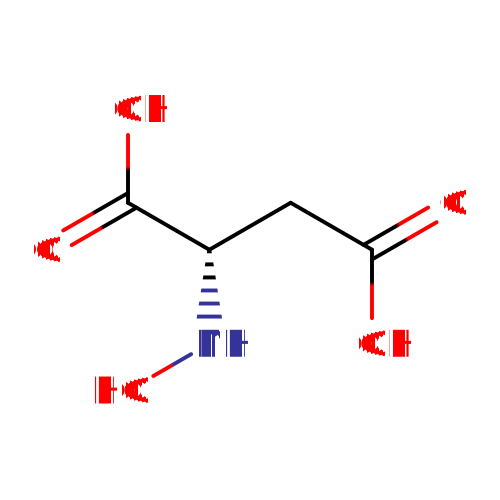
| Record Information |
|---|
| Version | 2.0 |
|---|
| Created at | 2022-09-12 06:32:08 UTC |
|---|
| Updated at | 2022-09-12 06:32:08 UTC |
|---|
| NP-MRD ID | NP0325637 |
|---|
| Secondary Accession Numbers | None |
|---|
| Natural Product Identification |
|---|
| Common Name | (2s)-2-(hydroxyamino)butanedioic acid |
|---|
| Description | Hydroxyaspartic acid, also known as hydroxyaspartate, belongs to the class of organic compounds known as aspartic acid and derivatives. Aspartic acid and derivatives are compounds containing an aspartic acid or a derivative thereof resulting from reaction of aspartic acid at the amino group or the carboxy group, or from the replacement of any hydrogen of glycine by a heteroatom. (2s)-2-(hydroxyamino)butanedioic acid is found in Medicago sativa. (2s)-2-(hydroxyamino)butanedioic acid was first documented in 2019 (PMID: 31527229). Based on a literature review a small amount of articles have been published on Hydroxyaspartic acid (PMID: 32378891) (PMID: 35963916) (PMID: 32725837) (PMID: 32266214). |
|---|
| Structure | InChI=1S/C4H7NO5/c6-3(7)1-2(5-10)4(8)9/h2,5,10H,1H2,(H,6,7)(H,8,9)/t2-/m0/s1 |
|---|
| Synonyms | | Value | Source |
|---|
| Hydroxyaspartate | Generator |
|
|---|
| Chemical Formula | C4H7NO5 |
|---|
| Average Mass | 149.1020 Da |
|---|
| Monoisotopic Mass | 149.03242 Da |
|---|
| IUPAC Name | (2S)-2-(hydroxyamino)butanedioic acid |
|---|
| Traditional Name | (2S)-2-(hydroxyamino)butanedioic acid |
|---|
| CAS Registry Number | Not Available |
|---|
| SMILES | ON[C@@H](CC(O)=O)C(O)=O |
|---|
| InChI Identifier | InChI=1S/C4H7NO5/c6-3(7)1-2(5-10)4(8)9/h2,5,10H,1H2,(H,6,7)(H,8,9)/t2-/m0/s1 |
|---|
| InChI Key | YDBVAWZTOAZPTJ-REOHCLBHSA-N |
|---|
| Experimental Spectra |
|---|
|
| Not Available | | Predicted Spectra |
|---|
|
| | Spectrum Type | Description | Depositor ID | Depositor Organization | Depositor | Deposition Date | View |
|---|
| 1D NMR | 13C NMR Spectrum (1D, 25 MHz, H2O, predicted) | Wishart Lab | Wishart Lab | David Wishart | 2021-06-20 | View Spectrum | | 1D NMR | 1H NMR Spectrum (1D, 100 MHz, H2O, predicted) | Wishart Lab | Wishart Lab | David Wishart | 2021-06-20 | View Spectrum | | 1D NMR | 13C NMR Spectrum (1D, 252 MHz, H2O, predicted) | Wishart Lab | Wishart Lab | David Wishart | 2021-06-20 | View Spectrum | | 1D NMR | 1H NMR Spectrum (1D, 1000 MHz, H2O, predicted) | Wishart Lab | Wishart Lab | David Wishart | 2021-06-20 | View Spectrum | | 1D NMR | 13C NMR Spectrum (1D, 50 MHz, H2O, predicted) | Wishart Lab | Wishart Lab | David Wishart | 2021-06-20 | View Spectrum | | 1D NMR | 1H NMR Spectrum (1D, 200 MHz, H2O, predicted) | Wishart Lab | Wishart Lab | David Wishart | 2021-06-20 | View Spectrum | | 1D NMR | 13C NMR Spectrum (1D, 75 MHz, H2O, predicted) | Wishart Lab | Wishart Lab | David Wishart | 2021-06-20 | View Spectrum | | 1D NMR | 1H NMR Spectrum (1D, 300 MHz, H2O, predicted) | Wishart Lab | Wishart Lab | David Wishart | 2021-06-20 | View Spectrum | | 1D NMR | 13C NMR Spectrum (1D, 101 MHz, H2O, predicted) | Wishart Lab | Wishart Lab | David Wishart | 2021-06-20 | View Spectrum | | 1D NMR | 1H NMR Spectrum (1D, 400 MHz, H2O, predicted) | Wishart Lab | Wishart Lab | David Wishart | 2021-06-20 | View Spectrum | | 1D NMR | 13C NMR Spectrum (1D, 126 MHz, H2O, predicted) | Wishart Lab | Wishart Lab | David Wishart | 2021-06-20 | View Spectrum | | 1D NMR | 1H NMR Spectrum (1D, 500 MHz, H2O, predicted) | Wishart Lab | Wishart Lab | David Wishart | 2021-06-20 | View Spectrum | | 1D NMR | 13C NMR Spectrum (1D, 151 MHz, H2O, predicted) | Wishart Lab | Wishart Lab | David Wishart | 2021-06-20 | View Spectrum | | 1D NMR | 1H NMR Spectrum (1D, 600 MHz, H2O, predicted) | Wishart Lab | Wishart Lab | David Wishart | 2021-06-20 | View Spectrum | | 1D NMR | 13C NMR Spectrum (1D, 176 MHz, H2O, predicted) | Wishart Lab | Wishart Lab | David Wishart | 2021-06-20 | View Spectrum | | 1D NMR | 1H NMR Spectrum (1D, 700 MHz, H2O, predicted) | Wishart Lab | Wishart Lab | David Wishart | 2021-06-20 | View Spectrum | | 1D NMR | 13C NMR Spectrum (1D, 201 MHz, H2O, predicted) | Wishart Lab | Wishart Lab | David Wishart | 2021-06-20 | View Spectrum | | 1D NMR | 1H NMR Spectrum (1D, 800 MHz, H2O, predicted) | Wishart Lab | Wishart Lab | David Wishart | 2021-06-20 | View Spectrum | | 1D NMR | 13C NMR Spectrum (1D, 226 MHz, H2O, predicted) | Wishart Lab | Wishart Lab | David Wishart | 2021-06-20 | View Spectrum | | 1D NMR | 1H NMR Spectrum (1D, 900 MHz, H2O, predicted) | Wishart Lab | Wishart Lab | David Wishart | 2021-06-20 | View Spectrum |
| | Chemical Shift Submissions |
|---|
|
| Not Available | | Species |
|---|
| Species of Origin | |
|---|
| Chemical Taxonomy |
|---|
| Description | Belongs to the class of organic compounds known as aspartic acid and derivatives. Aspartic acid and derivatives are compounds containing an aspartic acid or a derivative thereof resulting from reaction of aspartic acid at the amino group or the carboxy group, or from the replacement of any hydrogen of glycine by a heteroatom. |
|---|
| Kingdom | Organic compounds |
|---|
| Super Class | Organic acids and derivatives |
|---|
| Class | Carboxylic acids and derivatives |
|---|
| Sub Class | Amino acids, peptides, and analogues |
|---|
| Direct Parent | Aspartic acid and derivatives |
|---|
| Alternative Parents | |
|---|
| Substituents | - Aspartic acid or derivatives
- N-hydroxyl-alpha-amino acid
- Fatty acid
- Dicarboxylic acid or derivatives
- N-organohydroxylamine
- Carboxylic acid
- Organic nitrogen compound
- Organic oxygen compound
- Organic oxide
- Hydrocarbon derivative
- Organooxygen compound
- Organonitrogen compound
- Carbonyl group
- Aliphatic acyclic compound
|
|---|
| Molecular Framework | Aliphatic acyclic compounds |
|---|
| External Descriptors | Not Available |
|---|
| Physical Properties |
|---|
| State | Not Available |
|---|
| Experimental Properties | | Property | Value | Reference |
|---|
| Melting Point | Not Available | Not Available | | Boiling Point | Not Available | Not Available | | Water Solubility | Not Available | Not Available | | LogP | Not Available | Not Available |
|
|---|
| Predicted Properties | |
|---|
| General References | - Matsui K, Kan Y, Kikuchi J, Matsushima K, Takemura M, Maki H, Kozono I, Ueda T, Minagawa K: Stalobacin: Discovery of Novel Lipopeptide Antibiotics with Potent Antibacterial Activity against Multidrug-Resistant Bacteria. J Med Chem. 2020 Jun 11;63(11):6090-6095. doi: 10.1021/acs.jmedchem.0c00295. Epub 2020 May 19. [PubMed:32378891 ]
- Lee Y, Seo Y, Lee B, Kwon H, Chung K, Kim YG: Divergent synthesis of biologically active L-threo-beta-hydroxyaspartates from common trans-oxazolidine dicarboxylate. Amino Acids. 2022 Aug 13. pii: 10.1007/s00726-022-03196-8. doi: 10.1007/s00726-022-03196-8. [PubMed:35963916 ]
- Sun Z, Shang Z, Forelli N, Po KHL, Chen S, Brady SF, Li X: Total Synthesis of Malacidin A by beta-Hydroxyaspartic Acid Ligation-Mediated Cyclization and Absolute Structure Establishment. Angew Chem Int Ed Engl. 2020 Nov 2;59(45):19868-19872. doi: 10.1002/anie.202009092. Epub 2020 Aug 31. [PubMed:32725837 ]
- Li Y, Liu L, Zhang G, He N, Guo W, Hong B, Xie Y: Potashchelins, a Suite of Lipid Siderophores Bearing Both L-threo and L-erythro Beta-Hydroxyaspartic Acids, Acquired From the Potash-Salt-Ore-Derived Extremophile Halomonas sp. MG34. Front Chem. 2020 Mar 20;8:197. doi: 10.3389/fchem.2020.00197. eCollection 2020. [PubMed:32266214 ]
- Reitz ZL, Hardy CD, Suk J, Bouvet J, Butler A: Genomic analysis of siderophore beta-hydroxylases reveals divergent stereocontrol and expands the condensation domain family. Proc Natl Acad Sci U S A. 2019 Oct 1;116(40):19805-19814. doi: 10.1073/pnas.1903161116. Epub 2019 Sep 16. [PubMed:31527229 ]
- LOTUS database [Link]
|
|---|