| Record Information |
|---|
| Version | 2.0 |
|---|
| Created at | 2022-09-12 04:51:43 UTC |
|---|
| Updated at | 2022-09-12 04:51:44 UTC |
|---|
| NP-MRD ID | NP0324649 |
|---|
| Secondary Accession Numbers | None |
|---|
| Natural Product Identification |
|---|
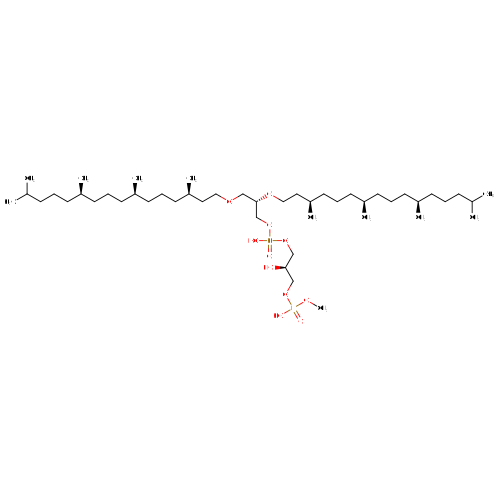
| Common Name | (2s)-2,3-bis({[(3r,7r,11r)-3,7,11,15-tetramethylhexadecyl]oxy})propoxy((2r)-2-hydroxy-3-{[hydroxy(methoxy)phosphoryl]oxy}propoxy)phosphinic acid |
|---|
| Description | Pgp-me belongs to the class of organic compounds known as acyclic diterpenoids. These are diterpenoids (compounds made of four consecutive isoprene units) that do not contain a cycle. Thus, PGP-me is considered to be a glycerophosphoglycerophosphate. (2s)-2,3-bis({[(3r,7r,11r)-3,7,11,15-tetramethylhexadecyl]oxy})propoxy((2r)-2-hydroxy-3-{[hydroxy(methoxy)phosphoryl]oxy}propoxy)phosphinic acid is found in Bacterium. (2s)-2,3-bis({[(3r,7r,11r)-3,7,11,15-tetramethylhexadecyl]oxy})propoxy((2r)-2-hydroxy-3-{[hydroxy(methoxy)phosphoryl]oxy}propoxy)phosphinic acid was first documented in 2022 (PMID: 36108543). Based on a literature review a small amount of articles have been published on Pgp-me (PMID: 35922580) (PMID: 35805918) (PMID: 35644061) (PMID: 35616996). |
|---|
| Structure | COP(O)(=O)OC[C@@H](O)COP(O)(=O)OC[C@H](COCC[C@H](C)CCC[C@H](C)CCC[C@H](C)CCCC(C)C)OCC[C@H](C)CCC[C@H](C)CCC[C@H](C)CCCC(C)C InChI=1S/C47H98O11P2/c1-38(2)18-12-20-40(5)22-14-24-42(7)26-16-28-44(9)30-32-54-36-47(37-58-60(51,52)57-35-46(48)34-56-59(49,50)53-11)55-33-31-45(10)29-17-27-43(8)25-15-23-41(6)21-13-19-39(3)4/h38-48H,12-37H2,1-11H3,(H,49,50)(H,51,52)/t40-,41-,42-,43-,44-,45-,46-,47+/m1/s1 |
|---|
| Synonyms | | Value | Source |
|---|
| Phosphatidylglycerophosphate methyl ester | MeSH |
|
|---|
| Chemical Formula | C47H98O11P2 |
|---|
| Average Mass | 901.2380 Da |
|---|
| Monoisotopic Mass | 900.65844 Da |
|---|
| IUPAC Name | [(2S)-2,3-bis({[(3R,7R,11R)-3,7,11,15-tetramethylhexadecyl]oxy})propoxy][(2R)-2-hydroxy-3-{[hydroxy(methoxy)phosphoryl]oxy}propoxy]phosphinic acid |
|---|
| Traditional Name | (2S)-2,3-bis({[(3R,7R,11R)-3,7,11,15-tetramethylhexadecyl]oxy})propoxy((2R)-2-hydroxy-3-{[hydroxy(methoxy)phosphoryl]oxy}propoxy)phosphinic acid |
|---|
| CAS Registry Number | Not Available |
|---|
| SMILES | COP(O)(=O)OC[C@@H](O)COP(O)(=O)OC[C@H](COCC[C@H](C)CCC[C@H](C)CCC[C@H](C)CCCC(C)C)OCC[C@H](C)CCC[C@H](C)CCC[C@H](C)CCCC(C)C |
|---|
| InChI Identifier | InChI=1S/C47H98O11P2/c1-38(2)18-12-20-40(5)22-14-24-42(7)26-16-28-44(9)30-32-54-36-47(37-58-60(51,52)57-35-46(48)34-56-59(49,50)53-11)55-33-31-45(10)29-17-27-43(8)25-15-23-41(6)21-13-19-39(3)4/h38-48H,12-37H2,1-11H3,(H,49,50)(H,51,52)/t40-,41-,42-,43-,44-,45-,46-,47+/m1/s1 |
|---|
| InChI Key | ORVRQEXCVQTLMU-XPEHDBCOSA-N |
|---|
| Experimental Spectra |
|---|
|
| Not Available | | Predicted Spectra |
|---|
|
| Not Available | | Chemical Shift Submissions |
|---|
|
| Not Available | | Species |
|---|
| Species of Origin | |
|---|
| Chemical Taxonomy |
|---|
| Description | Belongs to the class of organic compounds known as acyclic diterpenoids. These are diterpenoids (compounds made of four consecutive isoprene units) that do not contain a cycle. |
|---|
| Kingdom | Organic compounds |
|---|
| Super Class | Lipids and lipid-like molecules |
|---|
| Class | Prenol lipids |
|---|
| Sub Class | Diterpenoids |
|---|
| Direct Parent | Acyclic diterpenoids |
|---|
| Alternative Parents | |
|---|
| Substituents | - Acyclic diterpenoid
- Glycerophospholipid
- Dialkyl phosphate
- Glycerol ether
- Organic phosphoric acid derivative
- Phosphoric acid ester
- Alkyl phosphate
- Secondary alcohol
- Ether
- Dialkyl ether
- Hydrocarbon derivative
- Organooxygen compound
- Organic oxide
- Alcohol
- Organic oxygen compound
- Aliphatic acyclic compound
|
|---|
| Molecular Framework | Aliphatic acyclic compounds |
|---|
| External Descriptors | |
|---|
| Physical Properties |
|---|
| State | Not Available |
|---|
| Experimental Properties | | Property | Value | Reference |
|---|
| Melting Point | Not Available | Not Available | | Boiling Point | Not Available | Not Available | | Water Solubility | Not Available | Not Available | | LogP | Not Available | Not Available |
|
|---|
| Predicted Properties | |
|---|
| General References | - Sorokin DY, Yakimov M, Messina E, Merkel AY, Koenen M, Bale NJ, Sinninghe Damste JS: Natranaeroarchaeum sulfidigenes gen. nov., sp. nov., carbohydrate-utilizing sulfur-respiring haloarchaeon from hypersaline soda lakes, a member of a new family Natronoarchaeaceae fam. nov. in the order Halobacteriales. Syst Appl Microbiol. 2022 Nov;45(6):126356. doi: 10.1016/j.syapm.2022.126356. Epub 2022 Aug 31. [PubMed:36108543 ]
- Wang BB, Sun YP, Wu ZP, Zheng XW, Hou J, Cui HL: Halorientalis salina sp. nov., Halorientalis marina sp. nov., Halorientalis litorea sp. nov.: three extremely halophilic archaea isolated from a salt lake and coarse sea salt. Extremophiles. 2022 Aug 3;26(3):26. doi: 10.1007/s00792-022-01275-y. [PubMed:35922580 ]
- Chen S, Ding X, Sun C, Wang F, He X, Watts A, Zhao X: Archaeal Lipids Regulating the Trimeric Structure Dynamics of Bacteriorhodopsin for Efficient Proton Release and Uptake. Int J Mol Sci. 2022 Jun 21;23(13):6913. doi: 10.3390/ijms23136913. [PubMed:35805918 ]
- Sorokin DY, Elcheninov AG, Khizhniak TV, Koenen M, Bale NJ, Damste JSS, Kublanov IV: Natronocalculus amylovorans gen. nov., sp. nov., and Natranaeroarchaeum aerophilus sp. nov., dominant culturable amylolytic natronoarchaea from hypersaline soda lakes in southwestern Siberia. Syst Appl Microbiol. 2022 Jul;45(4):126336. doi: 10.1016/j.syapm.2022.126336. Epub 2022 May 20. [PubMed:35644061 ]
- Bao CX, Li SY, Xin YJ, Hou J, Cui HL: Natrinema halophilum sp. nov., Natrinema salinisoli sp. nov., Natrinema amylolyticum sp. nov. and Haloterrigena alkaliphila sp. nov., four extremely halophilic archaea isolated from salt mine, saline soil and salt lake. Int J Syst Evol Microbiol. 2022 May;72(5). doi: 10.1099/ijsem.0.005385. [PubMed:35616996 ]
- LOTUS database [Link]
|
|---|