| Record Information |
|---|
| Version | 2.0 |
|---|
| Created at | 2022-09-12 01:05:57 UTC |
|---|
| Updated at | 2022-09-12 01:05:57 UTC |
|---|
| NP-MRD ID | NP0322366 |
|---|
| Secondary Accession Numbers | None |
|---|
| Natural Product Identification |
|---|
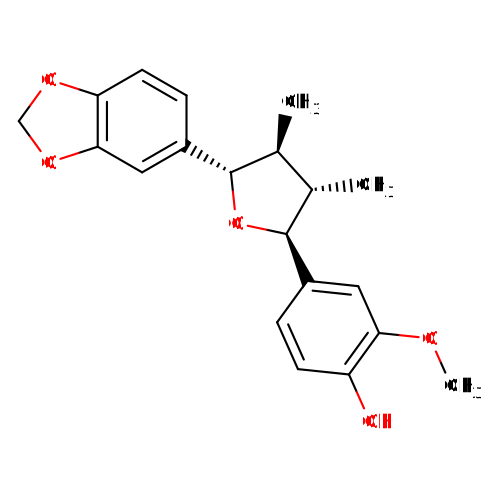
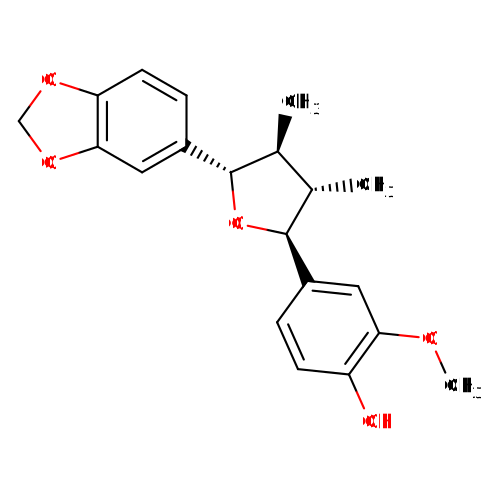
| Common Name | 4-[(2s,3s,4s,5s)-5-(2h-1,3-benzodioxol-5-yl)-3,4-dimethyloxolan-2-yl]-2-methoxyphenol |
|---|
| Description | Talaumidin belongs to the class of organic compounds known as 7,7'-epoxylignans. These are lignans with a structure based on a 2,5-diaryl-3, 4-dimethyltetrahydrofuran skeleton. 4-[(2s,3s,4s,5s)-5-(2h-1,3-benzodioxol-5-yl)-3,4-dimethyloxolan-2-yl]-2-methoxyphenol is found in Aristolochia arcuata, Magnolia liliifera, Myristica fragrans and Virola surinamensis. 4-[(2s,3s,4s,5s)-5-(2h-1,3-benzodioxol-5-yl)-3,4-dimethyloxolan-2-yl]-2-methoxyphenol was first documented in 2005 (PMID: 15684486). Based on a literature review a significant number of articles have been published on Talaumidin (PMID: 17764190) (PMID: 20332453) (PMID: 32391327) (PMID: 32009033) (PMID: 29721999) (PMID: 29454919). |
|---|
| Structure | COC1=CC(=CC=C1O)[C@H]1O[C@@H]([C@@H](C)[C@@H]1C)C1=CC=C2OCOC2=C1 InChI=1S/C20H22O5/c1-11-12(2)20(14-5-7-16-18(9-14)24-10-23-16)25-19(11)13-4-6-15(21)17(8-13)22-3/h4-9,11-12,19-21H,10H2,1-3H3/t11-,12-,19-,20-/m0/s1 |
|---|
| Synonyms | Not Available |
|---|
| Chemical Formula | C20H22O5 |
|---|
| Average Mass | 342.3910 Da |
|---|
| Monoisotopic Mass | 342.14672 Da |
|---|
| IUPAC Name | 4-[(2S,3S,4S,5S)-5-(2H-1,3-benzodioxol-5-yl)-3,4-dimethyloxolan-2-yl]-2-methoxyphenol |
|---|
| Traditional Name | 4-[(2S,3S,4S,5S)-5-(2H-1,3-benzodioxol-5-yl)-3,4-dimethyloxolan-2-yl]-2-methoxyphenol |
|---|
| CAS Registry Number | Not Available |
|---|
| SMILES | COC1=CC(=CC=C1O)[C@H]1O[C@@H]([C@@H](C)[C@@H]1C)C1=CC=C2OCOC2=C1 |
|---|
| InChI Identifier | InChI=1S/C20H22O5/c1-11-12(2)20(14-5-7-16-18(9-14)24-10-23-16)25-19(11)13-4-6-15(21)17(8-13)22-3/h4-9,11-12,19-21H,10H2,1-3H3/t11-,12-,19-,20-/m0/s1 |
|---|
| InChI Key | JPDORDSJPIKURD-HIGYNYDNSA-N |
|---|
| Experimental Spectra |
|---|
|
| Not Available | | Predicted Spectra |
|---|
|
| | Spectrum Type | Description | Depositor ID | Depositor Organization | Depositor | Deposition Date | View |
|---|
| 1D NMR | 13C NMR Spectrum (1D, 25 MHz, H2O, predicted) | Wishart Lab | Wishart Lab | David Wishart | 2021-06-20 | View Spectrum | | 1D NMR | 1H NMR Spectrum (1D, 100 MHz, H2O, predicted) | Wishart Lab | Wishart Lab | David Wishart | 2021-06-20 | View Spectrum | | 1D NMR | 13C NMR Spectrum (1D, 252 MHz, H2O, predicted) | Wishart Lab | Wishart Lab | David Wishart | 2021-06-20 | View Spectrum | | 1D NMR | 1H NMR Spectrum (1D, 1000 MHz, H2O, predicted) | Wishart Lab | Wishart Lab | David Wishart | 2021-06-20 | View Spectrum | | 1D NMR | 13C NMR Spectrum (1D, 50 MHz, H2O, predicted) | Wishart Lab | Wishart Lab | David Wishart | 2021-06-20 | View Spectrum | | 1D NMR | 1H NMR Spectrum (1D, 200 MHz, H2O, predicted) | Wishart Lab | Wishart Lab | David Wishart | 2021-06-20 | View Spectrum | | 1D NMR | 13C NMR Spectrum (1D, 75 MHz, H2O, predicted) | Wishart Lab | Wishart Lab | David Wishart | 2021-06-20 | View Spectrum | | 1D NMR | 1H NMR Spectrum (1D, 300 MHz, H2O, predicted) | Wishart Lab | Wishart Lab | David Wishart | 2021-06-20 | View Spectrum | | 1D NMR | 13C NMR Spectrum (1D, 101 MHz, H2O, predicted) | Wishart Lab | Wishart Lab | David Wishart | 2021-06-20 | View Spectrum | | 1D NMR | 1H NMR Spectrum (1D, 400 MHz, H2O, predicted) | Wishart Lab | Wishart Lab | David Wishart | 2021-06-20 | View Spectrum | | 1D NMR | 13C NMR Spectrum (1D, 126 MHz, H2O, predicted) | Wishart Lab | Wishart Lab | David Wishart | 2021-06-20 | View Spectrum | | 1D NMR | 1H NMR Spectrum (1D, 500 MHz, H2O, predicted) | Wishart Lab | Wishart Lab | David Wishart | 2021-06-20 | View Spectrum | | 1D NMR | 13C NMR Spectrum (1D, 151 MHz, H2O, predicted) | Wishart Lab | Wishart Lab | David Wishart | 2021-06-20 | View Spectrum | | 1D NMR | 1H NMR Spectrum (1D, 600 MHz, H2O, predicted) | Wishart Lab | Wishart Lab | David Wishart | 2021-06-20 | View Spectrum | | 1D NMR | 13C NMR Spectrum (1D, 176 MHz, H2O, predicted) | Wishart Lab | Wishart Lab | David Wishart | 2021-06-20 | View Spectrum | | 1D NMR | 1H NMR Spectrum (1D, 700 MHz, H2O, predicted) | Wishart Lab | Wishart Lab | David Wishart | 2021-06-20 | View Spectrum | | 1D NMR | 13C NMR Spectrum (1D, 201 MHz, H2O, predicted) | Wishart Lab | Wishart Lab | David Wishart | 2021-06-20 | View Spectrum | | 1D NMR | 1H NMR Spectrum (1D, 800 MHz, H2O, predicted) | Wishart Lab | Wishart Lab | David Wishart | 2021-06-20 | View Spectrum | | 1D NMR | 13C NMR Spectrum (1D, 226 MHz, H2O, predicted) | Wishart Lab | Wishart Lab | David Wishart | 2021-06-20 | View Spectrum | | 1D NMR | 1H NMR Spectrum (1D, 900 MHz, H2O, predicted) | Wishart Lab | Wishart Lab | David Wishart | 2021-06-20 | View Spectrum |
| | Chemical Shift Submissions |
|---|
|
| Not Available | | Species |
|---|
| Species of Origin | |
|---|
| Chemical Taxonomy |
|---|
| Description | Belongs to the class of organic compounds known as 7,7'-epoxylignans. These are lignans with a structure based on a 2,5-diaryl-3, 4-dimethyltetrahydrofuran skeleton. |
|---|
| Kingdom | Organic compounds |
|---|
| Super Class | Lignans, neolignans and related compounds |
|---|
| Class | Furanoid lignans |
|---|
| Sub Class | Tetrahydrofuran lignans |
|---|
| Direct Parent | 7,7'-epoxylignans |
|---|
| Alternative Parents | |
|---|
| Substituents | - 7,7p-epoxylignan
- Dibenzylbutane lignan skeleton
- Methoxyphenol
- Benzodioxole
- Phenoxy compound
- Anisole
- Methoxybenzene
- Phenol ether
- 1-hydroxy-2-unsubstituted benzenoid
- Alkyl aryl ether
- Phenol
- Monocyclic benzene moiety
- Benzenoid
- Oxolane
- Ether
- Acetal
- Dialkyl ether
- Organoheterocyclic compound
- Oxacycle
- Hydrocarbon derivative
- Organic oxygen compound
- Organooxygen compound
- Aromatic heteropolycyclic compound
|
|---|
| Molecular Framework | Aromatic heteropolycyclic compounds |
|---|
| External Descriptors | Not Available |
|---|
| Physical Properties |
|---|
| State | Not Available |
|---|
| Experimental Properties | | Property | Value | Reference |
|---|
| Melting Point | Not Available | Not Available | | Boiling Point | Not Available | Not Available | | Water Solubility | Not Available | Not Available | | LogP | Not Available | Not Available |
|
|---|
| Predicted Properties | |
|---|
| General References | - Kim H, Wooten CM, Park Y, Hong J: Stereoselective synthesis of tetrahydrofuran lignans via BF(3) x OEt(2)-promoted reductive deoxygenation/epimerization of cyclic hemiketal: synthesis of (-)-odoratisol C, (-)-futokadsurin A, (-)-veraguensin, (+)-fragransin A(2), (+)-galbelgin, and (+)-talaumidin. Org Lett. 2007 Sep 27;9(20):3965-8. doi: 10.1021/ol7016388. Epub 2007 Sep 1. [PubMed:17764190 ]
- Pusztai R, Abrantes M, Serly J, Duarte N, Molnar J, Ferreira MJ: Antitumor-promoting activity of lignans: inhibition of human cytomegalovirus IE gene expression. Anticancer Res. 2010 Feb;30(2):451-4. [PubMed:20332453 ]
- Zhai H, Inoue T, Moriyama M, Esumi T, Mitsumoto Y, Fukuyama Y: Neuroprotective effects of 2,5-diaryl-3,4-dimethyltetrahydrofuran neolignans. Biol Pharm Bull. 2005 Feb;28(2):289-93. doi: 10.1248/bpb.28.289. [PubMed:15684486 ]
- Harada K, Kubo M, Fukuyama Y: Chemistry and Neurotrophic Activities of (-)-Talaumidin and Its Derivatives. Front Chem. 2020 Apr 23;8:301. doi: 10.3389/fchem.2020.00301. eCollection 2020. [PubMed:32391327 ]
- Harada K: [Development of New Neurotrophic Compounds Based on Talaumidin]. Yakugaku Zasshi. 2020;140(2):129-137. doi: 10.1248/yakushi.19-00167. [PubMed:32009033 ]
- Koriyama Y, Furukawa A, Sugitani K, Kubo M, Harada K, Fukuyama Y: Talaumidin Promotes Neurite Outgrowth of Staurosporine-Differentiated RGC-5 Cells Through PI3K/Akt-Dependent Pathways. Adv Exp Med Biol. 2018;1074:649-653. doi: 10.1007/978-3-319-75402-4_79. [PubMed:29721999 ]
- Harada K, Zaha K, Bando R, Irimaziri R, Kubo M, Koriyama Y, Fukuyama Y: Structure-activity relationships of talaumidin derivatives: Their neurite-outgrowth promotion in vitro and optic nerve regeneration in vivo. Eur J Med Chem. 2018 Mar 25;148:86-94. doi: 10.1016/j.ejmech.2018.02.014. Epub 2018 Feb 9. [PubMed:29454919 ]
- Harada K, Kubo M, Horiuchi H, Ishii A, Esumi T, Hioki H, Fukuyama Y: Systematic Asymmetric Synthesis of All Diastereomers of (-)-Talaumidin and Their Neurotrophic Activity. J Org Chem. 2015 Jul 17;80(14):7076-88. doi: 10.1021/acs.joc.5b00945. Epub 2015 Jul 6. [PubMed:26108800 ]
- Xue P, Wang LP, Jiao XZ, Jiang YJ, Xiao Q, Luo ZG, Xie P, Liang XT: Total synthesis of (-)-talaumidin and (-)-galbelgin. J Asian Nat Prod Res. 2009;11(3):281-7. doi: 10.1080/10286020802675191. [PubMed:19408154 ]
- Abrantes M, Mil-Homens T, Duarte N, Lopes D, Cravo P, Madureira Md, Ferreira MJ: Antiplasmodial activity of lignans and extracts from Pycnanthus angolensis. Planta Med. 2008 Sep;74(11):1408-12. doi: 10.1055/s-2008-1081317. Epub 2008 Jul 31. [PubMed:18671202 ]
- LOTUS database [Link]
|
|---|