| Record Information |
|---|
| Version | 2.0 |
|---|
| Created at | 2022-09-11 21:55:25 UTC |
|---|
| Updated at | 2022-09-11 21:55:25 UTC |
|---|
| NP-MRD ID | NP0320331 |
|---|
| Secondary Accession Numbers | None |
|---|
| Natural Product Identification |
|---|
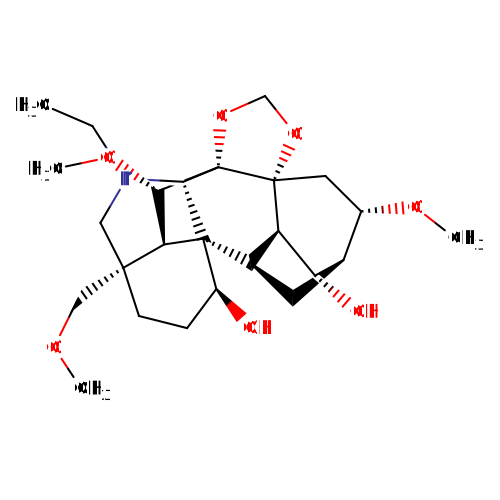
| Common Name | (1s,2r,3r,4s,5s,6s,8r,12s,13s,16s,19s,20r,21s)-14-ethyl-6,21-dimethoxy-16-(methoxymethyl)-9,11-dioxa-14-azaheptacyclo[10.7.2.1²,⁵.0¹,¹³.0³,⁸.0⁸,¹².0¹⁶,²⁰]docosane-4,19-diol |
|---|
| Description | Delbrunine belongs to the class of organic compounds known as aconitane-type diterpenoid alkaloids. These are alkaloid diterpenoids with a structure based on the hexacyclic aconitane skeleton. These compounds have no oxygen functionality at the C7 atom. (1s,2r,3r,4s,5s,6s,8r,12s,13s,16s,19s,20r,21s)-14-ethyl-6,21-dimethoxy-16-(methoxymethyl)-9,11-dioxa-14-azaheptacyclo[10.7.2.1²,⁵.0¹,¹³.0³,⁸.0⁸,¹².0¹⁶,²⁰]docosane-4,19-diol is found in Delphinium brunonianum. (1s,2r,3r,4s,5s,6s,8r,12s,13s,16s,19s,20r,21s)-14-ethyl-6,21-dimethoxy-16-(methoxymethyl)-9,11-dioxa-14-azaheptacyclo[10.7.2.1²,⁵.0¹,¹³.0³,⁸.0⁸,¹².0¹⁶,²⁰]docosane-4,19-diol was first documented in 2010 (PMID: 20550959). Based on a literature review a small amount of articles have been published on Delbrunine (PMID: 35408656) (PMID: 35127798). |
|---|
| Structure | CCN1C[C@]2(COC)CC[C@H](O)[C@@]34[C@@H]5C[C@H]6[C@H](O)[C@@H]5[C@@]5(C[C@@H]6OC)OCO[C@]5([C@@H](OC)[C@H]23)[C@@H]14 InChI=1S/C25H39NO7/c1-5-26-10-22(11-29-2)7-6-16(27)24-14-8-13-15(30-3)9-23(17(14)18(13)28)25(21(24)26,33-12-32-23)20(31-4)19(22)24/h13-21,27-28H,5-12H2,1-4H3/t13-,14-,15+,16+,17-,18+,19-,20+,21+,22+,23-,24+,25-/m1/s1 |
|---|
| Synonyms | Not Available |
|---|
| Chemical Formula | C25H39NO7 |
|---|
| Average Mass | 465.5870 Da |
|---|
| Monoisotopic Mass | 465.27265 Da |
|---|
| IUPAC Name | (1S,2R,3R,4S,5S,6S,8R,12S,13S,16S,19S,20R,21S)-14-ethyl-6,21-dimethoxy-16-(methoxymethyl)-9,11-dioxa-14-azaheptacyclo[10.7.2.1^{2,5}.0^{1,13}.0^{3,8}.0^{8,12}.0^{16,20}]docosane-4,19-diol |
|---|
| Traditional Name | (1S,2R,3R,4S,5S,6S,8R,12S,13S,16S,19S,20R,21S)-14-ethyl-6,21-dimethoxy-16-(methoxymethyl)-9,11-dioxa-14-azaheptacyclo[10.7.2.1^{2,5}.0^{1,13}.0^{3,8}.0^{8,12}.0^{16,20}]docosane-4,19-diol |
|---|
| CAS Registry Number | Not Available |
|---|
| SMILES | CCN1C[C@]2(COC)CC[C@H](O)[C@@]34[C@@H]5C[C@H]6[C@H](O)[C@@H]5[C@@]5(C[C@@H]6OC)OCO[C@]5([C@@H](OC)[C@H]23)[C@@H]14 |
|---|
| InChI Identifier | InChI=1S/C25H39NO7/c1-5-26-10-22(11-29-2)7-6-16(27)24-14-8-13-15(30-3)9-23(17(14)18(13)28)25(21(24)26,33-12-32-23)20(31-4)19(22)24/h13-21,27-28H,5-12H2,1-4H3/t13-,14-,15+,16+,17-,18+,19-,20+,21+,22+,23-,24+,25-/m1/s1 |
|---|
| InChI Key | MSIFWQXGXCPJTR-DIZROUMASA-N |
|---|
| Experimental Spectra |
|---|
|
| Not Available | | Predicted Spectra |
|---|
|
| Not Available | | Chemical Shift Submissions |
|---|
|
| Not Available | | Species |
|---|
| Species of Origin | |
|---|
| Chemical Taxonomy |
|---|
| Description | Belongs to the class of organic compounds known as aconitane-type diterpenoid alkaloids. These are alkaloid diterpenoids with a structure based on the hexacyclic aconitane skeleton. These compounds have no oxygen functionality at the C7 atom. |
|---|
| Kingdom | Organic compounds |
|---|
| Super Class | Lipids and lipid-like molecules |
|---|
| Class | Prenol lipids |
|---|
| Sub Class | Diterpenoids |
|---|
| Direct Parent | Aconitane-type diterpenoid alkaloids |
|---|
| Alternative Parents | |
|---|
| Substituents | - Aconitane-type diterpenoid alkaloid
- Quinolidine
- Alkaloid or derivatives
- Azepane
- Piperidine
- Cyclic alcohol
- Meta-dioxolane
- Tertiary aliphatic amine
- Tertiary amine
- Secondary alcohol
- Oxacycle
- Azacycle
- Organoheterocyclic compound
- Ether
- Dialkyl ether
- Acetal
- Organic nitrogen compound
- Organic oxygen compound
- Organopnictogen compound
- Hydrocarbon derivative
- Organooxygen compound
- Organonitrogen compound
- Amine
- Alcohol
- Aliphatic heteropolycyclic compound
|
|---|
| Molecular Framework | Aliphatic heteropolycyclic compounds |
|---|
| External Descriptors | Not Available |
|---|
| Physical Properties |
|---|
| State | Not Available |
|---|
| Experimental Properties | | Property | Value | Reference |
|---|
| Melting Point | Not Available | Not Available | | Boiling Point | Not Available | Not Available | | Water Solubility | Not Available | Not Available | | LogP | Not Available | Not Available |
|
|---|
| Predicted Properties | |
|---|
| General References | - Ma H, Ma Y, Dawa Z, Yao Y, Wang M, Zhang K, Zhu C, Liu F, Lin C: Diterpenoid Alkaloids Isolated from Delphinium brunonianum and Their Inhibitory Effects on Hepatocytes Lipid Accumulation. Molecules. 2022 Mar 30;27(7). pii: molecules27072257. doi: 10.3390/molecules27072257. [PubMed:35408656 ]
- Tang Q, Chen S, Rizvi SAH, Qu J, Wang L, Wang S, Ma C, Liu L, Kang W: Two Alkaloids From Delphinium brunonianum Royle, Their Anti-inflammatory and Anti-oxidative Stress Activity via NF-kappaB Signaling Pathway. Front Nutr. 2022 Jan 20;8:826957. doi: 10.3389/fnut.2021.826957. eCollection 2021. [PubMed:35127798 ]
- He YQ, Ma ZY, Wei XM, Du BZ, Jing ZX, Yao BH, Gao LM: Chemical constituents from Delphinium chrysotrichum and their biological activity. Fitoterapia. 2010 Oct;81(7):929-31. doi: 10.1016/j.fitote.2010.06.008. Epub 2010 Jun 13. [PubMed:20550959 ]
- LOTUS database [Link]
|
|---|