| Record Information |
|---|
| Version | 2.0 |
|---|
| Created at | 2022-09-11 21:54:23 UTC |
|---|
| Updated at | 2022-09-11 21:54:23 UTC |
|---|
| NP-MRD ID | NP0320319 |
|---|
| Secondary Accession Numbers | None |
|---|
| Natural Product Identification |
|---|
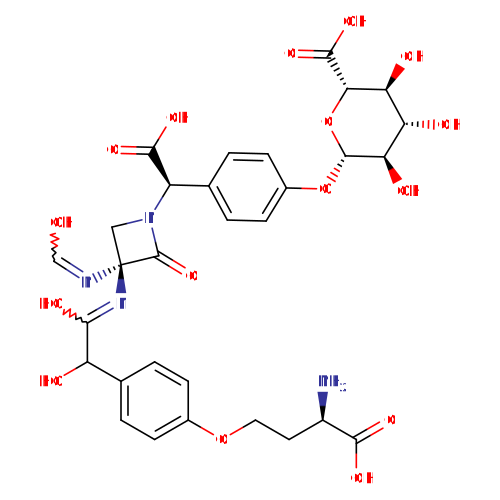
| Common Name | (2s,3s,4s,5r,6s)-6-{4-[(r)-[(3s)-3-[(2-{4-[(3r)-3-amino-3-carboxypropoxy]phenyl}-1,2-dihydroxyethylidene)amino]-3-[(hydroxymethylidene)amino]-2-oxoazetidin-1-yl](carboxy)methyl]phenoxy}-3,4,5-trihydroxyoxane-2-carboxylic acid |
|---|
| Description | Formadicin A belongs to the class of organic compounds known as dipeptides. These are organic compounds containing a sequence of exactly two alpha-amino acids joined by a peptide bond. Based on a literature review very few articles have been published on Formadicin A. |
|---|
| Structure | N[C@H](CCOC1=CC=C(C=C1)C(O)C(O)=N[C@]1(CN([C@@H](C(O)=O)C2=CC=C(O[C@@H]3O[C@@H]([C@@H](O)[C@H](O)[C@H]3O)C(O)=O)C=C2)C1=O)N=CO)C(O)=O InChI=1S/C30H34N4O16/c31-17(25(41)42)9-10-48-15-5-3-14(4-6-15)19(36)24(40)33-30(32-12-35)11-34(29(30)47)18(26(43)44)13-1-7-16(8-2-13)49-28-22(39)20(37)21(38)23(50-28)27(45)46/h1-8,12,17-23,28,36-39H,9-11,31H2,(H,32,35)(H,33,40)(H,41,42)(H,43,44)(H,45,46)/t17-,18-,19?,20+,21+,22-,23+,28-,30+/m1/s1 |
|---|
| Synonyms | | Value | Source |
|---|
| Formadicin b | MeSH | | Formadicin | MeSH | | Formadicin D | MeSH | | Formadicin C | MeSH |
|
|---|
| Chemical Formula | C30H34N4O16 |
|---|
| Average Mass | 706.6140 Da |
|---|
| Monoisotopic Mass | 706.19698 Da |
|---|
| IUPAC Name | (2S,3S,4S,5R,6S)-6-{4-[(R)-[(3S)-3-[(2-{4-[(3R)-3-amino-3-carboxypropoxy]phenyl}-1,2-dihydroxyethylidene)amino]-3-[(hydroxymethylidene)amino]-2-oxoazetidin-1-yl](carboxy)methyl]phenoxy}-3,4,5-trihydroxyoxane-2-carboxylic acid |
|---|
| Traditional Name | (2S,3S,4S,5R,6S)-6-{4-[(R)-[(3S)-3-[(2-{4-[(3R)-3-amino-3-carboxypropoxy]phenyl}-1,2-dihydroxyethylidene)amino]-3-[(hydroxymethylidene)amino]-2-oxoazetidin-1-yl](carboxy)methyl]phenoxy}-3,4,5-trihydroxyoxane-2-carboxylic acid |
|---|
| CAS Registry Number | Not Available |
|---|
| SMILES | N[C@H](CCOC1=CC=C(C=C1)C(O)C(O)=N[C@]1(CN([C@@H](C(O)=O)C2=CC=C(O[C@@H]3O[C@@H]([C@@H](O)[C@H](O)[C@H]3O)C(O)=O)C=C2)C1=O)N=CO)C(O)=O |
|---|
| InChI Identifier | InChI=1S/C30H34N4O16/c31-17(25(41)42)9-10-48-15-5-3-14(4-6-15)19(36)24(40)33-30(32-12-35)11-34(29(30)47)18(26(43)44)13-1-7-16(8-2-13)49-28-22(39)20(37)21(38)23(50-28)27(45)46/h1-8,12,17-23,28,36-39H,9-11,31H2,(H,32,35)(H,33,40)(H,41,42)(H,43,44)(H,45,46)/t17-,18-,19?,20+,21+,22-,23+,28-,30+/m1/s1 |
|---|
| InChI Key | HRGDBBMLDRNUJF-NLHSHBLTSA-N |
|---|
| Experimental Spectra |
|---|
|
| Not Available | | Predicted Spectra |
|---|
|
| Not Available | | Chemical Shift Submissions |
|---|
|
| Not Available | | Species |
|---|
| Species of Origin | Not Available |
|---|
| Chemical Taxonomy |
|---|
| Description | Belongs to the class of organic compounds known as dipeptides. These are organic compounds containing a sequence of exactly two alpha-amino acids joined by a peptide bond. |
|---|
| Kingdom | Organic compounds |
|---|
| Super Class | Organic acids and derivatives |
|---|
| Class | Carboxylic acids and derivatives |
|---|
| Sub Class | Amino acids, peptides, and analogues |
|---|
| Direct Parent | Dipeptides |
|---|
| Alternative Parents | |
|---|
| Substituents | - Alpha-dipeptide
- Phenolic glycoside
- Monobactam
- 1-o-glucuronide
- O-glucuronide
- Glucuronic acid or derivatives
- N-acyl-alpha amino acid or derivatives
- Hexose monosaccharide
- N-formyl-alpha-amino acid
- N-formyl-alpha amino acid or derivatives
- Glycosyl compound
- O-glycosyl compound
- Alpha-amino acid
- Alpha-amino acid or derivatives
- D-alpha-amino acid
- Phenylacetamide
- Tricarboxylic acid or derivatives
- Phenol ether
- Phenoxy compound
- Beta-hydroxy acid
- Alkyl aryl ether
- Benzenoid
- Monocyclic benzene moiety
- Pyran
- Oxane
- Hydroxy acid
- Monosaccharide
- Tertiary carboxylic acid amide
- Beta-lactam
- Secondary carboxylic acid amide
- Amino acid or derivatives
- Azetidine
- Secondary alcohol
- Carboxamide group
- Lactam
- Amino acid
- Oxacycle
- Organoheterocyclic compound
- Azacycle
- Acetal
- Polyol
- Ether
- Carboxylic acid
- Amine
- Alcohol
- Carbonyl group
- Organic nitrogen compound
- Primary amine
- Aromatic alcohol
- Organooxygen compound
- Primary aliphatic amine
- Organopnictogen compound
- Organic oxygen compound
- Organic oxide
- Organonitrogen compound
- Hydrocarbon derivative
- Aromatic heteromonocyclic compound
|
|---|
| Molecular Framework | Aromatic heteromonocyclic compounds |
|---|
| External Descriptors | Not Available |
|---|
| Physical Properties |
|---|
| State | Not Available |
|---|
| Experimental Properties | | Property | Value | Reference |
|---|
| Melting Point | Not Available | Not Available | | Boiling Point | Not Available | Not Available | | Water Solubility | Not Available | Not Available | | LogP | Not Available | Not Available |
|
|---|
| Predicted Properties | |
|---|