| Record Information |
|---|
| Version | 2.0 |
|---|
| Created at | 2022-09-11 20:34:46 UTC |
|---|
| Updated at | 2022-09-11 20:34:46 UTC |
|---|
| NP-MRD ID | NP0319515 |
|---|
| Secondary Accession Numbers | None |
|---|
| Natural Product Identification |
|---|
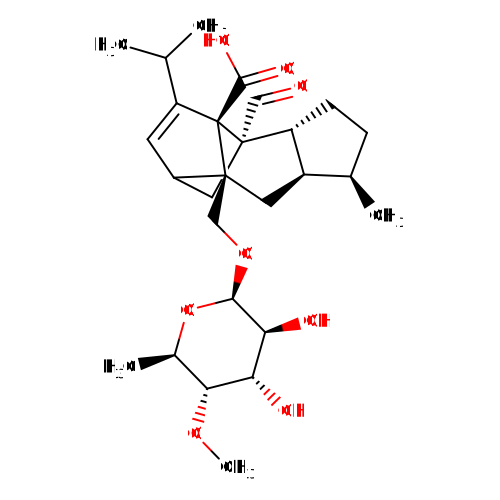
| Common Name | (1r,2s,4r,5r,8r,9s)-2-({[(2r,3s,4s,5s,6r)-3,4-dihydroxy-5-methoxy-6-methyloxan-2-yl]oxy}methyl)-9-formyl-13-isopropyl-5-methyltetracyclo[7.4.0.0²,¹¹.0⁴,⁸]tridec-12-ene-1-carboxylic acid |
|---|
| Description | Sordarin belongs to the class of organic compounds known as terpene glycosides. These are prenol lipids containing a carbohydrate moiety glycosidically bound to a terpene backbone. (1r,2s,4r,5r,8r,9s)-2-({[(2r,3s,4s,5s,6r)-3,4-dihydroxy-5-methoxy-6-methyloxan-2-yl]oxy}methyl)-9-formyl-13-isopropyl-5-methyltetracyclo[7.4.0.0²,¹¹.0⁴,⁸]tridec-12-ene-1-carboxylic acid is found in Hypoxylon croceum and Parascedosporium putredinis. (1r,2s,4r,5r,8r,9s)-2-({[(2r,3s,4s,5s,6r)-3,4-dihydroxy-5-methoxy-6-methyloxan-2-yl]oxy}methyl)-9-formyl-13-isopropyl-5-methyltetracyclo[7.4.0.0²,¹¹.0⁴,⁸]tridec-12-ene-1-carboxylic acid was first documented in 2016 (PMID: 27072286). Based on a literature review a significant number of articles have been published on Sordarin (PMID: 28383269) (PMID: 31478377) (PMID: 35546152) (PMID: 32358585) (PMID: 35701881) (PMID: 34767248). |
|---|
| Structure | CO[C@@H]1[C@@H](C)O[C@@H](OC[C@@]23C[C@@H]4[C@H](C)CC[C@H]4[C@]4(CC2C=C(C(C)C)[C@@]34C(O)=O)C=O)[C@@H](O)[C@@H]1O InChI=1S/C27H40O8/c1-13(2)19-8-16-9-25(11-28)18-7-6-14(3)17(18)10-26(16,27(19,25)24(31)32)12-34-23-21(30)20(29)22(33-5)15(4)35-23/h8,11,13-18,20-23,29-30H,6-7,9-10,12H2,1-5H3,(H,31,32)/t14-,15-,16?,17-,18-,20+,21+,22-,23-,25+,26+,27+/m1/s1 |
|---|
| Synonyms | | Value | Source |
|---|
| Sordarin b | MeSH |
|
|---|
| Chemical Formula | C27H40O8 |
|---|
| Average Mass | 492.6090 Da |
|---|
| Monoisotopic Mass | 492.27232 Da |
|---|
| IUPAC Name | (1R,2S,4R,5R,8R,9S)-2-({[(2R,3S,4S,5S,6R)-3,4-dihydroxy-5-methoxy-6-methyloxan-2-yl]oxy}methyl)-9-formyl-5-methyl-13-(propan-2-yl)tetracyclo[7.4.0.0^{2,11}.0^{4,8}]tridec-12-ene-1-carboxylic acid |
|---|
| Traditional Name | (1R,2S,4R,5R,8R,9S)-2-({[(2R,3S,4S,5S,6R)-3,4-dihydroxy-5-methoxy-6-methyloxan-2-yl]oxy}methyl)-9-formyl-13-isopropyl-5-methyltetracyclo[7.4.0.0^{2,11}.0^{4,8}]tridec-12-ene-1-carboxylic acid |
|---|
| CAS Registry Number | Not Available |
|---|
| SMILES | CO[C@@H]1[C@@H](C)O[C@@H](OC[C@@]23C[C@@H]4[C@H](C)CC[C@H]4[C@]4(CC2C=C(C(C)C)[C@@]34C(O)=O)C=O)[C@@H](O)[C@@H]1O |
|---|
| InChI Identifier | InChI=1S/C27H40O8/c1-13(2)19-8-16-9-25(11-28)18-7-6-14(3)17(18)10-26(16,27(19,25)24(31)32)12-34-23-21(30)20(29)22(33-5)15(4)35-23/h8,11,13-18,20-23,29-30H,6-7,9-10,12H2,1-5H3,(H,31,32)/t14-,15-,16?,17-,18-,20+,21+,22-,23-,25+,26+,27+/m1/s1 |
|---|
| InChI Key | OGGVRVMISBQNMQ-UQYLMRGISA-N |
|---|
| Experimental Spectra |
|---|
|
| Not Available | | Predicted Spectra |
|---|
|
| | Spectrum Type | Description | Depositor ID | Depositor Organization | Depositor | Deposition Date | View |
|---|
| 1D NMR | 13C NMR Spectrum (1D, 25 MHz, H2O, predicted) | Wishart Lab | Wishart Lab | David Wishart | 2021-06-20 | View Spectrum | | 1D NMR | 1H NMR Spectrum (1D, 100 MHz, H2O, predicted) | Wishart Lab | Wishart Lab | David Wishart | 2021-06-20 | View Spectrum | | 1D NMR | 13C NMR Spectrum (1D, 252 MHz, H2O, predicted) | Wishart Lab | Wishart Lab | David Wishart | 2021-06-20 | View Spectrum | | 1D NMR | 1H NMR Spectrum (1D, 1000 MHz, H2O, predicted) | Wishart Lab | Wishart Lab | David Wishart | 2021-06-20 | View Spectrum | | 1D NMR | 13C NMR Spectrum (1D, 50 MHz, H2O, predicted) | Wishart Lab | Wishart Lab | David Wishart | 2021-06-20 | View Spectrum | | 1D NMR | 1H NMR Spectrum (1D, 200 MHz, H2O, predicted) | Wishart Lab | Wishart Lab | David Wishart | 2021-06-20 | View Spectrum | | 1D NMR | 13C NMR Spectrum (1D, 75 MHz, H2O, predicted) | Wishart Lab | Wishart Lab | David Wishart | 2021-06-20 | View Spectrum | | 1D NMR | 1H NMR Spectrum (1D, 300 MHz, H2O, predicted) | Wishart Lab | Wishart Lab | David Wishart | 2021-06-20 | View Spectrum | | 1D NMR | 13C NMR Spectrum (1D, 101 MHz, H2O, predicted) | Wishart Lab | Wishart Lab | David Wishart | 2021-06-20 | View Spectrum | | 1D NMR | 1H NMR Spectrum (1D, 400 MHz, H2O, predicted) | Wishart Lab | Wishart Lab | David Wishart | 2021-06-20 | View Spectrum | | 1D NMR | 13C NMR Spectrum (1D, 126 MHz, H2O, predicted) | Wishart Lab | Wishart Lab | David Wishart | 2021-06-20 | View Spectrum | | 1D NMR | 1H NMR Spectrum (1D, 500 MHz, H2O, predicted) | Wishart Lab | Wishart Lab | David Wishart | 2021-06-20 | View Spectrum | | 1D NMR | 13C NMR Spectrum (1D, 151 MHz, H2O, predicted) | Wishart Lab | Wishart Lab | David Wishart | 2021-06-20 | View Spectrum | | 1D NMR | 1H NMR Spectrum (1D, 600 MHz, H2O, predicted) | Wishart Lab | Wishart Lab | David Wishart | 2021-06-20 | View Spectrum | | 1D NMR | 13C NMR Spectrum (1D, 176 MHz, H2O, predicted) | Wishart Lab | Wishart Lab | David Wishart | 2021-06-20 | View Spectrum | | 1D NMR | 1H NMR Spectrum (1D, 700 MHz, H2O, predicted) | Wishart Lab | Wishart Lab | David Wishart | 2021-06-20 | View Spectrum | | 1D NMR | 13C NMR Spectrum (1D, 201 MHz, H2O, predicted) | Wishart Lab | Wishart Lab | David Wishart | 2021-06-20 | View Spectrum | | 1D NMR | 1H NMR Spectrum (1D, 800 MHz, H2O, predicted) | Wishart Lab | Wishart Lab | David Wishart | 2021-06-20 | View Spectrum | | 1D NMR | 13C NMR Spectrum (1D, 226 MHz, H2O, predicted) | Wishart Lab | Wishart Lab | David Wishart | 2021-06-20 | View Spectrum | | 1D NMR | 1H NMR Spectrum (1D, 900 MHz, H2O, predicted) | Wishart Lab | Wishart Lab | David Wishart | 2021-06-20 | View Spectrum |
| | Chemical Shift Submissions |
|---|
|
| Not Available | | Species |
|---|
| Species of Origin | |
|---|
| Chemical Taxonomy |
|---|
| Description | Belongs to the class of organic compounds known as terpene glycosides. These are prenol lipids containing a carbohydrate moiety glycosidically bound to a terpene backbone. |
|---|
| Kingdom | Organic compounds |
|---|
| Super Class | Lipids and lipid-like molecules |
|---|
| Class | Prenol lipids |
|---|
| Sub Class | Terpene glycosides |
|---|
| Direct Parent | Terpene glycosides |
|---|
| Alternative Parents | |
|---|
| Substituents | - Terpene glycoside
- Sesquiterpenoid
- Hexose monosaccharide
- Glycosyl compound
- O-glycosyl compound
- Monosaccharide
- Oxane
- 1,2-diol
- Secondary alcohol
- Acetal
- Carboxylic acid derivative
- Carboxylic acid
- Dialkyl ether
- Ether
- Monocarboxylic acid or derivatives
- Oxacycle
- Organoheterocyclic compound
- Aldehyde
- Organic oxide
- Hydrocarbon derivative
- Carbonyl group
- Organic oxygen compound
- Alcohol
- Organooxygen compound
- Aliphatic heteropolycyclic compound
|
|---|
| Molecular Framework | Aliphatic heteropolycyclic compounds |
|---|
| External Descriptors | Not Available |
|---|
| Physical Properties |
|---|
| State | Not Available |
|---|
| Experimental Properties | | Property | Value | Reference |
|---|
| Melting Point | Not Available | Not Available | | Boiling Point | Not Available | Not Available | | Water Solubility | Not Available | Not Available | | LogP | Not Available | Not Available |
|
|---|
| Predicted Properties | |
|---|
| General References | - Dewapriya P, Prasad P, Damodar R, Salim AA, Capon RJ: Talarolide A, a Cyclic Heptapeptide Hydroxamate from an Australian Marine Tunicate-Associated Fungus, Talaromyces sp. (CMB-TU011). Org Lett. 2017 Apr 21;19(8):2046-2049. doi: 10.1021/acs.orglett.7b00638. Epub 2017 Apr 6. [PubMed:28383269 ]
- Zhang MQ, Xu KX, Xue Y, Cao F, Yang LJ, Hou XM, Wang CY, Shao CL: Sordarin Diterpene Glycosides with an Unusual 1,3-Dioxolan-4-one Ring from the Zoanthid-Derived Fungus Curvularia hawaiiensis TA26-15. J Nat Prod. 2019 Sep 27;82(9):2477-2482. doi: 10.1021/acs.jnatprod.9b00164. Epub 2019 Sep 3. [PubMed:31478377 ]
- Sun Z, Jamieson CS, Ohashi M, Houk KN, Tang Y: Discovery and characterization of a terpene biosynthetic pathway featuring a norbornene-forming Diels-Alderase. Nat Commun. 2022 May 11;13(1):2568. doi: 10.1038/s41467-022-30288-6. [PubMed:35546152 ]
- Ueno M, Kobayashi M, Fujie A, Shibata T: Cloning and heterologous expression of P450Lent4B11, a novel bacterial P450 gene, for hydroxylation of an antifungal agent sordaricin. J Antibiot (Tokyo). 2020 Sep;73(9):615-621. doi: 10.1038/s41429-020-0310-9. Epub 2020 May 1. [PubMed:32358585 ]
- Kudo F, Matsuura Y, Hayashi T, Fukushima M, Eguchi T: Genome mining of the sordarin biosynthetic gene cluster from Sordaria araneosa Cain ATCC 36386: characterization of cycloaraneosene synthase and GDP-6-deoxyaltrose transferase. J Antibiot (Tokyo). 2016 Jul;69(7):541-8. doi: 10.1038/ja.2016.40. Epub 2016 Apr 13. [PubMed:27072286 ]
- Liu SH, Sun JL, Hu YL, Zhang L, Zhang X, Yan ZY, Guo X, Guo ZK, Jiao RH, Zhang B, Tan RX, Ge HM: Biosynthesis of Sordarin Revealing a Diels-Alderase for the Formation of the Norbornene Skeleton. Angew Chem Int Ed Engl. 2022 Aug 15;61(33):e202205577. doi: 10.1002/anie.202205577. Epub 2022 Jul 7. [PubMed:35701881 ]
- Shao Y, Molestak E, Su W, Stankevic M, Tchorzewski M: Sordarin- An anti-fungal antibiotic with a unique modus operandi. Br J Pharmacol. 2022 Mar;179(6):1125-1145. doi: 10.1111/bph.15724. Epub 2022 Jan 13. [PubMed:34767248 ]
- Harms K, Milic A, Stchigel AM, Stadler M, Surup F, Marin-Felix Y: Three New Derivatives of Zopfinol from Pseudorhypophila Mangenotii gen. et comb. nov. J Fungi (Basel). 2021 Mar 3;7(3):181. doi: 10.3390/jof7030181. [PubMed:33802411 ]
- Park MY, Park SJ, Kim JJ, Lee DH, Kim BS: Inhibitory Effect of Moriniafungin Produced by Setosphaeria rostrata F3736 on the Development of Rhizopus Rot. Plant Pathol J. 2020 Dec 1;36(6):570-578. doi: 10.5423/PPJ.OA.09.2020.0176. [PubMed:33312092 ]
- Dorfer M, Heine D, Konig S, Gore S, Werz O, Hertweck C, Gressler M, Hoffmeister D: Melleolides impact fungal translation via elongation factor 2. Org Biomol Chem. 2019 May 15;17(19):4906-4916. doi: 10.1039/c9ob00562e. [PubMed:31042251 ]
- Wu Y, Dockendorff C: Synthesis of Simplified Azasordarin Analogs as Potential Antifungal Agents. J Org Chem. 2019 May 3;84(9):5292-5304. doi: 10.1021/acs.joc.9b00296. Epub 2019 Apr 9. [PubMed:30919633 ]
- Liang XR, Ma XY, Ji NY: Trichosordarin A, a norditerpene glycoside from the marine-derived fungus Trichoderma harzianum R5. Nat Prod Res. 2020 Jul;34(14):2037-2042. doi: 10.1080/14786419.2019.1574782. Epub 2019 Feb 19. [PubMed:30777455 ]
- Villahermosa D, Knapp K, Fleck O: A mutated dph3 gene causes sensitivity of Schizosaccharomyces pombe cells to cytotoxic agents. Curr Genet. 2017 Dec;63(6):1081-1091. doi: 10.1007/s00294-017-0711-x. Epub 2017 May 29. [PubMed:28555368 ]
- Seyedmousavi S, Rafati H, Ilkit M, Tolooe A, Hedayati MT, Verweij P: Systemic Antifungal Agents: Current Status and Projected Future Developments. Methods Mol Biol. 2017;1508:107-139. doi: 10.1007/978-1-4939-6515-1_5. [PubMed:27837500 ]
- Abeyrathne PD, Koh CS, Grant T, Grigorieff N, Korostelev AA: Ensemble cryo-EM uncovers inchworm-like translocation of a viral IRES through the ribosome. Elife. 2016 May 9;5:e14874. doi: 10.7554/eLife.14874. [PubMed:27159452 ]
- LOTUS database [Link]
|
|---|