| Record Information |
|---|
| Version | 2.0 |
|---|
| Created at | 2022-09-11 17:18:57 UTC |
|---|
| Updated at | 2022-09-11 17:18:57 UTC |
|---|
| NP-MRD ID | NP0317428 |
|---|
| Secondary Accession Numbers | None |
|---|
| Natural Product Identification |
|---|
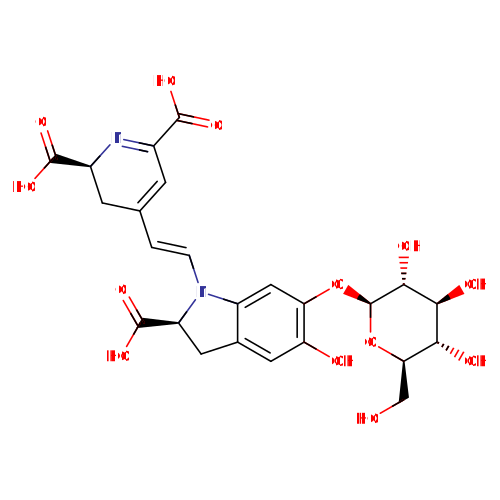
| Common Name | (2s)-4-[(1e)-2-[(2s)-2-carboxy-5-hydroxy-6-{[(2s,3r,4s,5s,6r)-3,4,5-trihydroxy-6-(hydroxymethyl)oxan-2-yl]oxy}-2,3-dihydroindol-1-yl]ethenyl]-2,3-dihydropyridine-2,6-dicarboxylic acid |
|---|
| Description | Gomphrenin I belongs to the class of organic compounds known as phenolic glycosides. These are organic compounds containing a phenolic structure attached to a glycosyl moiety. Some examples of phenolic structures include lignans, and flavonoids. Among the sugar units found in natural glycosides are D-glucose, L-Fructose, and L rhamnose. (2s)-4-[(1e)-2-[(2s)-2-carboxy-5-hydroxy-6-{[(2s,3r,4s,5s,6r)-3,4,5-trihydroxy-6-(hydroxymethyl)oxan-2-yl]oxy}-2,3-dihydroindol-1-yl]ethenyl]-2,3-dihydropyridine-2,6-dicarboxylic acid is found in Basella alba, Bougainvillea glabra and Phytolacca americana. (2s)-4-[(1e)-2-[(2s)-2-carboxy-5-hydroxy-6-{[(2s,3r,4s,5s,6r)-3,4,5-trihydroxy-6-(hydroxymethyl)oxan-2-yl]oxy}-2,3-dihydroindol-1-yl]ethenyl]-2,3-dihydropyridine-2,6-dicarboxylic acid was first documented in 2005 (PMID: 15656686). Based on a literature review a significant number of articles have been published on Gomphrenin I (PMID: 20839771) (PMID: 30145453) (PMID: 28551213) (PMID: 27649502) (PMID: 26243919). |
|---|
| Structure | OC[C@H]1O[C@@H](OC2=C(O)C=C3C[C@H](N(\C=C\C4=CC(=N[C@@H](C4)C(O)=O)C(O)=O)C3=C2)C(O)=O)[C@H](O)[C@@H](O)[C@@H]1O InChI=1S/C24H26N2O13/c27-8-17-18(29)19(30)20(31)24(39-17)38-16-7-13-10(6-15(16)28)5-14(23(36)37)26(13)2-1-9-3-11(21(32)33)25-12(4-9)22(34)35/h1-3,6-7,12,14,17-20,24,27-31H,4-5,8H2,(H,32,33)(H,34,35)(H,36,37)/b2-1+/t12-,14-,17+,18+,19-,20+,24+/m0/s1 |
|---|
| Synonyms | | Value | Source |
|---|
| Betanidin 6-O-beta-glucoside | MeSH |
|
|---|
| Chemical Formula | C24H26N2O13 |
|---|
| Average Mass | 550.4730 Da |
|---|
| Monoisotopic Mass | 550.14349 Da |
|---|
| IUPAC Name | (2S)-4-[(E)-2-[(2S)-2-carboxy-5-hydroxy-6-{[(2S,3R,4S,5S,6R)-3,4,5-trihydroxy-6-(hydroxymethyl)oxan-2-yl]oxy}-2,3-dihydro-1H-indol-1-yl]ethenyl]-2,3-dihydropyridine-2,6-dicarboxylic acid |
|---|
| Traditional Name | (2S)-4-[(E)-2-[(2S)-2-carboxy-5-hydroxy-6-{[(2S,3R,4S,5S,6R)-3,4,5-trihydroxy-6-(hydroxymethyl)oxan-2-yl]oxy}-2,3-dihydroindol-1-yl]ethenyl]-2,3-dihydropyridine-2,6-dicarboxylic acid |
|---|
| CAS Registry Number | Not Available |
|---|
| SMILES | OC[C@H]1O[C@@H](OC2=C(O)C=C3C[C@H](N(\C=C\C4=CC(=N[C@@H](C4)C(O)=O)C(O)=O)C3=C2)C(O)=O)[C@H](O)[C@@H](O)[C@@H]1O |
|---|
| InChI Identifier | InChI=1S/C24H26N2O13/c27-8-17-18(29)19(30)20(31)24(39-17)38-16-7-13-10(6-15(16)28)5-14(23(36)37)26(13)2-1-9-3-11(21(32)33)25-12(4-9)22(34)35/h1-3,6-7,12,14,17-20,24,27-31H,4-5,8H2,(H,32,33)(H,34,35)(H,36,37)/b2-1+/t12-,14-,17+,18+,19-,20+,24+/m0/s1 |
|---|
| InChI Key | IKCBLEDGTPAJDE-FTNGGYTGSA-N |
|---|
| Experimental Spectra |
|---|
|
| Not Available | | Predicted Spectra |
|---|
|
| | Spectrum Type | Description | Depositor ID | Depositor Organization | Depositor | Deposition Date | View |
|---|
| 1D NMR | 13C NMR Spectrum (1D, 25 MHz, H2O, predicted) | Wishart Lab | Wishart Lab | David Wishart | 2021-06-20 | View Spectrum | | 1D NMR | 1H NMR Spectrum (1D, 100 MHz, H2O, predicted) | Wishart Lab | Wishart Lab | David Wishart | 2021-06-20 | View Spectrum | | 1D NMR | 13C NMR Spectrum (1D, 252 MHz, H2O, predicted) | Wishart Lab | Wishart Lab | David Wishart | 2021-06-20 | View Spectrum | | 1D NMR | 1H NMR Spectrum (1D, 1000 MHz, H2O, predicted) | Wishart Lab | Wishart Lab | David Wishart | 2021-06-20 | View Spectrum | | 1D NMR | 13C NMR Spectrum (1D, 50 MHz, H2O, predicted) | Wishart Lab | Wishart Lab | David Wishart | 2021-06-20 | View Spectrum | | 1D NMR | 1H NMR Spectrum (1D, 200 MHz, H2O, predicted) | Wishart Lab | Wishart Lab | David Wishart | 2021-06-20 | View Spectrum | | 1D NMR | 13C NMR Spectrum (1D, 75 MHz, H2O, predicted) | Wishart Lab | Wishart Lab | David Wishart | 2021-06-20 | View Spectrum | | 1D NMR | 1H NMR Spectrum (1D, 300 MHz, H2O, predicted) | Wishart Lab | Wishart Lab | David Wishart | 2021-06-20 | View Spectrum | | 1D NMR | 13C NMR Spectrum (1D, 101 MHz, H2O, predicted) | Wishart Lab | Wishart Lab | David Wishart | 2021-06-20 | View Spectrum | | 1D NMR | 1H NMR Spectrum (1D, 400 MHz, H2O, predicted) | Wishart Lab | Wishart Lab | David Wishart | 2021-06-20 | View Spectrum | | 1D NMR | 13C NMR Spectrum (1D, 126 MHz, H2O, predicted) | Wishart Lab | Wishart Lab | David Wishart | 2021-06-20 | View Spectrum | | 1D NMR | 1H NMR Spectrum (1D, 500 MHz, H2O, predicted) | Wishart Lab | Wishart Lab | David Wishart | 2021-06-20 | View Spectrum | | 1D NMR | 13C NMR Spectrum (1D, 151 MHz, H2O, predicted) | Wishart Lab | Wishart Lab | David Wishart | 2021-06-20 | View Spectrum | | 1D NMR | 1H NMR Spectrum (1D, 600 MHz, H2O, predicted) | Wishart Lab | Wishart Lab | David Wishart | 2021-06-20 | View Spectrum | | 1D NMR | 13C NMR Spectrum (1D, 176 MHz, H2O, predicted) | Wishart Lab | Wishart Lab | David Wishart | 2021-06-20 | View Spectrum | | 1D NMR | 1H NMR Spectrum (1D, 700 MHz, H2O, predicted) | Wishart Lab | Wishart Lab | David Wishart | 2021-06-20 | View Spectrum | | 1D NMR | 13C NMR Spectrum (1D, 201 MHz, H2O, predicted) | Wishart Lab | Wishart Lab | David Wishart | 2021-06-20 | View Spectrum | | 1D NMR | 1H NMR Spectrum (1D, 800 MHz, H2O, predicted) | Wishart Lab | Wishart Lab | David Wishart | 2021-06-20 | View Spectrum | | 1D NMR | 13C NMR Spectrum (1D, 226 MHz, H2O, predicted) | Wishart Lab | Wishart Lab | David Wishart | 2021-06-20 | View Spectrum | | 1D NMR | 1H NMR Spectrum (1D, 900 MHz, H2O, predicted) | Wishart Lab | Wishart Lab | David Wishart | 2021-06-20 | View Spectrum |
| | Chemical Shift Submissions |
|---|
|
| Not Available | | Species |
|---|
| Species of Origin | |
|---|
| Chemical Taxonomy |
|---|
| Description | Belongs to the class of organic compounds known as phenolic glycosides. These are organic compounds containing a phenolic structure attached to a glycosyl moiety. Some examples of phenolic structures include lignans, and flavonoids. Among the sugar units found in natural glycosides are D-glucose, L-Fructose, and L rhamnose. |
|---|
| Kingdom | Organic compounds |
|---|
| Super Class | Organic oxygen compounds |
|---|
| Class | Organooxygen compounds |
|---|
| Sub Class | Carbohydrates and carbohydrate conjugates |
|---|
| Direct Parent | Phenolic glycosides |
|---|
| Alternative Parents | |
|---|
| Substituents | - Phenolic glycoside
- Hexose monosaccharide
- Indolecarboxylic acid
- Indolecarboxylic acid derivative
- O-glycosyl compound
- Alpha-amino acid
- Alpha-amino acid or derivatives
- L-alpha-amino acid
- Dihydropyridinecarboxylic acid derivative
- Indole or derivatives
- Tricarboxylic acid or derivatives
- Tertiary aliphatic/aromatic amine
- 1-hydroxy-2-unsubstituted benzenoid
- Dihydropyridine
- Aralkylamine
- Benzenoid
- Hydropyridine
- Oxane
- Monosaccharide
- Tertiary amine
- Amino acid or derivatives
- Secondary alcohol
- Amino acid
- Ketimine
- Oxacycle
- Propargyl-type 1,3-dipolar organic compound
- Polyol
- Acetal
- Organic 1,3-dipolar compound
- Allylamine
- Azacycle
- Organoheterocyclic compound
- Carboxylic acid derivative
- Enamine
- Carboxylic acid
- Organic nitrogen compound
- Organopnictogen compound
- Alcohol
- Organic oxide
- Carbonyl group
- Imine
- Amine
- Hydrocarbon derivative
- Organonitrogen compound
- Primary alcohol
- Aromatic heteropolycyclic compound
|
|---|
| Molecular Framework | Aromatic heteropolycyclic compounds |
|---|
| External Descriptors | Not Available |
|---|
| Physical Properties |
|---|
| State | Not Available |
|---|
| Experimental Properties | | Property | Value | Reference |
|---|
| Melting Point | Not Available | Not Available | | Boiling Point | Not Available | Not Available | | Water Solubility | Not Available | Not Available | | LogP | Not Available | Not Available |
|
|---|
| Predicted Properties | |
|---|
| General References | - Lin SM, Lin BH, Hsieh WM, Ko HJ, Liu CD, Chen LG, Chiou RY: Structural identification and bioactivities of red-violet pigments present in Basella alba fruits. J Agric Food Chem. 2010 Oct 13;58(19):10364-72. doi: 10.1021/jf1017719. [PubMed:20839771 ]
- Sporna-Kucab A, Bernas K, Grzegorczyk A, Malm A, Skalicka-Wozniak K, Wybraniec S: Liquid chromatographic techniques in betacyanin isomers separation from Gomphrena globosa L. flowers for the determination of their antimicrobial activities. J Pharm Biomed Anal. 2018 Nov 30;161:83-93. doi: 10.1016/j.jpba.2018.08.025. Epub 2018 Aug 15. [PubMed:30145453 ]
- Garcia-Cruz L, Duenas M, Santos-Buelgas C, Valle-Guadarrama S, Salinas-Moreno Y: Betalains and phenolic compounds profiling and antioxidant capacity of pitaya (Stenocereus spp.) fruit from two species (S. Pruinosus and S. stellatus). Food Chem. 2017 Nov 1;234:111-118. doi: 10.1016/j.foodchem.2017.04.174. Epub 2017 Apr 29. [PubMed:28551213 ]
- Sporna-Kucab A, Holda E, Wybraniec S: High-speed counter-current chromatography in separation of betacyanins from flowers of red Gomphrena globosa L. cultivars. J Chromatogr B Analyt Technol Biomed Life Sci. 2016 Oct 15;1033-1034:421-427. doi: 10.1016/j.jchromb.2016.09.005. Epub 2016 Sep 5. [PubMed:27649502 ]
- Kumar SS, Manoj P, Shetty NP, Prakash M, Giridhar P: Characterization of major betalain pigments -gomphrenin, betanin and isobetanin from Basella rubra L. fruit and evaluation of efficacy as a natural colourant in product (ice cream) development. J Food Sci Technol. 2015 Aug;52(8):4994-5002. doi: 10.1007/s13197-014-1527-z. Epub 2014 Aug 31. [PubMed:26243919 ]
- Stintzing FC, Herbach KM, Mosshammer MR, Carle R, Yi W, Sellappan S, Akoh CC, Bunch R, Felker P: Color, betalain pattern, and antioxidant properties of cactus pear (Opuntia spp.) clones. J Agric Food Chem. 2005 Jan 26;53(2):442-51. doi: 10.1021/jf048751y. [PubMed:15656686 ]
- LOTUS database [Link]
|
|---|