| Record Information |
|---|
| Version | 2.0 |
|---|
| Created at | 2022-09-11 11:29:09 UTC |
|---|
| Updated at | 2022-09-11 11:29:09 UTC |
|---|
| NP-MRD ID | NP0313748 |
|---|
| Secondary Accession Numbers | None |
|---|
| Natural Product Identification |
|---|
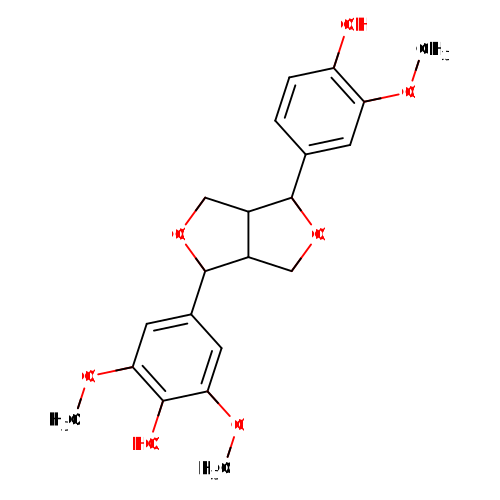
| Common Name | 4-[4-(4-hydroxy-3-methoxyphenyl)-hexahydrofuro[3,4-c]furan-1-yl]-2,6-dimethoxyphenol |
|---|
| Description | MEDIORESINOL belongs to the class of organic compounds known as furanoid lignans. These are lignans with a structure that contains either a tetrahydrofuran ring, a furan ring, or a furofuan ring system, that arises from the joining of the two phenylpropanoid units. 4-[4-(4-hydroxy-3-methoxyphenyl)-hexahydrofuro[3,4-c]furan-1-yl]-2,6-dimethoxyphenol is found in Aconitum kongboense, Aralia bipinnata, Aristolochia elegans, Asclepias curassavica, Bambusa emeiensis, Daphne feddei, Daphne oleoides, Dendrobium loddigesii, Dirca occidentalis, Doliocarpus dentatus, Eucommia ulmoides, Gnetum montanum, Hedyotis lawsoniae, Helianthus annuus, Peperomia heyneana, Piper cubeba, Catunaregam spinosa, Rhaphidophora decursiva, Rubia wallichiana, Sambucus nigra, Saussurea medusa and Spatholobus suberectus. MEDIORESINOL is an extremely weak basic (essentially neutral) compound (based on its pKa). |
|---|
| Structure | COC1=CC(=CC=C1O)C1OCC2C1COC2C1=CC(OC)=C(O)C(OC)=C1 InChI=1S/C21H24O7/c1-24-16-6-11(4-5-15(16)22)20-13-9-28-21(14(13)10-27-20)12-7-17(25-2)19(23)18(8-12)26-3/h4-8,13-14,20-23H,9-10H2,1-3H3 |
|---|
| Synonyms | Not Available |
|---|
| Chemical Formula | C21H24O7 |
|---|
| Average Mass | 388.4160 Da |
|---|
| Monoisotopic Mass | 388.15220 Da |
|---|
| IUPAC Name | 4-[4-(4-hydroxy-3-methoxyphenyl)-hexahydrofuro[3,4-c]furan-1-yl]-2,6-dimethoxyphenol |
|---|
| Traditional Name | 4-[4-(4-hydroxy-3-methoxyphenyl)-hexahydrofuro[3,4-c]furan-1-yl]-2,6-dimethoxyphenol |
|---|
| CAS Registry Number | Not Available |
|---|
| SMILES | COC1=CC(=CC=C1O)C1OCC2C1COC2C1=CC(OC)=C(O)C(OC)=C1 |
|---|
| InChI Identifier | InChI=1S/C21H24O7/c1-24-16-6-11(4-5-15(16)22)20-13-9-28-21(14(13)10-27-20)12-7-17(25-2)19(23)18(8-12)26-3/h4-8,13-14,20-23H,9-10H2,1-3H3 |
|---|
| InChI Key | VJOBNGRIBLNUKN-UHFFFAOYSA-N |
|---|
| Experimental Spectra |
|---|
|
| Not Available | | Predicted Spectra |
|---|
|
| | Spectrum Type | Description | Depositor ID | Depositor Organization | Depositor | Deposition Date | View |
|---|
| 1D NMR | 13C NMR Spectrum (1D, 25 MHz, H2O, predicted) | Wishart Lab | Wishart Lab | David Wishart | 2021-06-20 | View Spectrum | | 1D NMR | 1H NMR Spectrum (1D, 100 MHz, H2O, predicted) | Wishart Lab | Wishart Lab | David Wishart | 2021-06-20 | View Spectrum | | 1D NMR | 13C NMR Spectrum (1D, 252 MHz, H2O, predicted) | Wishart Lab | Wishart Lab | David Wishart | 2021-06-20 | View Spectrum | | 1D NMR | 1H NMR Spectrum (1D, 1000 MHz, H2O, predicted) | Wishart Lab | Wishart Lab | David Wishart | 2021-06-20 | View Spectrum | | 1D NMR | 13C NMR Spectrum (1D, 50 MHz, H2O, predicted) | Wishart Lab | Wishart Lab | David Wishart | 2021-06-20 | View Spectrum | | 1D NMR | 1H NMR Spectrum (1D, 200 MHz, H2O, predicted) | Wishart Lab | Wishart Lab | David Wishart | 2021-06-20 | View Spectrum | | 1D NMR | 13C NMR Spectrum (1D, 75 MHz, H2O, predicted) | Wishart Lab | Wishart Lab | David Wishart | 2021-06-20 | View Spectrum | | 1D NMR | 1H NMR Spectrum (1D, 300 MHz, H2O, predicted) | Wishart Lab | Wishart Lab | David Wishart | 2021-06-20 | View Spectrum | | 1D NMR | 13C NMR Spectrum (1D, 101 MHz, H2O, predicted) | Wishart Lab | Wishart Lab | David Wishart | 2021-06-20 | View Spectrum | | 1D NMR | 1H NMR Spectrum (1D, 400 MHz, H2O, predicted) | Wishart Lab | Wishart Lab | David Wishart | 2021-06-20 | View Spectrum | | 1D NMR | 13C NMR Spectrum (1D, 126 MHz, H2O, predicted) | Wishart Lab | Wishart Lab | David Wishart | 2021-06-20 | View Spectrum | | 1D NMR | 1H NMR Spectrum (1D, 500 MHz, H2O, predicted) | Wishart Lab | Wishart Lab | David Wishart | 2021-06-20 | View Spectrum | | 1D NMR | 13C NMR Spectrum (1D, 151 MHz, H2O, predicted) | Wishart Lab | Wishart Lab | David Wishart | 2021-06-20 | View Spectrum | | 1D NMR | 1H NMR Spectrum (1D, 600 MHz, H2O, predicted) | Wishart Lab | Wishart Lab | David Wishart | 2021-06-20 | View Spectrum | | 1D NMR | 13C NMR Spectrum (1D, 176 MHz, H2O, predicted) | Wishart Lab | Wishart Lab | David Wishart | 2021-06-20 | View Spectrum | | 1D NMR | 1H NMR Spectrum (1D, 700 MHz, H2O, predicted) | Wishart Lab | Wishart Lab | David Wishart | 2021-06-20 | View Spectrum | | 1D NMR | 13C NMR Spectrum (1D, 201 MHz, H2O, predicted) | Wishart Lab | Wishart Lab | David Wishart | 2021-06-20 | View Spectrum | | 1D NMR | 1H NMR Spectrum (1D, 800 MHz, H2O, predicted) | Wishart Lab | Wishart Lab | David Wishart | 2021-06-20 | View Spectrum | | 1D NMR | 13C NMR Spectrum (1D, 226 MHz, H2O, predicted) | Wishart Lab | Wishart Lab | David Wishart | 2021-06-20 | View Spectrum | | 1D NMR | 1H NMR Spectrum (1D, 900 MHz, H2O, predicted) | Wishart Lab | Wishart Lab | David Wishart | 2021-06-20 | View Spectrum |
| | Chemical Shift Submissions |
|---|
|
| Not Available | | Species |
|---|
| Species of Origin | |
|---|
| Chemical Taxonomy |
|---|
| Description | Belongs to the class of organic compounds known as furanoid lignans. These are lignans with a structure that contains either a tetrahydrofuran ring, a furan ring, or a furofuan ring system, that arises from the joining of the two phenylpropanoid units. |
|---|
| Kingdom | Organic compounds |
|---|
| Super Class | Lignans, neolignans and related compounds |
|---|
| Class | Furanoid lignans |
|---|
| Sub Class | Not Available |
|---|
| Direct Parent | Furanoid lignans |
|---|
| Alternative Parents | |
|---|
| Substituents | - Furanoid lignan
- Furofuran lignan skeleton
- Methoxyphenol
- Dimethoxybenzene
- M-dimethoxybenzene
- Anisole
- Phenoxy compound
- Furofuran
- Phenol ether
- Methoxybenzene
- Phenol
- 1-hydroxy-2-unsubstituted benzenoid
- Alkyl aryl ether
- Benzenoid
- Monocyclic benzene moiety
- Tetrahydrofuran
- Ether
- Organoheterocyclic compound
- Oxacycle
- Dialkyl ether
- Organooxygen compound
- Organic oxygen compound
- Hydrocarbon derivative
- Aromatic heteropolycyclic compound
|
|---|
| Molecular Framework | Aromatic heteropolycyclic compounds |
|---|
| External Descriptors | Not Available |
|---|
| Physical Properties |
|---|
| State | Not Available |
|---|
| Experimental Properties | | Property | Value | Reference |
|---|
| Melting Point | Not Available | Not Available | | Boiling Point | Not Available | Not Available | | Water Solubility | Not Available | Not Available | | LogP | Not Available | Not Available |
|
|---|
| Predicted Properties | |
|---|