| Record Information |
|---|
| Version | 2.0 |
|---|
| Created at | 2022-09-11 07:07:33 UTC |
|---|
| Updated at | 2022-09-11 07:07:33 UTC |
|---|
| NP-MRD ID | NP0311254 |
|---|
| Secondary Accession Numbers | None |
|---|
| Natural Product Identification |
|---|
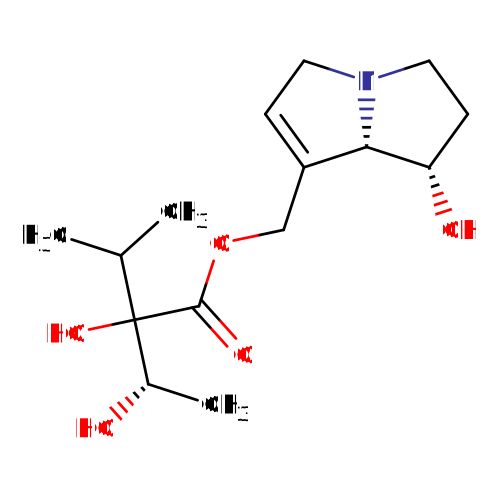
| Common Name | [(7s,7as)-7-hydroxy-5,6,7,7a-tetrahydro-3h-pyrrolizin-1-yl]methyl 2-hydroxy-2-[(1s)-1-hydroxyethyl]-3-methylbutanoate |
|---|
| Description | Echinatine, also known as indicine or rinderine, belongs to the class of organic compounds known as alkaloids and derivatives. These are naturally occurring chemical compounds that contain mostly basic nitrogen atoms. This group also includes some related compounds with neutral and even weakly acidic properties. Also some synthetic compounds of similar structure are attributed to alkaloids. In addition to carbon, hydrogen and nitrogen, alkaloids may also contain oxygen, sulfur and more rarely other elements such as chlorine, bromine, and phosphorus. [(7s,7as)-7-hydroxy-5,6,7,7a-tetrahydro-3h-pyrrolizin-1-yl]methyl 2-hydroxy-2-[(1s)-1-hydroxyethyl]-3-methylbutanoate is found in Ageratum conyzoides, Cynoglossum creticum, Cynoglossum officinale, Cynoglossum zeylanicum, Echium vulgare, Eupatorium cannabinum, Eupatorium japonicum, Eupatorium rotundifolium, Heliotropium suaveolens, Moltkiopsis ciliata, Solenanthus coronatus and Suchtelenia calycina. [(7s,7as)-7-hydroxy-5,6,7,7a-tetrahydro-3h-pyrrolizin-1-yl]methyl 2-hydroxy-2-[(1s)-1-hydroxyethyl]-3-methylbutanoate was first documented in 2020 (PMID: 32803302). Based on a literature review a small amount of articles have been published on Echinatine (PMID: 34240803) (PMID: 35249161) (PMID: 34863040) (PMID: 33919433). |
|---|
| Structure | CC(C)C(O)([C@H](C)O)C(=O)OCC1=CCN2CC[C@H](O)[C@H]12 InChI=1S/C15H25NO5/c1-9(2)15(20,10(3)17)14(19)21-8-11-4-6-16-7-5-12(18)13(11)16/h4,9-10,12-13,17-18,20H,5-8H2,1-3H3/t10-,12-,13-,15?/m0/s1 |
|---|
| Synonyms | | Value | Source |
|---|
| Indicine pyrrolizidine | MeSH | | Indicine, (1R-(1alpha,7(2S*,3S*),7abeta))-isomer | MeSH | | Indicine, (1S-(1alpha,7(2R*,3S*),7aalpha))-isomer | MeSH | | Indicine | MeSH | | Rinderine | MeSH | | Indicine, (1R-(1alpha,7(2S*,3R*),7abeta))-isomer | MeSH | | Indicine, (1S-(1alpha,7(2R*,3R*),7aalpha))-isomer | MeSH | | Lycopsamine | MeSH |
|
|---|
| Chemical Formula | C15H25NO5 |
|---|
| Average Mass | 299.3670 Da |
|---|
| Monoisotopic Mass | 299.17327 Da |
|---|
| IUPAC Name | [(1S,7aS)-1-hydroxy-2,3,5,7a-tetrahydro-1H-pyrrolizin-7-yl]methyl 2-hydroxy-2-[(1S)-1-hydroxyethyl]-3-methylbutanoate |
|---|
| Traditional Name | [(7S,7aS)-7-hydroxy-5,6,7,7a-tetrahydro-3H-pyrrolizin-1-yl]methyl 2-hydroxy-2-[(1S)-1-hydroxyethyl]-3-methylbutanoate |
|---|
| CAS Registry Number | Not Available |
|---|
| SMILES | CC(C)C(O)([C@H](C)O)C(=O)OCC1=CCN2CC[C@H](O)[C@H]12 |
|---|
| InChI Identifier | InChI=1S/C15H25NO5/c1-9(2)15(20,10(3)17)14(19)21-8-11-4-6-16-7-5-12(18)13(11)16/h4,9-10,12-13,17-18,20H,5-8H2,1-3H3/t10-,12-,13-,15?/m0/s1 |
|---|
| InChI Key | SFVVQRJOGUKCEG-RZUNFUDNSA-N |
|---|
| Experimental Spectra |
|---|
|
| Not Available | | Predicted Spectra |
|---|
|
| | Spectrum Type | Description | Depositor ID | Depositor Organization | Depositor | Deposition Date | View |
|---|
| 1D NMR | 13C NMR Spectrum (1D, 25 MHz, H2O, predicted) | Wishart Lab | Wishart Lab | David Wishart | 2021-06-20 | View Spectrum | | 1D NMR | 1H NMR Spectrum (1D, 100 MHz, H2O, predicted) | Wishart Lab | Wishart Lab | David Wishart | 2021-06-20 | View Spectrum | | 1D NMR | 13C NMR Spectrum (1D, 252 MHz, H2O, predicted) | Wishart Lab | Wishart Lab | David Wishart | 2021-06-20 | View Spectrum | | 1D NMR | 1H NMR Spectrum (1D, 1000 MHz, H2O, predicted) | Wishart Lab | Wishart Lab | David Wishart | 2021-06-20 | View Spectrum | | 1D NMR | 13C NMR Spectrum (1D, 50 MHz, H2O, predicted) | Wishart Lab | Wishart Lab | David Wishart | 2021-06-20 | View Spectrum | | 1D NMR | 1H NMR Spectrum (1D, 200 MHz, H2O, predicted) | Wishart Lab | Wishart Lab | David Wishart | 2021-06-20 | View Spectrum | | 1D NMR | 13C NMR Spectrum (1D, 75 MHz, H2O, predicted) | Wishart Lab | Wishart Lab | David Wishart | 2021-06-20 | View Spectrum | | 1D NMR | 1H NMR Spectrum (1D, 300 MHz, H2O, predicted) | Wishart Lab | Wishart Lab | David Wishart | 2021-06-20 | View Spectrum | | 1D NMR | 13C NMR Spectrum (1D, 101 MHz, H2O, predicted) | Wishart Lab | Wishart Lab | David Wishart | 2021-06-20 | View Spectrum | | 1D NMR | 1H NMR Spectrum (1D, 400 MHz, H2O, predicted) | Wishart Lab | Wishart Lab | David Wishart | 2021-06-20 | View Spectrum | | 1D NMR | 13C NMR Spectrum (1D, 126 MHz, H2O, predicted) | Wishart Lab | Wishart Lab | David Wishart | 2021-06-20 | View Spectrum | | 1D NMR | 1H NMR Spectrum (1D, 500 MHz, H2O, predicted) | Wishart Lab | Wishart Lab | David Wishart | 2021-06-20 | View Spectrum | | 1D NMR | 13C NMR Spectrum (1D, 151 MHz, H2O, predicted) | Wishart Lab | Wishart Lab | David Wishart | 2021-06-20 | View Spectrum | | 1D NMR | 1H NMR Spectrum (1D, 600 MHz, H2O, predicted) | Wishart Lab | Wishart Lab | David Wishart | 2021-06-20 | View Spectrum | | 1D NMR | 13C NMR Spectrum (1D, 176 MHz, H2O, predicted) | Wishart Lab | Wishart Lab | David Wishart | 2021-06-20 | View Spectrum | | 1D NMR | 1H NMR Spectrum (1D, 700 MHz, H2O, predicted) | Wishart Lab | Wishart Lab | David Wishart | 2021-06-20 | View Spectrum | | 1D NMR | 13C NMR Spectrum (1D, 201 MHz, H2O, predicted) | Wishart Lab | Wishart Lab | David Wishart | 2021-06-20 | View Spectrum | | 1D NMR | 1H NMR Spectrum (1D, 800 MHz, H2O, predicted) | Wishart Lab | Wishart Lab | David Wishart | 2021-06-20 | View Spectrum | | 1D NMR | 13C NMR Spectrum (1D, 226 MHz, H2O, predicted) | Wishart Lab | Wishart Lab | David Wishart | 2021-06-20 | View Spectrum | | 1D NMR | 1H NMR Spectrum (1D, 900 MHz, H2O, predicted) | Wishart Lab | Wishart Lab | David Wishart | 2021-06-20 | View Spectrum |
| | Chemical Shift Submissions |
|---|
|
| Not Available | | Species |
|---|
| Species of Origin | |
|---|
| Chemical Taxonomy |
|---|
| Description | Belongs to the class of organic compounds known as alkaloids and derivatives. These are naturally occurring chemical compounds that contain mostly basic nitrogen atoms. This group also includes some related compounds with neutral and even weakly acidic properties. Also some synthetic compounds of similar structure are attributed to alkaloids. In addition to carbon, hydrogen and nitrogen, alkaloids may also contain oxygen, sulfur and more rarely other elements such as chlorine, bromine, and phosphorus. |
|---|
| Kingdom | Organic compounds |
|---|
| Super Class | Alkaloids and derivatives |
|---|
| Class | Not Available |
|---|
| Sub Class | Not Available |
|---|
| Direct Parent | Alkaloids and derivatives |
|---|
| Alternative Parents | |
|---|
| Substituents | - Alkaloid or derivatives
- Pyrrolizine
- Beta-hydroxy acid
- Fatty acid ester
- Hydroxy acid
- N-alkylpyrrolidine
- Fatty acyl
- Tertiary alcohol
- Pyrroline
- Pyrrolidine
- Amino acid or derivatives
- Tertiary aliphatic amine
- Tertiary amine
- Secondary alcohol
- Carboxylic acid ester
- Azacycle
- Organoheterocyclic compound
- Carboxylic acid derivative
- Monocarboxylic acid or derivatives
- Hydrocarbon derivative
- Organonitrogen compound
- Alcohol
- Organic oxygen compound
- Organooxygen compound
- Organopnictogen compound
- Carbonyl group
- Organic nitrogen compound
- Organic oxide
- Amine
- Aliphatic heteropolycyclic compound
|
|---|
| Molecular Framework | Aliphatic heteropolycyclic compounds |
|---|
| External Descriptors | Not Available |
|---|
| Physical Properties |
|---|
| State | Not Available |
|---|
| Experimental Properties | | Property | Value | Reference |
|---|
| Melting Point | Not Available | Not Available | | Boiling Point | Not Available | Not Available | | Water Solubility | Not Available | Not Available | | LogP | Not Available | Not Available |
|
|---|
| Predicted Properties | |
|---|
| General References | - Zan K, Hu X, Li Y, Wang Y, Jin H, Zuo T, Ma S: Simultaneous determination of eight pyrrolizidine alkaloids in various parts of Eupatorium lindleyanum by ultra high performance liquid chromatography tandem mass spectrometry and risk assessments based on a real-life exposure scenario. J Sep Sci. 2021 Sep;44(17):3237-3247. doi: 10.1002/jssc.202100286. Epub 2021 Jul 20. [PubMed:34240803 ]
- Friedle C, Kapp T, Wallner K, Alkattea R, Vetter W: High abundance of pyrrolizidine alkaloids in bee pollen collected in July 2019 from Southern Germany. Environ Monit Assess. 2022 Mar 6;194(4):250. doi: 10.1007/s10661-022-09907-8. [PubMed:35249161 ]
- Letsyo E: High-performance counter-current chromatography purification and off-line mass spectrometry monitoring and identification of pyrrolizidine alkaloid markers of tropical Ghanaian honey. J Sep Sci. 2022 Feb;45(4):960-967. doi: 10.1002/jssc.202100718. Epub 2021 Dec 19. [PubMed:34863040 ]
- Graikou K, Damianakos H, Ganos C, Syklowska-Baranek K, Jeziorek M, Pietrosiuk A, Roussakis C, Chinou I: Chemical Profile and Screening of Bioactive Metabolites of Rindera graeca (A. DC.) Bois. & Heldr. (Boraginaceae) In Vitro Cultures. Plants (Basel). 2021 Apr 21;10(5):834. doi: 10.3390/plants10050834. [PubMed:33919433 ]
- Dzuman Z, Jonatova P, Stranska-Zachariasova M, Prusova N, Brabenec O, Novakova A, Fenclova M, Hajslova J: Development of a new LC-MS method for accurate and sensitive determination of 33 pyrrolizidine and 21 tropane alkaloids in plant-based food matrices. Anal Bioanal Chem. 2020 Oct;412(26):7155-7167. doi: 10.1007/s00216-020-02848-6. Epub 2020 Aug 15. [PubMed:32803302 ]
- LOTUS database [Link]
|
|---|