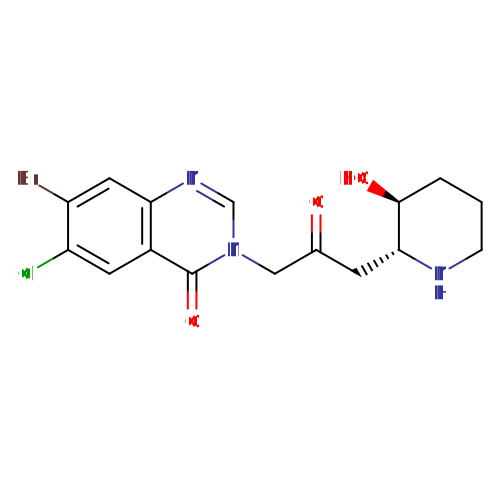
| Record Information |
|---|
| Version | 2.0 |
|---|
| Created at | 2022-09-11 01:27:50 UTC |
|---|
| Updated at | 2022-09-11 01:27:50 UTC |
|---|
| NP-MRD ID | NP0307973 |
|---|
| Secondary Accession Numbers | None |
|---|
| Natural Product Identification |
|---|
| Common Name | halofuginone |
|---|
| Description | Halofuginone belongs to the class of organic compounds known as quinazolines. Quinazolines are compounds containing a quinazoline moiety, which is made up of two fused six-member aromatic rings, a benzene ring and a pyrimidine ring. Inhibition of prolyl tRNA charging leads to the accumulation of uncharged prolyl tRNAs, which serve as a signal to initiate the amino acid starvation response, which in turn exerts anti-inflammatory and anti-fibrotic effects. Halofuginone is a drug which is used for the treatment of scleroderma, cancer, and restenosis. Halofuginone is a very strong basic compound (based on its pKa). Halofuginone therefore has potential for the treatment of autoimmune disorders. Collgard Biopharmaceuticals is developing halofuginone for the treatment of scleroderma and it has received orphan drug designation from the U.S. Food and Drug Administration. It is a synthetic halogenated derivative of febrifugine, a natural quinazolinone alkaloid which can be found in the Chinese herb Dichroa febrifuga (Chang Shan). Halofuginone is also an inhibitor of collagen type I gene expression and as a consequence it may inhibit tumor cell growth. Halofuginone exerts its effects by acting as a high affinity inhibitor of the enzyme glutamyl-prolyl tRNA synthetase. Halofuginone inhibits the development of T helper 17 cells, immune cells that play an important role in autoimmune disease, but it does not affect other kinds of T cells which are involved in normal immune function. halofuginone is found in Hydrangea febrifuga. Halofuginone is a coccidiostat used in veterinary medicine. |
|---|
| Structure | [H][C@]1(O)CCCN[C@]1([H])CC(=O)CN1C=NC2=C(C=C(Cl)C(Br)=C2)C1=O InChI=1S/C16H17BrClN3O3/c17-11-6-13-10(5-12(11)18)16(24)21(8-20-13)7-9(22)4-14-15(23)2-1-3-19-14/h5-6,8,14-15,19,23H,1-4,7H2/t14-,15+/m1/s1 |
|---|
| Synonyms | | Value | Source |
|---|
| Rel-halofuginone | ChEMBL | | 7-bromo-6-Chlorofebrifugine | MeSH | | Stenorol | MeSH | | Halofunginone | MeSH |
|
|---|
| Chemical Formula | C16H17BrClN3O3 |
|---|
| Average Mass | 414.6810 Da |
|---|
| Monoisotopic Mass | 413.01418 Da |
|---|
| IUPAC Name | 7-bromo-6-chloro-3-{3-[(2R,3S)-3-hydroxypiperidin-2-yl]-2-oxopropyl}-3,4-dihydroquinazolin-4-one |
|---|
| Traditional Name | 7-bromo-6-chloro-3-{3-[(2R,3S)-3-hydroxypiperidin-2-yl]-2-oxopropyl}quinazolin-4-one |
|---|
| CAS Registry Number | Not Available |
|---|
| SMILES | [H][C@]1(O)CCCN[C@]1([H])CC(=O)CN1C=NC2=C(C=C(Cl)C(Br)=C2)C1=O |
|---|
| InChI Identifier | InChI=1S/C16H17BrClN3O3/c17-11-6-13-10(5-12(11)18)16(24)21(8-20-13)7-9(22)4-14-15(23)2-1-3-19-14/h5-6,8,14-15,19,23H,1-4,7H2/t14-,15+/m1/s1 |
|---|
| InChI Key | LVASCWIMLIKXLA-CABCVRRESA-N |
|---|
| Experimental Spectra |
|---|
|
| Not Available | | Predicted Spectra |
|---|
|
| | Spectrum Type | Description | Depositor ID | Depositor Organization | Depositor | Deposition Date | View |
|---|
| 1D NMR | 13C NMR Spectrum (1D, 25 MHz, H2O, predicted) | Wishart Lab | Wishart Lab | David Wishart | 2021-06-20 | View Spectrum | | 1D NMR | 1H NMR Spectrum (1D, 100 MHz, H2O, predicted) | Wishart Lab | Wishart Lab | David Wishart | 2021-06-20 | View Spectrum | | 1D NMR | 13C NMR Spectrum (1D, 252 MHz, H2O, predicted) | Wishart Lab | Wishart Lab | David Wishart | 2021-06-20 | View Spectrum | | 1D NMR | 1H NMR Spectrum (1D, 1000 MHz, H2O, predicted) | Wishart Lab | Wishart Lab | David Wishart | 2021-06-20 | View Spectrum | | 1D NMR | 13C NMR Spectrum (1D, 50 MHz, H2O, predicted) | Wishart Lab | Wishart Lab | David Wishart | 2021-06-20 | View Spectrum | | 1D NMR | 1H NMR Spectrum (1D, 200 MHz, H2O, predicted) | Wishart Lab | Wishart Lab | David Wishart | 2021-06-20 | View Spectrum | | 1D NMR | 13C NMR Spectrum (1D, 75 MHz, H2O, predicted) | Wishart Lab | Wishart Lab | David Wishart | 2021-06-20 | View Spectrum | | 1D NMR | 1H NMR Spectrum (1D, 300 MHz, H2O, predicted) | Wishart Lab | Wishart Lab | David Wishart | 2021-06-20 | View Spectrum | | 1D NMR | 13C NMR Spectrum (1D, 101 MHz, H2O, predicted) | Wishart Lab | Wishart Lab | David Wishart | 2021-06-20 | View Spectrum | | 1D NMR | 1H NMR Spectrum (1D, 400 MHz, H2O, predicted) | Wishart Lab | Wishart Lab | David Wishart | 2021-06-20 | View Spectrum | | 1D NMR | 13C NMR Spectrum (1D, 126 MHz, H2O, predicted) | Wishart Lab | Wishart Lab | David Wishart | 2021-06-20 | View Spectrum | | 1D NMR | 1H NMR Spectrum (1D, 500 MHz, H2O, predicted) | Wishart Lab | Wishart Lab | David Wishart | 2021-06-20 | View Spectrum | | 1D NMR | 13C NMR Spectrum (1D, 151 MHz, H2O, predicted) | Wishart Lab | Wishart Lab | David Wishart | 2021-06-20 | View Spectrum | | 1D NMR | 1H NMR Spectrum (1D, 600 MHz, H2O, predicted) | Wishart Lab | Wishart Lab | David Wishart | 2021-06-20 | View Spectrum | | 1D NMR | 13C NMR Spectrum (1D, 176 MHz, H2O, predicted) | Wishart Lab | Wishart Lab | David Wishart | 2021-06-20 | View Spectrum | | 1D NMR | 1H NMR Spectrum (1D, 700 MHz, H2O, predicted) | Wishart Lab | Wishart Lab | David Wishart | 2021-06-20 | View Spectrum | | 1D NMR | 13C NMR Spectrum (1D, 201 MHz, H2O, predicted) | Wishart Lab | Wishart Lab | David Wishart | 2021-06-20 | View Spectrum | | 1D NMR | 1H NMR Spectrum (1D, 800 MHz, H2O, predicted) | Wishart Lab | Wishart Lab | David Wishart | 2021-06-20 | View Spectrum | | 1D NMR | 13C NMR Spectrum (1D, 226 MHz, H2O, predicted) | Wishart Lab | Wishart Lab | David Wishart | 2021-06-20 | View Spectrum | | 1D NMR | 1H NMR Spectrum (1D, 900 MHz, H2O, predicted) | Wishart Lab | Wishart Lab | David Wishart | 2021-06-20 | View Spectrum |
| | Chemical Shift Submissions |
|---|
|
| Not Available | | Species |
|---|
| Species of Origin | |
|---|
| Chemical Taxonomy |
|---|
| Description | Belongs to the class of organic compounds known as quinazolines. Quinazolines are compounds containing a quinazoline moiety, which is made up of two fused six-member aromatic rings, a benzene ring and a pyrimidine ring. |
|---|
| Kingdom | Organic compounds |
|---|
| Super Class | Organoheterocyclic compounds |
|---|
| Class | Diazanaphthalenes |
|---|
| Sub Class | Benzodiazines |
|---|
| Direct Parent | Quinazolines |
|---|
| Alternative Parents | |
|---|
| Substituents | - Quinazoline
- Pyrimidone
- Aryl bromide
- Aryl chloride
- Aryl halide
- Beta-aminoketone
- Benzenoid
- Pyrimidine
- Piperidine
- Heteroaromatic compound
- 1,2-aminoalcohol
- Ketone
- Lactam
- Secondary alcohol
- Secondary aliphatic amine
- Azacycle
- Secondary amine
- Organobromide
- Organohalogen compound
- Amine
- Alcohol
- Organic nitrogen compound
- Carbonyl group
- Hydrocarbon derivative
- Organic oxide
- Organopnictogen compound
- Organic oxygen compound
- Organochloride
- Organonitrogen compound
- Organooxygen compound
- Aromatic heteropolycyclic compound
|
|---|
| Molecular Framework | Aromatic heteropolycyclic compounds |
|---|
| External Descriptors | Not Available |
|---|
| Physical Properties |
|---|
| State | Not Available |
|---|
| Experimental Properties | | Property | Value | Reference |
|---|
| Melting Point | Not Available | Not Available | | Boiling Point | Not Available | Not Available | | Water Solubility | Not Available | Not Available | | LogP | Not Available | Not Available |
|
|---|
| Predicted Properties | |
|---|