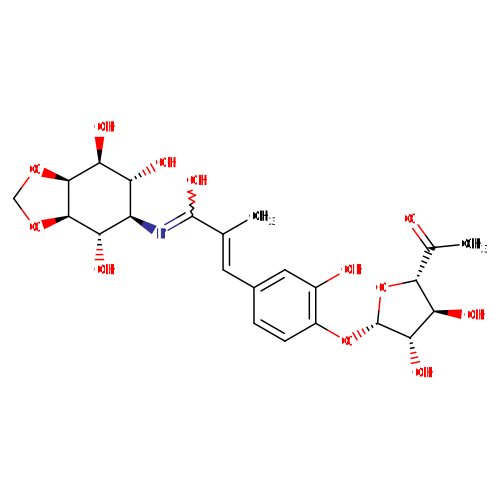
| Record Information |
|---|
| Version | 2.0 |
|---|
| Created at | 2022-09-10 23:23:16 UTC |
|---|
| Updated at | 2022-09-10 23:23:17 UTC |
|---|
| NP-MRD ID | NP0306722 |
|---|
| Secondary Accession Numbers | None |
|---|
| Natural Product Identification |
|---|
| Common Name | (2e)-n-[(3ar,4s,5r,6r,7s,7as)-4,6,7-trihydroxy-hexahydro-2h-1,3-benzodioxol-5-yl]-3-(4-{[(2s,3s,4s,5s)-5-acetyl-3,4-dihydroxyoxolan-2-yl]oxy}-3-hydroxyphenyl)-2-methylprop-2-enimidic acid |
|---|
| Description | HYGROMYCIN, also known as hygromycin a, belongs to the class of organic compounds known as phenolic glycosides. These are organic compounds containing a phenolic structure attached to a glycosyl moiety. Some examples of phenolic structures include lignans, and flavonoids. Among the sugar units found in natural glycosides are D-glucose, L-Fructose, and L rhamnose. (2e)-n-[(3ar,4s,5r,6r,7s,7as)-4,6,7-trihydroxy-hexahydro-2h-1,3-benzodioxol-5-yl]-3-(4-{[(2s,3s,4s,5s)-5-acetyl-3,4-dihydroxyoxolan-2-yl]oxy}-3-hydroxyphenyl)-2-methylprop-2-enimidic acid is found in Streptomyces noboritoensis. (2e)-n-[(3ar,4s,5r,6r,7s,7as)-4,6,7-trihydroxy-hexahydro-2h-1,3-benzodioxol-5-yl]-3-(4-{[(2s,3s,4s,5s)-5-acetyl-3,4-dihydroxyoxolan-2-yl]oxy}-3-hydroxyphenyl)-2-methylprop-2-enimidic acid was first documented in 2022 (PMID: 36082708). Based on a literature review a small amount of articles have been published on HYGROMYCIN (PMID: 36077399) (PMID: 36006545) (PMID: 36005449) (PMID: 35968963). |
|---|
| Structure | CC(=O)[C@H]1O[C@@H](OC2=CC=C(\C=C(/C)C(O)=N[C@H]3[C@H](O)[C@H]4OCO[C@H]4[C@@H](O)[C@@H]3O)C=C2O)[C@@H](O)[C@@H]1O InChI=1S/C23H29NO12/c1-8(22(32)24-13-14(27)16(29)21-20(15(13)28)33-7-34-21)5-10-3-4-12(11(26)6-10)35-23-18(31)17(30)19(36-23)9(2)25/h3-6,13-21,23,26-31H,7H2,1-2H3,(H,24,32)/b8-5+/t13-,14-,15+,16+,17+,18+,19-,20-,21+,23-/m1/s1 |
|---|
| Synonyms | | Value | Source |
|---|
| Hygromycin a | MeSH |
|
|---|
| Chemical Formula | C23H29NO12 |
|---|
| Average Mass | 511.4800 Da |
|---|
| Monoisotopic Mass | 511.16898 Da |
|---|
| IUPAC Name | (2E)-N-[(3aR,4S,5R,6R,7S,7aS)-4,6,7-trihydroxy-hexahydro-2H-1,3-benzodioxol-5-yl]-3-(4-{[(2S,3S,4S,5S)-5-acetyl-3,4-dihydroxyoxolan-2-yl]oxy}-3-hydroxyphenyl)-2-methylprop-2-enimidic acid |
|---|
| Traditional Name | (2E)-N-[(3aR,4S,5R,6R,7S,7aS)-4,6,7-trihydroxy-hexahydro-2H-1,3-benzodioxol-5-yl]-3-(4-{[(2S,3S,4S,5S)-5-acetyl-3,4-dihydroxyoxolan-2-yl]oxy}-3-hydroxyphenyl)-2-methylprop-2-enimidic acid |
|---|
| CAS Registry Number | Not Available |
|---|
| SMILES | CC(=O)[C@H]1O[C@@H](OC2=CC=C(\C=C(/C)C(O)=N[C@H]3[C@H](O)[C@H]4OCO[C@H]4[C@@H](O)[C@@H]3O)C=C2O)[C@@H](O)[C@@H]1O |
|---|
| InChI Identifier | InChI=1S/C23H29NO12/c1-8(22(32)24-13-14(27)16(29)21-20(15(13)28)33-7-34-21)5-10-3-4-12(11(26)6-10)35-23-18(31)17(30)19(36-23)9(2)25/h3-6,13-21,23,26-31H,7H2,1-2H3,(H,24,32)/b8-5+/t13-,14-,15+,16+,17+,18+,19-,20-,21+,23-/m1/s1 |
|---|
| InChI Key | YQYJSBFKSSDGFO-YYVVTDTASA-N |
|---|
| Experimental Spectra |
|---|
|
| Not Available | | Predicted Spectra |
|---|
|
| | Spectrum Type | Description | Depositor ID | Depositor Organization | Depositor | Deposition Date | View |
|---|
| 1D NMR | 13C NMR Spectrum (1D, 25 MHz, H2O, predicted) | Wishart Lab | Wishart Lab | David Wishart | 2021-06-20 | View Spectrum | | 1D NMR | 1H NMR Spectrum (1D, 100 MHz, H2O, predicted) | Wishart Lab | Wishart Lab | David Wishart | 2021-06-20 | View Spectrum | | 1D NMR | 13C NMR Spectrum (1D, 252 MHz, H2O, predicted) | Wishart Lab | Wishart Lab | David Wishart | 2021-06-20 | View Spectrum | | 1D NMR | 1H NMR Spectrum (1D, 1000 MHz, H2O, predicted) | Wishart Lab | Wishart Lab | David Wishart | 2021-06-20 | View Spectrum | | 1D NMR | 13C NMR Spectrum (1D, 50 MHz, H2O, predicted) | Wishart Lab | Wishart Lab | David Wishart | 2021-06-20 | View Spectrum | | 1D NMR | 1H NMR Spectrum (1D, 200 MHz, H2O, predicted) | Wishart Lab | Wishart Lab | David Wishart | 2021-06-20 | View Spectrum | | 1D NMR | 13C NMR Spectrum (1D, 75 MHz, H2O, predicted) | Wishart Lab | Wishart Lab | David Wishart | 2021-06-20 | View Spectrum | | 1D NMR | 1H NMR Spectrum (1D, 300 MHz, H2O, predicted) | Wishart Lab | Wishart Lab | David Wishart | 2021-06-20 | View Spectrum | | 1D NMR | 13C NMR Spectrum (1D, 101 MHz, H2O, predicted) | Wishart Lab | Wishart Lab | David Wishart | 2021-06-20 | View Spectrum | | 1D NMR | 1H NMR Spectrum (1D, 400 MHz, H2O, predicted) | Wishart Lab | Wishart Lab | David Wishart | 2021-06-20 | View Spectrum | | 1D NMR | 13C NMR Spectrum (1D, 126 MHz, H2O, predicted) | Wishart Lab | Wishart Lab | David Wishart | 2021-06-20 | View Spectrum | | 1D NMR | 1H NMR Spectrum (1D, 500 MHz, H2O, predicted) | Wishart Lab | Wishart Lab | David Wishart | 2021-06-20 | View Spectrum | | 1D NMR | 13C NMR Spectrum (1D, 151 MHz, H2O, predicted) | Wishart Lab | Wishart Lab | David Wishart | 2021-06-20 | View Spectrum | | 1D NMR | 1H NMR Spectrum (1D, 600 MHz, H2O, predicted) | Wishart Lab | Wishart Lab | David Wishart | 2021-06-20 | View Spectrum | | 1D NMR | 13C NMR Spectrum (1D, 176 MHz, H2O, predicted) | Wishart Lab | Wishart Lab | David Wishart | 2021-06-20 | View Spectrum | | 1D NMR | 1H NMR Spectrum (1D, 700 MHz, H2O, predicted) | Wishart Lab | Wishart Lab | David Wishart | 2021-06-20 | View Spectrum | | 1D NMR | 13C NMR Spectrum (1D, 201 MHz, H2O, predicted) | Wishart Lab | Wishart Lab | David Wishart | 2021-06-20 | View Spectrum | | 1D NMR | 1H NMR Spectrum (1D, 800 MHz, H2O, predicted) | Wishart Lab | Wishart Lab | David Wishart | 2021-06-20 | View Spectrum | | 1D NMR | 13C NMR Spectrum (1D, 226 MHz, H2O, predicted) | Wishart Lab | Wishart Lab | David Wishart | 2021-06-20 | View Spectrum | | 1D NMR | 1H NMR Spectrum (1D, 900 MHz, H2O, predicted) | Wishart Lab | Wishart Lab | David Wishart | 2021-06-20 | View Spectrum |
| | Chemical Shift Submissions |
|---|
|
| Not Available | | Species |
|---|
| Species of Origin | |
|---|
| Chemical Taxonomy |
|---|
| Description | Belongs to the class of organic compounds known as phenolic glycosides. These are organic compounds containing a phenolic structure attached to a glycosyl moiety. Some examples of phenolic structures include lignans, and flavonoids. Among the sugar units found in natural glycosides are D-glucose, L-Fructose, and L rhamnose. |
|---|
| Kingdom | Organic compounds |
|---|
| Super Class | Organic oxygen compounds |
|---|
| Class | Organooxygen compounds |
|---|
| Sub Class | Carbohydrates and carbohydrate conjugates |
|---|
| Direct Parent | Phenolic glycosides |
|---|
| Alternative Parents | |
|---|
| Substituents | - Phenolic glycoside
- O-glycosyl compound
- Pentose monosaccharide
- Phenoxy compound
- Phenol ether
- 1-hydroxy-4-unsubstituted benzenoid
- 1-hydroxy-2-unsubstituted benzenoid
- Phenol
- Benzenoid
- Monosaccharide
- Monocyclic benzene moiety
- Cyclitol or derivatives
- Tetrahydrofuran
- Cyclic alcohol
- Meta-dioxolane
- Secondary alcohol
- Ketone
- Oxacycle
- Organoheterocyclic compound
- Organic 1,3-dipolar compound
- Propargyl-type 1,3-dipolar organic compound
- Polyol
- Carboximidic acid derivative
- Carboximidic acid
- Acetal
- Organic nitrogen compound
- Organopnictogen compound
- Organic oxide
- Hydrocarbon derivative
- Organonitrogen compound
- Carbonyl group
- Alcohol
- Aromatic heteropolycyclic compound
|
|---|
| Molecular Framework | Aromatic heteropolycyclic compounds |
|---|
| External Descriptors | Not Available |
|---|
| Physical Properties |
|---|
| State | Not Available |
|---|
| Experimental Properties | | Property | Value | Reference |
|---|
| Melting Point | Not Available | Not Available | | Boiling Point | Not Available | Not Available | | Water Solubility | Not Available | Not Available | | LogP | Not Available | Not Available |
|
|---|
| Predicted Properties | |
|---|
| General References | - Li M, Wang C, Yuan M, Lu S, Qian Z, Li B, Xu T, Wang H: [Establishment of a THP-1 macrophage model infected by recombinant Mycobacterium smegmatis expressing green fluorescent protein]. Xi Bao Yu Fen Zi Mian Yi Xue Za Zhi. 2022 Sep;38(9):789-793. [PubMed:36082708 ]
- Li Y, Xiao F, Zhai C, Li X, Wu Y, Gao H, Li J, Zhai S, Liu B, Wu G: Qualitative and Quantitative Real-Time PCR Methods for Assessing False-Positive Rates in Genetically Modified Organisms Based on the Microbial-Infection-Linked HPT Gene. Int J Mol Sci. 2022 Sep 2;23(17):10000. doi: 10.3390/ijms231710000. [PubMed:36077399 ]
- Gupta V, Khan S, Verma RK, Shanker K, Singh SV, Rahman LU: Overexpression of chrysanthemyl diphosphate synthase (CDS) gene in Tagetes erecta leads to the overproduction of pyrethrin. Transgenic Res. 2022 Dec;31(6):625-635. doi: 10.1007/s11248-022-00323-9. Epub 2022 Aug 25. [PubMed:36006545 ]
- de Castro RJA, Rego MTAM, Brandao FS, Perez ALA, De Marco JL, Pocas-Fonseca MJ, Nichols C, Alspaugh JA, Felipe MSS, Alanio A, Bocca AL, Fernandes L: Engineered Fluorescent Strains of Cryptococcus neoformans: a Versatile Toolbox for Studies of Host-Pathogen Interactions and Fungal Biology, Including the Viable but Nonculturable State. Microbiol Spectr. 2022 Oct 26;10(5):e0150422. doi: 10.1128/spectrum.01504-22. Epub 2022 Aug 25. [PubMed:36005449 ]
- Park SO, Frazer C, Bennett RJ: An Adjuvant-Based Approach Enables the Use of Dominant HYG and KAN Selectable Markers in Candida albicans. mSphere. 2022 Aug 31;7(4):e0034722. doi: 10.1128/msphere.00347-22. Epub 2022 Aug 15. [PubMed:35968963 ]
- LOTUS database [Link]
|
|---|