| Record Information |
|---|
| Version | 2.0 |
|---|
| Created at | 2022-09-10 21:12:34 UTC |
|---|
| Updated at | 2022-09-10 21:12:34 UTC |
|---|
| NP-MRD ID | NP0305396 |
|---|
| Secondary Accession Numbers | None |
|---|
| Natural Product Identification |
|---|
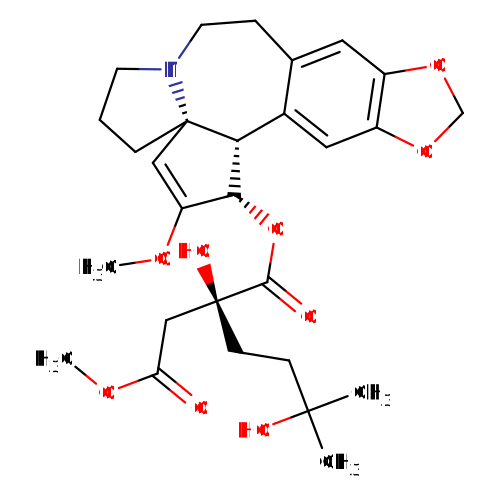
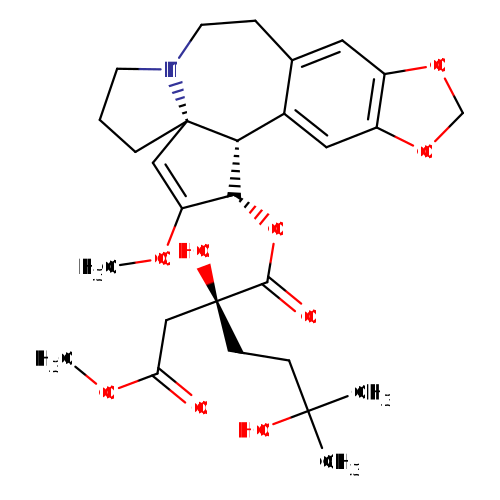
| Common Name | (2s,3s,6r)-4-methoxy-16,18-dioxa-10-azapentacyclo[11.7.0.0²,⁶.0⁶,¹⁰.0¹⁵,¹⁹]icosa-1(20),4,13,15(19)-tetraen-3-yl 1-methyl (3s)-3-hydroxy-3-(3-hydroxy-3-methylbutyl)butanedioate |
|---|
| Description | Harringtonine belongs to the class of organic compounds known as cephalotaxus alkaloids. These are alkaloids with a structure based on the cephalotaxine skeleton, a tetracyclic 1,3-benzodioxole-containing compound which arises from the skeletal rearrangement of the hydroaromatic component of the Erythrina group. (2s,3s,6r)-4-methoxy-16,18-dioxa-10-azapentacyclo[11.7.0.0²,⁶.0⁶,¹⁰.0¹⁵,¹⁹]icosa-1(20),4,13,15(19)-tetraen-3-yl 1-methyl (3s)-3-hydroxy-3-(3-hydroxy-3-methylbutyl)butanedioate was first documented in 2020 (PMID: 32906689). Based on a literature review a significant number of articles have been published on harringtonine (PMID: 33458709) (PMID: 35362917) (PMID: 35148094) (PMID: 34676091) (PMID: 34531841) (PMID: 34389492). |
|---|
| Structure | COC(=O)C[C@@](O)(CCC(C)(C)O)C(=O)O[C@H]1[C@H]2C3=CC4=C(OCO4)C=C3CCN3CCC[C@]23C=C1OC InChI=1S/C28H37NO9/c1-26(2,32)8-9-28(33,15-22(30)35-4)25(31)38-24-21(34-3)14-27-7-5-10-29(27)11-6-17-12-19-20(37-16-36-19)13-18(17)23(24)27/h12-14,23-24,32-33H,5-11,15-16H2,1-4H3/t23-,24-,27+,28+/m1/s1 |
|---|
| Synonyms | | Value | Source |
|---|
| Harringtonine, (S)-isomer | MeSH | | 2'r-Harringtonine | MeSH | | Harringtonine hydrochloride | MeSH | | Harringtonin | MeSH | | Cephalotaxine, 4-methyl (2R)-2-hydroxy-2-(3-hydroxy-3-methylbutyl)butanedioate (ester) | MeSH | | Harringtonine, (R)-isomer | MeSH | | Harringtonine, racemic mixture | MeSH |
|
|---|
| Chemical Formula | C28H37NO9 |
|---|
| Average Mass | 531.6020 Da |
|---|
| Monoisotopic Mass | 531.24683 Da |
|---|
| IUPAC Name | (2S,3S,6R)-4-methoxy-16,18-dioxa-10-azapentacyclo[11.7.0.0^{2,6}.0^{6,10}.0^{15,19}]icosa-1(20),4,13,15(19)-tetraen-3-yl 1-methyl (3S)-3-hydroxy-3-(3-hydroxy-3-methylbutyl)butanedioate |
|---|
| Traditional Name | (2S,3S,6R)-4-methoxy-16,18-dioxa-10-azapentacyclo[11.7.0.0^{2,6}.0^{6,10}.0^{15,19}]icosa-1(20),4,13,15(19)-tetraen-3-yl 1-methyl (3S)-3-hydroxy-3-(3-hydroxy-3-methylbutyl)butanedioate |
|---|
| CAS Registry Number | Not Available |
|---|
| SMILES | COC(=O)C[C@@](O)(CCC(C)(C)O)C(=O)O[C@H]1[C@H]2C3=CC4=C(OCO4)C=C3CCN3CCC[C@]23C=C1OC |
|---|
| InChI Identifier | InChI=1S/C28H37NO9/c1-26(2,32)8-9-28(33,15-22(30)35-4)25(31)38-24-21(34-3)14-27-7-5-10-29(27)11-6-17-12-19-20(37-16-36-19)13-18(17)23(24)27/h12-14,23-24,32-33H,5-11,15-16H2,1-4H3/t23-,24-,27+,28+/m1/s1 |
|---|
| InChI Key | HAVJATCHLFRDHY-ZBVBGGFBSA-N |
|---|
| Experimental Spectra |
|---|
|
| Not Available | | Predicted Spectra |
|---|
|
| | Spectrum Type | Description | Depositor ID | Depositor Organization | Depositor | Deposition Date | View |
|---|
| 1D NMR | 13C NMR Spectrum (1D, 25 MHz, H2O, predicted) | Wishart Lab | Wishart Lab | David Wishart | 2021-06-20 | View Spectrum | | 1D NMR | 1H NMR Spectrum (1D, 100 MHz, H2O, predicted) | Wishart Lab | Wishart Lab | David Wishart | 2021-06-20 | View Spectrum | | 1D NMR | 13C NMR Spectrum (1D, 252 MHz, H2O, predicted) | Wishart Lab | Wishart Lab | David Wishart | 2021-06-20 | View Spectrum | | 1D NMR | 1H NMR Spectrum (1D, 1000 MHz, H2O, predicted) | Wishart Lab | Wishart Lab | David Wishart | 2021-06-20 | View Spectrum | | 1D NMR | 13C NMR Spectrum (1D, 50 MHz, H2O, predicted) | Wishart Lab | Wishart Lab | David Wishart | 2021-06-20 | View Spectrum | | 1D NMR | 1H NMR Spectrum (1D, 200 MHz, H2O, predicted) | Wishart Lab | Wishart Lab | David Wishart | 2021-06-20 | View Spectrum | | 1D NMR | 13C NMR Spectrum (1D, 75 MHz, H2O, predicted) | Wishart Lab | Wishart Lab | David Wishart | 2021-06-20 | View Spectrum | | 1D NMR | 1H NMR Spectrum (1D, 300 MHz, H2O, predicted) | Wishart Lab | Wishart Lab | David Wishart | 2021-06-20 | View Spectrum | | 1D NMR | 13C NMR Spectrum (1D, 101 MHz, H2O, predicted) | Wishart Lab | Wishart Lab | David Wishart | 2021-06-20 | View Spectrum | | 1D NMR | 1H NMR Spectrum (1D, 400 MHz, H2O, predicted) | Wishart Lab | Wishart Lab | David Wishart | 2021-06-20 | View Spectrum | | 1D NMR | 13C NMR Spectrum (1D, 126 MHz, H2O, predicted) | Wishart Lab | Wishart Lab | David Wishart | 2021-06-20 | View Spectrum | | 1D NMR | 1H NMR Spectrum (1D, 500 MHz, H2O, predicted) | Wishart Lab | Wishart Lab | David Wishart | 2021-06-20 | View Spectrum | | 1D NMR | 13C NMR Spectrum (1D, 151 MHz, H2O, predicted) | Wishart Lab | Wishart Lab | David Wishart | 2021-06-20 | View Spectrum | | 1D NMR | 1H NMR Spectrum (1D, 600 MHz, H2O, predicted) | Wishart Lab | Wishart Lab | David Wishart | 2021-06-20 | View Spectrum | | 1D NMR | 13C NMR Spectrum (1D, 176 MHz, H2O, predicted) | Wishart Lab | Wishart Lab | David Wishart | 2021-06-20 | View Spectrum | | 1D NMR | 1H NMR Spectrum (1D, 700 MHz, H2O, predicted) | Wishart Lab | Wishart Lab | David Wishart | 2021-06-20 | View Spectrum | | 1D NMR | 13C NMR Spectrum (1D, 201 MHz, H2O, predicted) | Wishart Lab | Wishart Lab | David Wishart | 2021-06-20 | View Spectrum | | 1D NMR | 1H NMR Spectrum (1D, 800 MHz, H2O, predicted) | Wishart Lab | Wishart Lab | David Wishart | 2021-06-20 | View Spectrum | | 1D NMR | 13C NMR Spectrum (1D, 226 MHz, H2O, predicted) | Wishart Lab | Wishart Lab | David Wishart | 2021-06-20 | View Spectrum | | 1D NMR | 1H NMR Spectrum (1D, 900 MHz, H2O, predicted) | Wishart Lab | Wishart Lab | David Wishart | 2021-06-20 | View Spectrum |
| | Chemical Shift Submissions |
|---|
|
| Not Available | | Species |
|---|
| Species of Origin | Not Available |
|---|
| Chemical Taxonomy |
|---|
| Description | Belongs to the class of organic compounds known as cephalotaxus alkaloids. These are alkaloids with a structure based on the cephalotaxine skeleton, a tetracyclic 1,3-benzodioxole-containing compound which arises from the skeletal rearrangement of the hydroaromatic component of the Erythrina group. |
|---|
| Kingdom | Organic compounds |
|---|
| Super Class | Alkaloids and derivatives |
|---|
| Class | Cephalotaxus alkaloids |
|---|
| Sub Class | Not Available |
|---|
| Direct Parent | Cephalotaxus alkaloids |
|---|
| Alternative Parents | |
|---|
| Substituents | - Cephalotaxine
- Cephalotaxus alkaloid skeleton
- Benzazepine
- Benzodioxole
- Fatty acid methyl ester
- Azepine
- Fatty acid ester
- Aralkylamine
- N-alkylpyrrolidine
- Benzenoid
- Dicarboxylic acid or derivatives
- Fatty acyl
- Pyrrolidine
- Methyl ester
- Tertiary alcohol
- Amino acid or derivatives
- Carboxylic acid ester
- Tertiary amine
- Tertiary aliphatic amine
- Acetal
- Carboxylic acid derivative
- Oxacycle
- Azacycle
- Organoheterocyclic compound
- Hydrocarbon derivative
- Alcohol
- Carbonyl group
- Organic oxide
- Organopnictogen compound
- Organic oxygen compound
- Amine
- Organic nitrogen compound
- Organonitrogen compound
- Organooxygen compound
- Aromatic heteropolycyclic compound
|
|---|
| Molecular Framework | Aromatic heteropolycyclic compounds |
|---|
| External Descriptors | Not Available |
|---|
| Physical Properties |
|---|
| State | Not Available |
|---|
| Experimental Properties | | Property | Value | Reference |
|---|
| Melting Point | Not Available | Not Available | | Boiling Point | Not Available | Not Available | | Water Solubility | Not Available | Not Available | | LogP | Not Available | Not Available |
|
|---|
| Predicted Properties | |
|---|
| General References | - Hollerer I, Powers EN, Brar GA: Global mapping of translation initiation sites by TIS profiling in budding yeast. STAR Protoc. 2020 Dec 30;2(1):100250. doi: 10.1016/j.xpro.2020.100250. eCollection 2021 Mar 19. [PubMed:33458709 ]
- Ma H, Wen H, Qin Y, Wu S, Zhang G, Wu CI, Cai Q: Homo-harringtonine, highly effective against coronaviruses, is safe in treating COVID-19 by nebulization. Sci China Life Sci. 2022 Jun;65(6):1263-1266. doi: 10.1007/s11427-021-2093-2. Epub 2022 Mar 22. [PubMed:35362917 ]
- Ochi A, Yoritate M, Miyamoto T, Usui K, Yusakul G, Putalun W, Tanaka H, Hirai G, Morimoto S, Sakamoto S: Harringtonine Ester Derivatives with Enhanced Antiproliferative Activities against HL-60 and HeLa Cells. J Nat Prod. 2022 Feb 25;85(2):345-351. doi: 10.1021/acs.jnatprod.1c00888. Epub 2022 Feb 11. [PubMed:35148094 ]
- Wen HJ, Liu FL, Huang MX, Luo RH, He WB, Feng J, Chen FL, Cai QC, Ma HJ, Yang ZF, Zhou X, Shang Y, Lyu XM, Zhang DY, Xiao F, Shan H, He JX, Zheng YT, Wu CI: A proposal for clinical trials of COVID-19 treatment using homo-harringtonine. Natl Sci Rev. 2020 Oct 12;8(1):nwaa257. doi: 10.1093/nsr/nwaa257. eCollection 2021 Jan. [PubMed:34676091 ]
- Liu Y, You Q, Zhang F, Chen D, Huang Z, Wu Z: Harringtonine Inhibits Herpes Simplex Virus Type 1 Infection by Reducing Herpes Virus Entry Mediator Expression. Front Microbiol. 2021 Aug 31;12:722748. doi: 10.3389/fmicb.2021.722748. eCollection 2021. [PubMed:34531841 ]
- Ji S, Liu M, Galon EM, Rizk MA, Li J, Li Y, Zafar I, Igarashi I, Xuan X: In vitro screening of novel anti-Babesia gibsoni drugs from natural products. Parasitol Int. 2021 Dec;85:102437. doi: 10.1016/j.parint.2021.102437. Epub 2021 Aug 11. [PubMed:34389492 ]
- Wang D, Wang J, Zhang J, Yi X, Piao J, Li L, Wang J, Zhang P, He Q: Decrease of ABCB1 protein expression and increase of G(1) phase arrest induced by oleanolic acid in human multidrug-resistant cancer cells. Exp Ther Med. 2021 Jul;22(1):735. doi: 10.3892/etm.2021.10167. Epub 2021 May 9. [PubMed:34055052 ]
- Lai ZZ, Ho YJ, Lu JW: Harringtonine Inhibits Zika Virus Infection through Multiple Mechanisms. Molecules. 2020 Sep 7;25(18):4082. doi: 10.3390/molecules25184082. [PubMed:32906689 ]
- LOTUS database [Link]
|
|---|