| Record Information |
|---|
| Version | 2.0 |
|---|
| Created at | 2022-09-10 21:07:56 UTC |
|---|
| Updated at | 2022-09-10 21:07:56 UTC |
|---|
| NP-MRD ID | NP0305360 |
|---|
| Secondary Accession Numbers | None |
|---|
| Natural Product Identification |
|---|
| Common Name | 2-{[2-(hydroxymethyl)-5-methoxy-3,9-dioxatricyclo[4.4.0.0²,⁴]dec-7-en-10-yl]oxy}-6-{[(3,4,5-trihydroxyoxan-2-yl)oxy]methyl}oxane-3,4,5-triol |
|---|
| Description | Karsoside belongs to the class of organic compounds known as o-glycosyl compounds. These are glycoside in which a sugar group is bonded through one carbon to another group via a O-glycosidic bond. 2-{[2-(hydroxymethyl)-5-methoxy-3,9-dioxatricyclo[4.4.0.0²,⁴]dec-7-en-10-yl]oxy}-6-{[(3,4,5-trihydroxyoxan-2-yl)oxy]methyl}oxane-3,4,5-triol is found in Scrophularia ilwensis. 2-{[2-(hydroxymethyl)-5-methoxy-3,9-dioxatricyclo[4.4.0.0²,⁴]dec-7-en-10-yl]oxy}-6-{[(3,4,5-trihydroxyoxan-2-yl)oxy]methyl}oxane-3,4,5-triol was first documented in 1993 (PMID: 8496707). Based on a literature review very few articles have been published on Karsoside. |
|---|
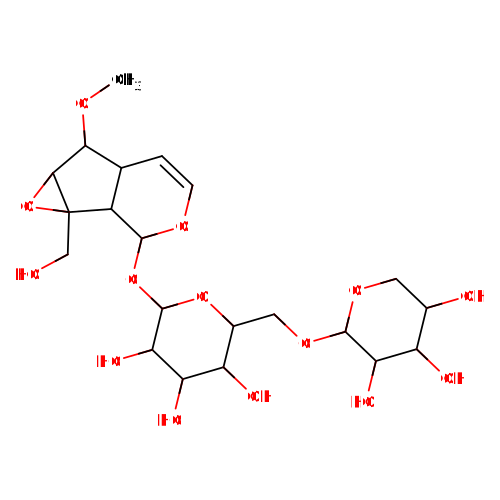
| Structure | COC1C2OC2(CO)C2C1C=COC2OC1OC(COC2OCC(O)C(O)C2O)C(O)C(O)C1O InChI=1S/C21H32O14/c1-29-16-7-2-3-30-18(10(7)21(6-22)17(16)35-21)34-20-15(28)13(26)12(25)9(33-20)5-32-19-14(27)11(24)8(23)4-31-19/h2-3,7-20,22-28H,4-6H2,1H3 |
|---|
| Synonyms | | Value | Source |
|---|
| 6'-O-(beta-D-Xylopyranosyl)methylcatalpol | MeSH |
|
|---|
| Chemical Formula | C21H32O14 |
|---|
| Average Mass | 508.4730 Da |
|---|
| Monoisotopic Mass | 508.17921 Da |
|---|
| IUPAC Name | 2-{[2-(hydroxymethyl)-5-methoxy-3,9-dioxatricyclo[4.4.0.0^{2,4}]dec-7-en-10-yl]oxy}-6-{[(3,4,5-trihydroxyoxan-2-yl)oxy]methyl}oxane-3,4,5-triol |
|---|
| Traditional Name | 2-{[2-(hydroxymethyl)-5-methoxy-3,9-dioxatricyclo[4.4.0.0^{2,4}]dec-7-en-10-yl]oxy}-6-{[(3,4,5-trihydroxyoxan-2-yl)oxy]methyl}oxane-3,4,5-triol |
|---|
| CAS Registry Number | Not Available |
|---|
| SMILES | COC1C2OC2(CO)C2C1C=COC2OC1OC(COC2OCC(O)C(O)C2O)C(O)C(O)C1O |
|---|
| InChI Identifier | InChI=1S/C21H32O14/c1-29-16-7-2-3-30-18(10(7)21(6-22)17(16)35-21)34-20-15(28)13(26)12(25)9(33-20)5-32-19-14(27)11(24)8(23)4-31-19/h2-3,7-20,22-28H,4-6H2,1H3 |
|---|
| InChI Key | LOKOJGZZDJOXCS-UHFFFAOYSA-N |
|---|
| Experimental Spectra |
|---|
|
| Not Available | | Predicted Spectra |
|---|
|
| Not Available | | Chemical Shift Submissions |
|---|
|
| Not Available | | Species |
|---|
| Species of Origin | |
|---|
| Chemical Taxonomy |
|---|
| Description | Belongs to the class of organic compounds known as o-glycosyl compounds. These are glycoside in which a sugar group is bonded through one carbon to another group via a O-glycosidic bond. |
|---|
| Kingdom | Organic compounds |
|---|
| Super Class | Organic oxygen compounds |
|---|
| Class | Organooxygen compounds |
|---|
| Sub Class | Carbohydrates and carbohydrate conjugates |
|---|
| Direct Parent | O-glycosyl compounds |
|---|
| Alternative Parents | |
|---|
| Substituents | - O-glycosyl compound
- Disaccharide
- Oxane
- Secondary alcohol
- Oxacycle
- Organoheterocyclic compound
- Polyol
- Ether
- Oxirane
- Dialkyl ether
- Acetal
- Hydrocarbon derivative
- Primary alcohol
- Alcohol
- Aliphatic heteropolycyclic compound
|
|---|
| Molecular Framework | Aliphatic heteropolycyclic compounds |
|---|
| External Descriptors | Not Available |
|---|
| Physical Properties |
|---|
| State | Not Available |
|---|
| Experimental Properties | | Property | Value | Reference |
|---|
| Melting Point | Not Available | Not Available | | Boiling Point | Not Available | Not Available | | Water Solubility | Not Available | Not Available | | LogP | Not Available | Not Available |
|
|---|
| Predicted Properties | |
|---|