| Record Information |
|---|
| Version | 2.0 |
|---|
| Created at | 2022-09-10 18:19:21 UTC |
|---|
| Updated at | 2022-09-10 18:19:21 UTC |
|---|
| NP-MRD ID | NP0303723 |
|---|
| Secondary Accession Numbers | None |
|---|
| Natural Product Identification |
|---|
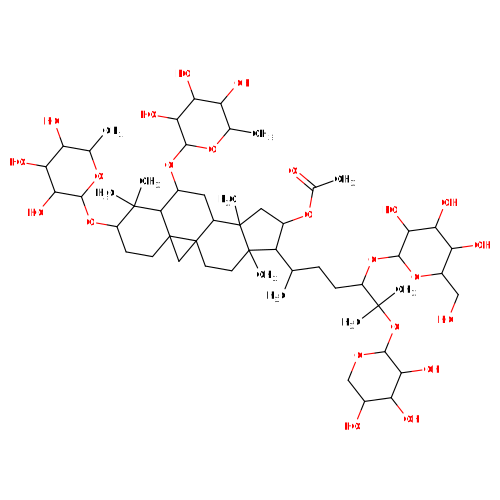
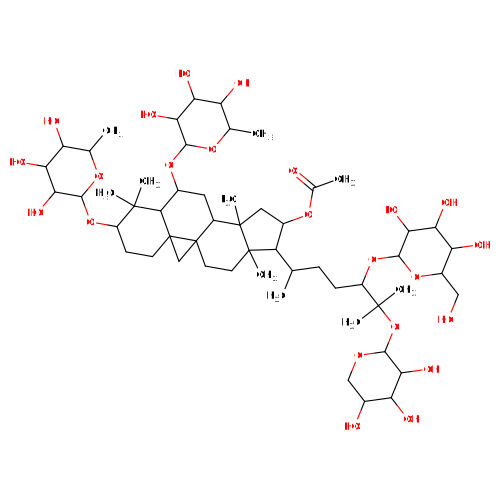
| Common Name | 7,7,12,16-tetramethyl-15-(6-methyl-5-{[3,4,5-trihydroxy-6-(hydroxymethyl)oxan-2-yl]oxy}-6-[(3,4,5-trihydroxyoxan-2-yl)oxy]heptan-2-yl)-6,9-bis[(3,4,5-trihydroxy-6-methyloxan-2-yl)oxy]pentacyclo[9.7.0.0¹,³.0³,⁸.0¹²,¹⁶]octadecan-14-yl acetate |
|---|
| Description | 7,7,12,16-Tetramethyl-15-(6-methyl-5-{[3,4,5-trihydroxy-6-(hydroxymethyl)oxan-2-yl]oxy}-6-[(3,4,5-trihydroxyoxan-2-yl)oxy]heptan-2-yl)-6,9-bis[(3,4,5-trihydroxy-6-methyloxan-2-yl)oxy]pentacyclo[9.7.0.0¹,³.0³,⁸.0¹²,¹⁶]Octadecan-14-yl acetate belongs to the class of organic compounds known as cucurbitacin glycosides. These are polycyclic compounds containing a carbohydrate derivative glycosidically linked to a curcubitane nucleus. 7,7,12,16-tetramethyl-15-(6-methyl-5-{[3,4,5-trihydroxy-6-(hydroxymethyl)oxan-2-yl]oxy}-6-[(3,4,5-trihydroxyoxan-2-yl)oxy]heptan-2-yl)-6,9-bis[(3,4,5-trihydroxy-6-methyloxan-2-yl)oxy]pentacyclo[9.7.0.0¹,³.0³,⁸.0¹²,¹⁶]octadecan-14-yl acetate is found in Astragalus cicer. 7,7,12,16-Tetramethyl-15-(6-methyl-5-{[3,4,5-trihydroxy-6-(hydroxymethyl)oxan-2-yl]oxy}-6-[(3,4,5-trihydroxyoxan-2-yl)oxy]heptan-2-yl)-6,9-bis[(3,4,5-trihydroxy-6-methyloxan-2-yl)oxy]pentacyclo[9.7.0.0¹,³.0³,⁸.0¹²,¹⁶]Octadecan-14-yl acetate is an extremely weak basic (essentially neutral) compound (based on its pKa). |
|---|
| Structure | CC(CCC(OC1OC(CO)C(O)C(O)C1O)C(C)(C)OC1OCC(O)C(O)C1O)C1C(CC2(C)C3CC(OC4OC(C)C(O)C(O)C4O)C4C5(CC35CCC12C)CCC(OC1OC(C)C(O)C(O)C1O)C4(C)C)OC(C)=O InChI=1S/C55H92O23/c1-22(11-12-32(77-49-44(69)40(65)37(62)29(19-56)75-49)51(7,8)78-46-41(66)36(61)26(58)20-70-46)33-28(73-25(4)57)18-53(10)30-17-27(74-47-42(67)38(63)34(59)23(2)71-47)45-50(5,6)31(76-48-43(68)39(64)35(60)24(3)72-48)13-14-55(45)21-54(30,55)16-15-52(33,53)9/h22-24,26-49,56,58-69H,11-21H2,1-10H3 |
|---|
| Synonyms | | Value | Source |
|---|
| 7,7,12,16-Tetramethyl-15-(6-methyl-5-{[3,4,5-trihydroxy-6-(hydroxymethyl)oxan-2-yl]oxy}-6-[(3,4,5-trihydroxyoxan-2-yl)oxy]heptan-2-yl)-6,9-bis[(3,4,5-trihydroxy-6-methyloxan-2-yl)oxy]pentacyclo[9.7.0.0,.0,.0,]octadecan-14-yl acetic acid | Generator | | 7,7,12,16-Tetramethyl-15-(6-methyl-5-{[3,4,5-trihydroxy-6-(hydroxymethyl)oxan-2-yl]oxy}-6-[(3,4,5-trihydroxyoxan-2-yl)oxy]heptan-2-yl)-6,9-bis[(3,4,5-trihydroxy-6-methyloxan-2-yl)oxy]pentacyclo[9.7.0.0¹,³.0³,⁸.0¹²,¹⁶]octadecan-14-yl acetic acid | Generator |
|
|---|
| Chemical Formula | C55H92O23 |
|---|
| Average Mass | 1121.3180 Da |
|---|
| Monoisotopic Mass | 1120.60294 Da |
|---|
| IUPAC Name | 7,7,12,16-tetramethyl-15-(6-methyl-5-{[3,4,5-trihydroxy-6-(hydroxymethyl)oxan-2-yl]oxy}-6-[(3,4,5-trihydroxyoxan-2-yl)oxy]heptan-2-yl)-6,9-bis[(3,4,5-trihydroxy-6-methyloxan-2-yl)oxy]pentacyclo[9.7.0.0¹,³.0³,⁸.0¹²,¹⁶]octadecan-14-yl acetate |
|---|
| Traditional Name | 7,7,12,16-tetramethyl-15-(6-methyl-5-{[3,4,5-trihydroxy-6-(hydroxymethyl)oxan-2-yl]oxy}-6-[(3,4,5-trihydroxyoxan-2-yl)oxy]heptan-2-yl)-6,9-bis[(3,4,5-trihydroxy-6-methyloxan-2-yl)oxy]pentacyclo[9.7.0.0¹,³.0³,⁸.0¹²,¹⁶]octadecan-14-yl acetate |
|---|
| CAS Registry Number | Not Available |
|---|
| SMILES | CC(CCC(OC1OC(CO)C(O)C(O)C1O)C(C)(C)OC1OCC(O)C(O)C1O)C1C(CC2(C)C3CC(OC4OC(C)C(O)C(O)C4O)C4C5(CC35CCC12C)CCC(OC1OC(C)C(O)C(O)C1O)C4(C)C)OC(C)=O |
|---|
| InChI Identifier | InChI=1S/C55H92O23/c1-22(11-12-32(77-49-44(69)40(65)37(62)29(19-56)75-49)51(7,8)78-46-41(66)36(61)26(58)20-70-46)33-28(73-25(4)57)18-53(10)30-17-27(74-47-42(67)38(63)34(59)23(2)71-47)45-50(5,6)31(76-48-43(68)39(64)35(60)24(3)72-48)13-14-55(45)21-54(30,55)16-15-52(33,53)9/h22-24,26-49,56,58-69H,11-21H2,1-10H3 |
|---|
| InChI Key | MAAMQCRKQCCEPR-UHFFFAOYSA-N |
|---|
| Experimental Spectra |
|---|
|
| Not Available | | Predicted Spectra |
|---|
|
| Not Available | | Chemical Shift Submissions |
|---|
|
| Not Available | | Species |
|---|
| Species of Origin | |
|---|
| Chemical Taxonomy |
|---|
| Description | Belongs to the class of organic compounds known as cucurbitacin glycosides. These are polycyclic compounds containing a carbohydrate derivative glycosidically linked to a curcubitane nucleus. |
|---|
| Kingdom | Organic compounds |
|---|
| Super Class | Lipids and lipid-like molecules |
|---|
| Class | Steroids and steroid derivatives |
|---|
| Sub Class | Steroidal glycosides |
|---|
| Direct Parent | Cucurbitacin glycosides |
|---|
| Alternative Parents | |
|---|
| Substituents | - Cucurbitacin glycoside skeleton
- Triterpene saponin
- Triterpene glycoside
- Cycloartanol-skeleton
- Triterpenoid
- 9b,19-cyclo-lanostane-skeleton
- Cycloartane-skeleton
- Bile acid, alcohol, or derivatives
- Steroid ester
- Fatty acyl glycoside
- Fatty acyl glycoside of mono- or disaccharide
- Alkyl glycoside
- Glycosyl compound
- O-glycosyl compound
- Fatty acyl
- Oxane
- Monosaccharide
- Carboxylic acid ester
- Secondary alcohol
- Polyol
- Acetal
- Carboxylic acid derivative
- Organoheterocyclic compound
- Oxacycle
- Monocarboxylic acid or derivatives
- Primary alcohol
- Alcohol
- Organic oxide
- Organic oxygen compound
- Hydrocarbon derivative
- Carbonyl group
- Organooxygen compound
- Aliphatic heteropolycyclic compound
|
|---|
| Molecular Framework | Aliphatic heteropolycyclic compounds |
|---|
| External Descriptors | Not Available |
|---|
| Physical Properties |
|---|
| State | Not Available |
|---|
| Experimental Properties | | Property | Value | Reference |
|---|
| Melting Point | Not Available | Not Available | | Boiling Point | Not Available | Not Available | | Water Solubility | Not Available | Not Available | | LogP | Not Available | Not Available |
|
|---|
| Predicted Properties | |
|---|