| Record Information |
|---|
| Version | 2.0 |
|---|
| Created at | 2022-09-10 17:22:38 UTC |
|---|
| Updated at | 2022-09-10 17:22:38 UTC |
|---|
| NP-MRD ID | NP0303207 |
|---|
| Secondary Accession Numbers | None |
|---|
| Natural Product Identification |
|---|
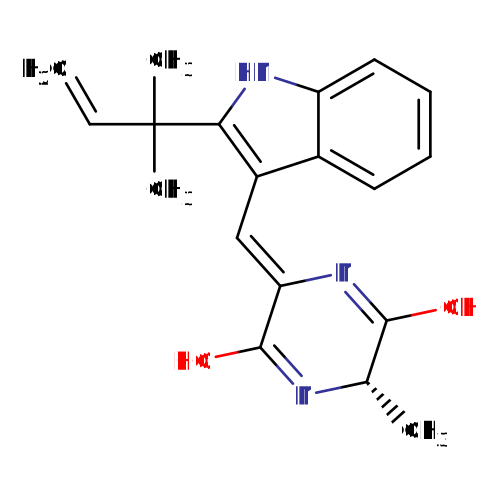
| Common Name | (3s,6z)-3-methyl-6-{[2-(2-methylbut-3-en-2-yl)-1h-indol-3-yl]methylidene}-3h-pyrazine-2,5-diol |
|---|
| Description | Neoechinulin A belongs to the class of organic compounds known as alpha amino acids and derivatives. These are amino acids in which the amino group is attached to the carbon atom immediately adjacent to the carboxylate group (alpha carbon), or a derivative thereof. (3s,6z)-3-methyl-6-{[2-(2-methylbut-3-en-2-yl)-1h-indol-3-yl]methylidene}-3h-pyrazine-2,5-diol is found in Aspergillus stellatus, Penicillium griseofulvum and Polysiphonia stricta. (3s,6z)-3-methyl-6-{[2-(2-methylbut-3-en-2-yl)-1h-indol-3-yl]methylidene}-3h-pyrazine-2,5-diol was first documented in 2019 (PMID: 31494811). Based on a literature review a significant number of articles have been published on neoechinulin A (PMID: 32212241) (PMID: 34180325) (PMID: 35323462) (PMID: 33983974) (PMID: 33381959) (PMID: 34741824). |
|---|
| Structure | C[C@@H]1N=C(O)\C(=C\C2=C(NC3=CC=CC=C23)C(C)(C)C=C)N=C1O InChI=1S/C19H21N3O2/c1-5-19(3,4)16-13(12-8-6-7-9-14(12)21-16)10-15-18(24)20-11(2)17(23)22-15/h5-11,21H,1H2,2-4H3,(H,20,24)(H,22,23)/b15-10-/t11-/m0/s1 |
|---|
| Synonyms | Not Available |
|---|
| Chemical Formula | C19H21N3O2 |
|---|
| Average Mass | 323.3960 Da |
|---|
| Monoisotopic Mass | 323.16338 Da |
|---|
| IUPAC Name | (3S,6Z)-3-methyl-6-{[2-(2-methylbut-3-en-2-yl)-1H-indol-3-yl]methylidene}-3,6-dihydropyrazine-2,5-diol |
|---|
| Traditional Name | (3S,6Z)-3-methyl-6-{[2-(2-methylbut-3-en-2-yl)-1H-indol-3-yl]methylidene}-3H-pyrazine-2,5-diol |
|---|
| CAS Registry Number | Not Available |
|---|
| SMILES | C[C@@H]1N=C(O)\C(=C\C2=C(NC3=CC=CC=C23)C(C)(C)C=C)N=C1O |
|---|
| InChI Identifier | InChI=1S/C19H21N3O2/c1-5-19(3,4)16-13(12-8-6-7-9-14(12)21-16)10-15-18(24)20-11(2)17(23)22-15/h5-11,21H,1H2,2-4H3,(H,20,24)(H,22,23)/b15-10-/t11-/m0/s1 |
|---|
| InChI Key | MYRPIYZIAHOECW-SAIXKJTDSA-N |
|---|
| Experimental Spectra |
|---|
|
| Not Available | | Predicted Spectra |
|---|
|
| | Spectrum Type | Description | Depositor ID | Depositor Organization | Depositor | Deposition Date | View |
|---|
| 1D NMR | 13C NMR Spectrum (1D, 25 MHz, H2O, predicted) | Wishart Lab | Wishart Lab | David Wishart | 2021-06-20 | View Spectrum | | 1D NMR | 1H NMR Spectrum (1D, 100 MHz, H2O, predicted) | Wishart Lab | Wishart Lab | David Wishart | 2021-06-20 | View Spectrum | | 1D NMR | 13C NMR Spectrum (1D, 252 MHz, H2O, predicted) | Wishart Lab | Wishart Lab | David Wishart | 2021-06-20 | View Spectrum | | 1D NMR | 1H NMR Spectrum (1D, 1000 MHz, H2O, predicted) | Wishart Lab | Wishart Lab | David Wishart | 2021-06-20 | View Spectrum | | 1D NMR | 13C NMR Spectrum (1D, 50 MHz, H2O, predicted) | Wishart Lab | Wishart Lab | David Wishart | 2021-06-20 | View Spectrum | | 1D NMR | 1H NMR Spectrum (1D, 200 MHz, H2O, predicted) | Wishart Lab | Wishart Lab | David Wishart | 2021-06-20 | View Spectrum | | 1D NMR | 13C NMR Spectrum (1D, 75 MHz, H2O, predicted) | Wishart Lab | Wishart Lab | David Wishart | 2021-06-20 | View Spectrum | | 1D NMR | 1H NMR Spectrum (1D, 300 MHz, H2O, predicted) | Wishart Lab | Wishart Lab | David Wishart | 2021-06-20 | View Spectrum | | 1D NMR | 13C NMR Spectrum (1D, 101 MHz, H2O, predicted) | Wishart Lab | Wishart Lab | David Wishart | 2021-06-20 | View Spectrum | | 1D NMR | 1H NMR Spectrum (1D, 400 MHz, H2O, predicted) | Wishart Lab | Wishart Lab | David Wishart | 2021-06-20 | View Spectrum | | 1D NMR | 13C NMR Spectrum (1D, 126 MHz, H2O, predicted) | Wishart Lab | Wishart Lab | David Wishart | 2021-06-20 | View Spectrum | | 1D NMR | 1H NMR Spectrum (1D, 500 MHz, H2O, predicted) | Wishart Lab | Wishart Lab | David Wishart | 2021-06-20 | View Spectrum | | 1D NMR | 13C NMR Spectrum (1D, 151 MHz, H2O, predicted) | Wishart Lab | Wishart Lab | David Wishart | 2021-06-20 | View Spectrum | | 1D NMR | 1H NMR Spectrum (1D, 600 MHz, H2O, predicted) | Wishart Lab | Wishart Lab | David Wishart | 2021-06-20 | View Spectrum | | 1D NMR | 13C NMR Spectrum (1D, 176 MHz, H2O, predicted) | Wishart Lab | Wishart Lab | David Wishart | 2021-06-20 | View Spectrum | | 1D NMR | 1H NMR Spectrum (1D, 700 MHz, H2O, predicted) | Wishart Lab | Wishart Lab | David Wishart | 2021-06-20 | View Spectrum | | 1D NMR | 13C NMR Spectrum (1D, 201 MHz, H2O, predicted) | Wishart Lab | Wishart Lab | David Wishart | 2021-06-20 | View Spectrum | | 1D NMR | 1H NMR Spectrum (1D, 800 MHz, H2O, predicted) | Wishart Lab | Wishart Lab | David Wishart | 2021-06-20 | View Spectrum | | 1D NMR | 13C NMR Spectrum (1D, 226 MHz, H2O, predicted) | Wishart Lab | Wishart Lab | David Wishart | 2021-06-20 | View Spectrum | | 1D NMR | 1H NMR Spectrum (1D, 900 MHz, H2O, predicted) | Wishart Lab | Wishart Lab | David Wishart | 2021-06-20 | View Spectrum |
| | Chemical Shift Submissions |
|---|
|
| Not Available | | Species |
|---|
| Species of Origin | |
|---|
| Chemical Taxonomy |
|---|
| Description | Belongs to the class of organic compounds known as alpha amino acids and derivatives. These are amino acids in which the amino group is attached to the carbon atom immediately adjacent to the carboxylate group (alpha carbon), or a derivative thereof. |
|---|
| Kingdom | Organic compounds |
|---|
| Super Class | Organic acids and derivatives |
|---|
| Class | Carboxylic acids and derivatives |
|---|
| Sub Class | Amino acids, peptides, and analogues |
|---|
| Direct Parent | Alpha amino acids and derivatives |
|---|
| Alternative Parents | |
|---|
| Substituents | - Alpha-amino acid or derivatives
- Indole
- Indole or derivatives
- Dioxopiperazine
- 2,5-dioxopiperazine
- 1,4-diazinane
- Piperazine
- Substituted pyrrole
- Benzenoid
- Heteroaromatic compound
- Pyrrole
- Secondary carboxylic acid amide
- Lactam
- Carboxamide group
- Azacycle
- Organoheterocyclic compound
- Organic nitrogen compound
- Organooxygen compound
- Organonitrogen compound
- Hydrocarbon derivative
- Organic oxide
- Organopnictogen compound
- Organic oxygen compound
- Carbonyl group
- Aromatic heteropolycyclic compound
|
|---|
| Molecular Framework | Aromatic heteropolycyclic compounds |
|---|
| External Descriptors | Not Available |
|---|
| Physical Properties |
|---|
| State | Not Available |
|---|
| Experimental Properties | | Property | Value | Reference |
|---|
| Melting Point | Not Available | Not Available | | Boiling Point | Not Available | Not Available | | Water Solubility | Not Available | Not Available | | LogP | Not Available | Not Available |
|
|---|
| Predicted Properties | |
|---|
| General References | - Wei X, Feng C, Wang SY, Zhang DM, Li XH, Zhang CX: New Indole Diketopiperazine Alkaloids from Soft Coral-Associated Epiphytic Fungus Aspergillus sp. EGF 15-0-3. Chem Biodivers. 2020 May;17(5):e2000106. doi: 10.1002/cbdv.202000106. Epub 2020 May 5. [PubMed:32212241 ]
- Sun JM, He JX, Huang M, Hu HX, Xu LT, Fang KL, Wang XN, Shen T: Two new physalins from Physalis alkekengi L. var. franchetii (Mast.) Makino. Nat Prod Res. 2021 Jun 28:1-7. doi: 10.1080/14786419.2021.1924713. [PubMed:34180325 ]
- Alhadrami HA, Burgio G, Thissera B, Orfali R, Jiffri SE, Yaseen M, Sayed AM, Rateb ME: Neoechinulin A as a Promising SARS-CoV-2 M(pro) Inhibitor: In Vitro and In Silico Study Showing the Ability of Simulations in Discerning Active from Inactive Enzyme Inhibitors. Mar Drugs. 2022 Feb 24;20(3). pii: md20030163. doi: 10.3390/md20030163. [PubMed:35323462 ]
- Calado MDL, Silva J, Alves C, Susano P, Santos D, Alves J, Martins A, Gaspar H, Pedrosa R, Campos MJ: Marine endophytic fungi associated with Halopteris scoparia (Linnaeus) Sauvageau as producers of bioactive secondary metabolites with potential dermocosmetic application. PLoS One. 2021 May 13;16(5):e0250954. doi: 10.1371/journal.pone.0250954. eCollection 2021. [PubMed:33983974 ]
- Nies J, Li SM: Prenylation and Dehydrogenation of a C2-Reversely Prenylated Diketopiperazine as a Branching Point in the Biosynthesis of Echinulin Family Alkaloids in Aspergillus ruber. ACS Chem Biol. 2021 Jan 15;16(1):185-192. doi: 10.1021/acschembio.0c00874. Epub 2020 Dec 31. [PubMed:33381959 ]
- Bovio E, Fauchon M, Toueix Y, Mehiri M, Varese GC, Hellio C: The Sponge-Associated Fungus Eurotium chevalieri MUT 2316 and its Bioactive Molecules: Potential Applications in the Field of Antifouling. Mar Biotechnol (NY). 2019 Dec;21(6):743-752. doi: 10.1007/s10126-019-09920-y. Epub 2019 Sep 7. [PubMed:31494811 ]
- Mitra S, Anand U, Sanyal R, Jha NK, Behl T, Mundhra A, Ghosh A, Radha, Kumar M, Prockow J, Dey A: Neoechinulins: Molecular, cellular, and functional attributes as promising therapeutics against cancer and other human diseases. Biomed Pharmacother. 2022 Jan;145:112378. doi: 10.1016/j.biopha.2021.112378. Epub 2021 Nov 3. [PubMed:34741824 ]
- Sharifi-Rad J, Bahukhandi A, Dhyani P, Sati P, Capanoglu E, Docea AO, Al-Harrasi A, Dey A, Calina D: Therapeutic Potential of Neoechinulins and Their Derivatives: An Overview of the Molecular Mechanisms Behind Pharmacological Activities. Front Nutr. 2021 Jul 16;8:664197. doi: 10.3389/fnut.2021.664197. eCollection 2021. [PubMed:34336908 ]
- Mohammed A, Bekeko Z, Yusufe M, Sulyok M, Krska R: Fungal Species and Multi-Mycotoxin Associated with Post-Harvest Sorghum (Sorghum bicolor (L.) Moench) Grain in Eastern Ethiopia. Toxins (Basel). 2022 Jul 11;14(7):473. doi: 10.3390/toxins14070473. [PubMed:35878211 ]
- Ma A, Jiang K, Chen B, Chen S, Qi X, Lu H, Liu J, Zhou X, Gao T, Li J, Zhao C: Evaluation of the anticarcinogenic potential of the endophyte, Streptomyces sp. LRE541 isolated from Lilium davidii var. unicolor (Hoog) Cotton. Microb Cell Fact. 2021 Dec 4;20(1):217. doi: 10.1186/s12934-021-01706-z. [PubMed:34863154 ]
- LOTUS database [Link]
|
|---|