| Record Information |
|---|
| Version | 2.0 |
|---|
| Created at | 2022-09-10 06:50:32 UTC |
|---|
| Updated at | 2022-09-10 06:50:32 UTC |
|---|
| NP-MRD ID | NP0296938 |
|---|
| Secondary Accession Numbers | None |
|---|
| Natural Product Identification |
|---|
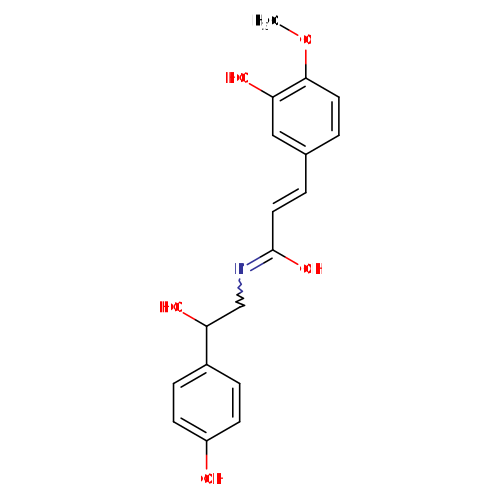
| Common Name | (2e)-n-[2-hydroxy-2-(4-hydroxyphenyl)ethyl]-3-(3-hydroxy-4-methoxyphenyl)prop-2-enimidic acid |
|---|
| Description | Trans-N-Feruloyloctopamine belongs to the class of organic compounds known as hydroxycinnamic acids and derivatives. Hydroxycinnamic acids and derivatives are compounds containing an cinnamic acid (or a derivative thereof) where the benzene ring is hydroxylated. (2e)-n-[2-hydroxy-2-(4-hydroxyphenyl)ethyl]-3-(3-hydroxy-4-methoxyphenyl)prop-2-enimidic acid is found in Lycium chinense and Solanum myriacanthum. (2e)-n-[2-hydroxy-2-(4-hydroxyphenyl)ethyl]-3-(3-hydroxy-4-methoxyphenyl)prop-2-enimidic acid was first documented in 2004 (PMID: 15266117). Based on a literature review a small amount of articles have been published on Trans-N-Feruloyloctopamine (PMID: 16989538) (PMID: 31909232). |
|---|
| Structure | COC1=CC=C(\C=C\C(O)=NCC(O)C2=CC=C(O)C=C2)C=C1O InChI=1S/C18H19NO5/c1-24-17-8-2-12(10-15(17)21)3-9-18(23)19-11-16(22)13-4-6-14(20)7-5-13/h2-10,16,20-22H,11H2,1H3,(H,19,23)/b9-3+ |
|---|
| Synonyms | Not Available |
|---|
| Chemical Formula | C18H19NO5 |
|---|
| Average Mass | 329.3520 Da |
|---|
| Monoisotopic Mass | 329.12632 Da |
|---|
| IUPAC Name | (2E)-N-[2-hydroxy-2-(4-hydroxyphenyl)ethyl]-3-(3-hydroxy-4-methoxyphenyl)prop-2-enimidic acid |
|---|
| Traditional Name | (2E)-N-[2-hydroxy-2-(4-hydroxyphenyl)ethyl]-3-(3-hydroxy-4-methoxyphenyl)prop-2-enimidic acid |
|---|
| CAS Registry Number | Not Available |
|---|
| SMILES | COC1=CC=C(\C=C\C(O)=NCC(O)C2=CC=C(O)C=C2)C=C1O |
|---|
| InChI Identifier | InChI=1S/C18H19NO5/c1-24-17-8-2-12(10-15(17)21)3-9-18(23)19-11-16(22)13-4-6-14(20)7-5-13/h2-10,16,20-22H,11H2,1H3,(H,19,23)/b9-3+ |
|---|
| InChI Key | YMUNILWOTSCYLI-YCRREMRBSA-N |
|---|
| Experimental Spectra |
|---|
|
| Not Available | | Predicted Spectra |
|---|
|
| | Spectrum Type | Description | Depositor ID | Depositor Organization | Depositor | Deposition Date | View |
|---|
| 1D NMR | 13C NMR Spectrum (1D, 25 MHz, H2O, predicted) | Wishart Lab | Wishart Lab | David Wishart | 2021-06-20 | View Spectrum | | 1D NMR | 1H NMR Spectrum (1D, 100 MHz, H2O, predicted) | Wishart Lab | Wishart Lab | David Wishart | 2021-06-20 | View Spectrum | | 1D NMR | 13C NMR Spectrum (1D, 252 MHz, H2O, predicted) | Wishart Lab | Wishart Lab | David Wishart | 2021-06-20 | View Spectrum | | 1D NMR | 1H NMR Spectrum (1D, 1000 MHz, H2O, predicted) | Wishart Lab | Wishart Lab | David Wishart | 2021-06-20 | View Spectrum | | 1D NMR | 13C NMR Spectrum (1D, 50 MHz, H2O, predicted) | Wishart Lab | Wishart Lab | David Wishart | 2021-06-20 | View Spectrum | | 1D NMR | 1H NMR Spectrum (1D, 200 MHz, H2O, predicted) | Wishart Lab | Wishart Lab | David Wishart | 2021-06-20 | View Spectrum | | 1D NMR | 13C NMR Spectrum (1D, 75 MHz, H2O, predicted) | Wishart Lab | Wishart Lab | David Wishart | 2021-06-20 | View Spectrum | | 1D NMR | 1H NMR Spectrum (1D, 300 MHz, H2O, predicted) | Wishart Lab | Wishart Lab | David Wishart | 2021-06-20 | View Spectrum | | 1D NMR | 13C NMR Spectrum (1D, 101 MHz, H2O, predicted) | Wishart Lab | Wishart Lab | David Wishart | 2021-06-20 | View Spectrum | | 1D NMR | 1H NMR Spectrum (1D, 400 MHz, H2O, predicted) | Wishart Lab | Wishart Lab | David Wishart | 2021-06-20 | View Spectrum | | 1D NMR | 13C NMR Spectrum (1D, 126 MHz, H2O, predicted) | Wishart Lab | Wishart Lab | David Wishart | 2021-06-20 | View Spectrum | | 1D NMR | 1H NMR Spectrum (1D, 500 MHz, H2O, predicted) | Wishart Lab | Wishart Lab | David Wishart | 2021-06-20 | View Spectrum | | 1D NMR | 13C NMR Spectrum (1D, 151 MHz, H2O, predicted) | Wishart Lab | Wishart Lab | David Wishart | 2021-06-20 | View Spectrum | | 1D NMR | 1H NMR Spectrum (1D, 600 MHz, H2O, predicted) | Wishart Lab | Wishart Lab | David Wishart | 2021-06-20 | View Spectrum | | 1D NMR | 13C NMR Spectrum (1D, 176 MHz, H2O, predicted) | Wishart Lab | Wishart Lab | David Wishart | 2021-06-20 | View Spectrum | | 1D NMR | 1H NMR Spectrum (1D, 700 MHz, H2O, predicted) | Wishart Lab | Wishart Lab | David Wishart | 2021-06-20 | View Spectrum | | 1D NMR | 13C NMR Spectrum (1D, 201 MHz, H2O, predicted) | Wishart Lab | Wishart Lab | David Wishart | 2021-06-20 | View Spectrum | | 1D NMR | 1H NMR Spectrum (1D, 800 MHz, H2O, predicted) | Wishart Lab | Wishart Lab | David Wishart | 2021-06-20 | View Spectrum | | 1D NMR | 13C NMR Spectrum (1D, 226 MHz, H2O, predicted) | Wishart Lab | Wishart Lab | David Wishart | 2021-06-20 | View Spectrum | | 1D NMR | 1H NMR Spectrum (1D, 900 MHz, H2O, predicted) | Wishart Lab | Wishart Lab | David Wishart | 2021-06-20 | View Spectrum |
| | Chemical Shift Submissions |
|---|
|
| Not Available | | Species |
|---|
| Species of Origin | |
|---|
| Chemical Taxonomy |
|---|
| Description | Belongs to the class of organic compounds known as hydroxycinnamic acids and derivatives. Hydroxycinnamic acids and derivatives are compounds containing an cinnamic acid (or a derivative thereof) where the benzene ring is hydroxylated. |
|---|
| Kingdom | Organic compounds |
|---|
| Super Class | Phenylpropanoids and polyketides |
|---|
| Class | Cinnamic acids and derivatives |
|---|
| Sub Class | Hydroxycinnamic acids and derivatives |
|---|
| Direct Parent | Hydroxycinnamic acids and derivatives |
|---|
| Alternative Parents | |
|---|
| Substituents | - Cinnamic acid amide
- Hydroxycinnamic acid or derivatives
- Methoxyphenol
- Anisole
- Phenoxy compound
- Phenol ether
- Styrene
- Methoxybenzene
- 1-hydroxy-2-unsubstituted benzenoid
- Alkyl aryl ether
- 1-hydroxy-4-unsubstituted benzenoid
- Phenol
- Benzenoid
- Monocyclic benzene moiety
- Secondary alcohol
- Secondary carboxylic acid amide
- Carboxamide group
- Carboxylic acid derivative
- Ether
- Hydrocarbon derivative
- Organic oxygen compound
- Organic nitrogen compound
- Organic oxide
- Organonitrogen compound
- Carbonyl group
- Organooxygen compound
- Alcohol
- Aromatic alcohol
- Aromatic homomonocyclic compound
|
|---|
| Molecular Framework | Aromatic homomonocyclic compounds |
|---|
| External Descriptors | Not Available |
|---|
| Physical Properties |
|---|
| State | Not Available |
|---|
| Experimental Properties | | Property | Value | Reference |
|---|
| Melting Point | Not Available | Not Available | | Boiling Point | Not Available | Not Available | | Water Solubility | Not Available | Not Available | | LogP | Not Available | Not Available |
|
|---|
| Predicted Properties | |
|---|
| General References | - Oueslati MH, Ben Jannet H, Mighri Z, Chriaa J, Abreu PM: Phytochemical constituents from Salsola tetrandra. J Nat Prod. 2006 Sep;69(9):1366-9. doi: 10.1021/np060222w. [PubMed:16989538 ]
- Lee DG, Park Y, Kim MR, Jung HJ, Seu YB, Hahm KS, Woo ER: Anti-fungal effects of phenolic amides isolated from the root bark of Lycium chinense. Biotechnol Lett. 2004 Jul;26(14):1125-30. doi: 10.1023/B:BILE.0000035483.85790.f7. [PubMed:15266117 ]
- Yalamanchili C, Chittiboyina AG, Haider S, Vasquez Y, Khan S, do Carmo JM, da Silva AA, Pinkerton M, Hall JE, Walker LA, Khan IA: In search for potential antidiabetic compounds from natural sources: docking, synthesis and biological screening of small molecules from Lycium spp. (Goji). Heliyon. 2019 Dec 27;6(1):e02782. doi: 10.1016/j.heliyon.2019.e02782. eCollection 2020 Jan. [PubMed:31909232 ]
- LOTUS database [Link]
|
|---|