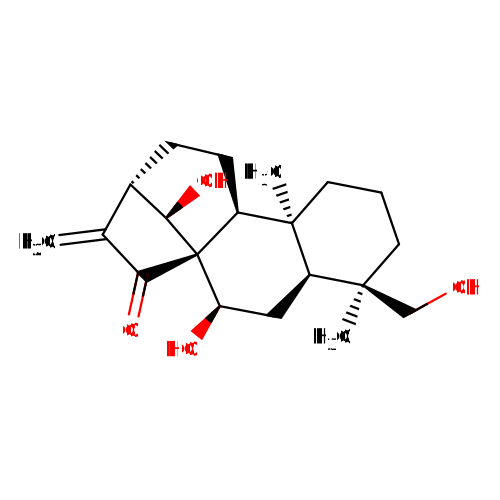
| Record Information |
|---|
| Version | 2.0 |
|---|
| Created at | 2022-09-09 23:15:51 UTC |
|---|
| Updated at | 2022-09-09 23:15:51 UTC |
|---|
| NP-MRD ID | NP0291962 |
|---|
| Secondary Accession Numbers | None |
|---|
| Natural Product Identification |
|---|
| Common Name | (1r,2r,4s,5s,9r,10s,13s,16r)-2,16-dihydroxy-5-(hydroxymethyl)-5,9-dimethyl-14-methylidenetetracyclo[11.2.1.0¹,¹⁰.0⁴,⁹]hexadecan-15-one |
|---|
| Description | Excisanin belongs to the class of organic compounds known as kaurane diterpenoids. These are diterpene alkaloids with a structure that is based on the kaurane skeleton. Kaurane is a tetracyclic compound that arises by cyclisation of a pimarane precursor followed by rearrangement. It possesses a [3,2,1]-bicyclic ring system with C15-C16 bridge connected to C13, forming the five-membered ring D. (1r,2r,4s,5s,9r,10s,13s,16r)-2,16-dihydroxy-5-(hydroxymethyl)-5,9-dimethyl-14-methylidenetetracyclo[11.2.1.0¹,¹⁰.0⁴,⁹]hexadecan-15-one is found in Croton kongensis, Isodon albopilosus, Isodon excisus and Isodon wikstroemioides. (1r,2r,4s,5s,9r,10s,13s,16r)-2,16-dihydroxy-5-(hydroxymethyl)-5,9-dimethyl-14-methylidenetetracyclo[11.2.1.0¹,¹⁰.0⁴,⁹]hexadecan-15-one was first documented in 2008 (PMID: 18491868). Based on a literature review a small amount of articles have been published on Excisanin (PMID: 35339903) (PMID: 19023532) (PMID: 24044886) (PMID: 22982090). |
|---|
| Structure | C[C@]1(CO)CCC[C@@]2(C)[C@@H]3CC[C@@H]4[C@@H](O)[C@@]3([C@H](O)C[C@H]12)C(=O)C4=C InChI=1S/C20H30O4/c1-11-12-5-6-13-19(3)8-4-7-18(2,10-21)14(19)9-15(22)20(13,16(11)23)17(12)24/h12-15,17,21-22,24H,1,4-10H2,2-3H3/t12-,13-,14+,15+,17+,18+,19-,20-/m0/s1 |
|---|
| Synonyms | Not Available |
|---|
| Chemical Formula | C20H30O4 |
|---|
| Average Mass | 334.4560 Da |
|---|
| Monoisotopic Mass | 334.21441 Da |
|---|
| IUPAC Name | Not Available |
|---|
| Traditional Name | Not Available |
|---|
| CAS Registry Number | Not Available |
|---|
| SMILES | C[C@]1(CO)CCC[C@@]2(C)[C@@H]3CC[C@@H]4[C@@H](O)[C@@]3([C@H](O)C[C@H]12)C(=O)C4=C |
|---|
| InChI Identifier | InChI=1S/C20H30O4/c1-11-12-5-6-13-19(3)8-4-7-18(2,10-21)14(19)9-15(22)20(13,16(11)23)17(12)24/h12-15,17,21-22,24H,1,4-10H2,2-3H3/t12-,13-,14+,15+,17+,18+,19-,20-/m0/s1 |
|---|
| InChI Key | NAXAHKFDLHFVHY-YNDYFHGHSA-N |
|---|
| Experimental Spectra |
|---|
|
| Not Available | | Predicted Spectra |
|---|
|
| | Spectrum Type | Description | Depositor ID | Depositor Organization | Depositor | Deposition Date | View |
|---|
| 1D NMR | 13C NMR Spectrum (1D, 25 MHz, H2O, predicted) | Wishart Lab | Wishart Lab | David Wishart | 2021-06-20 | View Spectrum | | 1D NMR | 1H NMR Spectrum (1D, 100 MHz, H2O, predicted) | Wishart Lab | Wishart Lab | David Wishart | 2021-06-20 | View Spectrum | | 1D NMR | 13C NMR Spectrum (1D, 252 MHz, H2O, predicted) | Wishart Lab | Wishart Lab | David Wishart | 2021-06-20 | View Spectrum | | 1D NMR | 1H NMR Spectrum (1D, 1000 MHz, H2O, predicted) | Wishart Lab | Wishart Lab | David Wishart | 2021-06-20 | View Spectrum | | 1D NMR | 13C NMR Spectrum (1D, 50 MHz, H2O, predicted) | Wishart Lab | Wishart Lab | David Wishart | 2021-06-20 | View Spectrum | | 1D NMR | 1H NMR Spectrum (1D, 200 MHz, H2O, predicted) | Wishart Lab | Wishart Lab | David Wishart | 2021-06-20 | View Spectrum | | 1D NMR | 13C NMR Spectrum (1D, 75 MHz, H2O, predicted) | Wishart Lab | Wishart Lab | David Wishart | 2021-06-20 | View Spectrum | | 1D NMR | 1H NMR Spectrum (1D, 300 MHz, H2O, predicted) | Wishart Lab | Wishart Lab | David Wishart | 2021-06-20 | View Spectrum | | 1D NMR | 13C NMR Spectrum (1D, 101 MHz, H2O, predicted) | Wishart Lab | Wishart Lab | David Wishart | 2021-06-20 | View Spectrum | | 1D NMR | 1H NMR Spectrum (1D, 400 MHz, H2O, predicted) | Wishart Lab | Wishart Lab | David Wishart | 2021-06-20 | View Spectrum | | 1D NMR | 13C NMR Spectrum (1D, 126 MHz, H2O, predicted) | Wishart Lab | Wishart Lab | David Wishart | 2021-06-20 | View Spectrum | | 1D NMR | 1H NMR Spectrum (1D, 500 MHz, H2O, predicted) | Wishart Lab | Wishart Lab | David Wishart | 2021-06-20 | View Spectrum | | 1D NMR | 13C NMR Spectrum (1D, 151 MHz, H2O, predicted) | Wishart Lab | Wishart Lab | David Wishart | 2021-06-20 | View Spectrum | | 1D NMR | 1H NMR Spectrum (1D, 600 MHz, H2O, predicted) | Wishart Lab | Wishart Lab | David Wishart | 2021-06-20 | View Spectrum | | 1D NMR | 13C NMR Spectrum (1D, 176 MHz, H2O, predicted) | Wishart Lab | Wishart Lab | David Wishart | 2021-06-20 | View Spectrum | | 1D NMR | 1H NMR Spectrum (1D, 700 MHz, H2O, predicted) | Wishart Lab | Wishart Lab | David Wishart | 2021-06-20 | View Spectrum | | 1D NMR | 13C NMR Spectrum (1D, 201 MHz, H2O, predicted) | Wishart Lab | Wishart Lab | David Wishart | 2021-06-20 | View Spectrum | | 1D NMR | 1H NMR Spectrum (1D, 800 MHz, H2O, predicted) | Wishart Lab | Wishart Lab | David Wishart | 2021-06-20 | View Spectrum | | 1D NMR | 13C NMR Spectrum (1D, 226 MHz, H2O, predicted) | Wishart Lab | Wishart Lab | David Wishart | 2021-06-20 | View Spectrum | | 1D NMR | 1H NMR Spectrum (1D, 900 MHz, H2O, predicted) | Wishart Lab | Wishart Lab | David Wishart | 2021-06-20 | View Spectrum |
| | Chemical Shift Submissions |
|---|
|
| Not Available | | Species |
|---|
| Species of Origin | |
|---|
| Chemical Taxonomy |
|---|
| Description | Belongs to the class of organic compounds known as kaurane diterpenoids. These are diterpene alkaloids with a structure that is based on the kaurane skeleton. Kaurane is a tetracyclic compound that arises by cyclisation of a pimarane precursor followed by rearrangement. It possesses a [3,2,1]-bicyclic ring system with C15-C16 bridge connected to C13, forming the five-membered ring D. |
|---|
| Kingdom | Organic compounds |
|---|
| Super Class | Lipids and lipid-like molecules |
|---|
| Class | Prenol lipids |
|---|
| Sub Class | Diterpenoids |
|---|
| Direct Parent | Kaurane diterpenoids |
|---|
| Alternative Parents | |
|---|
| Substituents | - Kaurane diterpenoid
- Cyclic alcohol
- Secondary alcohol
- Ketone
- Organic oxygen compound
- Organic oxide
- Hydrocarbon derivative
- Primary alcohol
- Organooxygen compound
- Carbonyl group
- Alcohol
- Aliphatic homopolycyclic compound
|
|---|
| Molecular Framework | Aliphatic homopolycyclic compounds |
|---|
| External Descriptors | Not Available |
|---|
| Physical Properties |
|---|
| State | Not Available |
|---|
| Experimental Properties | | Property | Value | Reference |
|---|
| Melting Point | Not Available | Not Available | | Boiling Point | Not Available | Not Available | | Water Solubility | Not Available | Not Available | | LogP | Not Available | Not Available |
|
|---|
| Predicted Properties | |
|---|
| General References | - Hong SS, Lee SA, Han XH, Hwang JS, Lee C, Lee D, Hong JT, Kim Y, Lee H, Hwang BY: ent-Kaurane diterpenoids from Isodon japonicus. J Nat Prod. 2008 Jun;71(6):1055-8. doi: 10.1021/np0705965. Epub 2008 May 21. [PubMed:18491868 ]
- El-Ashrey MK, Bakr RO, Fayed MAA, Refaey RH, Nissan YM: Pharmacophore based virtual screening for natural product database revealed possible inhibitors for SARS-COV-2 main protease. Virology. 2022 May;570:18-28. doi: 10.1016/j.virol.2022.03.003. Epub 2022 Mar 22. [PubMed:35339903 ]
- Lee C, Hong SS, Han XH, Jin Q, Li D, Kim TO, Kim HK, Lee J, Kwon SH, Kim YB, Lee MK, Hwang BY: A new abietane diterpenoid from Isodon inflexus. Arch Pharm Res. 2008 Nov;31(11):1381-4. doi: 10.1007/s12272-001-2120-3. Epub 2008 Nov 21. [PubMed:19023532 ]
- Qin J, Tang J, Jiao L, Ji J, Chen WD, Feng GK, Gao YH, Zhu XF, Deng R: A diterpenoid compound, excisanin A, inhibits the invasive behavior of breast cancer cells by modulating the integrin beta1/FAK/PI3K/AKT/beta-catenin signaling. Life Sci. 2013 Nov 4;93(18-19):655-63. doi: 10.1016/j.lfs.2013.09.002. Epub 2013 Sep 14. [PubMed:24044886 ]
- Zhang XY, Wu XQ, Deng R, Sun T, Feng GK, Zhu XF: Upregulation of sestrin 2 expression via JNK pathway activation contributes to autophagy induction in cancer cells. Cell Signal. 2013 Jan;25(1):150-8. doi: 10.1016/j.cellsig.2012.09.004. Epub 2012 Sep 7. [PubMed:22982090 ]
- LOTUS database [Link]
|
|---|