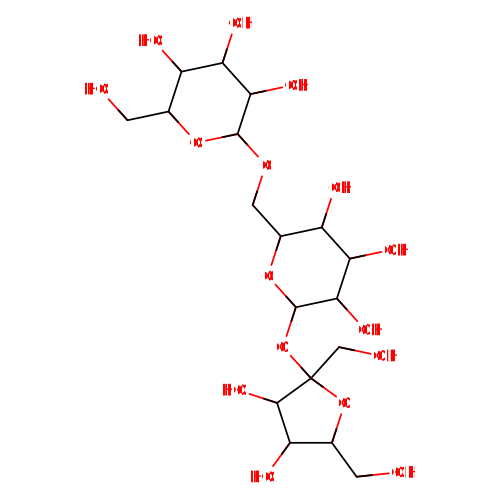
| Record Information |
|---|
| Version | 2.0 |
|---|
| Created at | 2022-09-09 17:20:58 UTC |
|---|
| Updated at | 2022-09-09 17:20:58 UTC |
|---|
| NP-MRD ID | NP0287876 |
|---|
| Secondary Accession Numbers | None |
|---|
| Natural Product Identification |
|---|
| Common Name | 2-[(6-{[3,4-dihydroxy-2,5-bis(hydroxymethyl)oxolan-2-yl]oxy}-3,4,5-trihydroxyoxan-2-yl)methoxy]-6-(hydroxymethyl)oxane-3,4,5-triol |
|---|
| Description | Raffinose belongs to the class of organic compounds known as oligosaccharides. These are carbohydrates made up of 3 to 10 monosaccharide units linked to each other through glycosidic bonds. Raffinose is an extremely weak basic (essentially neutral) compound (based on its pKa). Within humans, raffinose participates in a number of enzymatic reactions. In particular, raffinose and D-galactose can be biosynthesized from stachyose; which is mediated by the enzyme Alpha-galactosidase a. In addition, raffinose can be converted into sucrose and D-galactose through the action of the enzyme Alpha-galactosidase a. The enzyme does not cleave β-linked galactose, as in lactose. In humans, raffinose is involved in galactose metabolism. Outside of the human body, Raffinose is found, on average, in the highest concentration within a few different foods, such as ginkgo nuts, soy beans, and mung beans and in a lower concentration in gram beans, dates, and coconuts. Raffinose has also been detected, but not quantified in, several different foods, such as summer savories, mexican groundcherries, summer grapes, american cranberries, and common hazelnuts. This could make raffinose a potential biomarker for the consumption of these foods. Either raffinose or sucrose is used as a base substance for sucralose. Raffinose is a trisaccharide composed of galactose, glucose, and fructose. These oligosaccharides pass undigested through the stomach and upper intestine. The raffinose family of oligosaccharides (RFOs) are alpha-galactosyl derivatives of sucrose, and the most common are the trisaccharide raffinose, the tetrasaccharide stachyose, and the pentasaccharide verbascose. In the lower intestine, they are fermented by gas-producing bacteria that do possess the α-GAL enzyme and make short-chain fatty acids (SCFA)(acetic, propionic, butyric acids) commonly associated with eating beans and other vegetables. 2-[(6-{[3,4-dihydroxy-2,5-bis(hydroxymethyl)oxolan-2-yl]oxy}-3,4,5-trihydroxyoxan-2-yl)methoxy]-6-(hydroxymethyl)oxane-3,4,5-triol is found in Arabidopsis thaliana, Origanum vulgare, Rehmannia glutinosa and Salacia oblonga. Raffinose can be hydrolyzed to D-galactose and sucrose by the enzyme α-galactosidase (α-GAL), an enzyme not found in the human digestive tract. |
|---|
| Structure | OCC1OC(CO)(OC2OC(COC3OC(CO)C(O)C(O)C3O)C(O)C(O)C2O)C(O)C1O InChI=1S/C18H32O16/c19-1-5-8(22)11(25)13(27)16(31-5)30-3-7-9(23)12(26)14(28)17(32-7)34-18(4-21)15(29)10(24)6(2-20)33-18/h5-17,19-29H,1-4H2 |
|---|
| Synonyms | | Value | Source |
|---|
| b-D-Fructofuranosyl O-b-D-glucopyranosyl-(1->6)-a-D-glucopyranoside, 9ci, 8ci | HMDB | | b-D-Glucopyranosyl-(1->6)-a-D-glucopyranosyl-(1->2)-b-D-fructofuranoside | HMDB | | beta-D-GLCP-(1->6)-alpha-D-GLCP-(12)-beta-D-fruf | HMDB |
|
|---|
| Chemical Formula | C18H32O16 |
|---|
| Average Mass | 504.4371 Da |
|---|
| Monoisotopic Mass | 504.16903 Da |
|---|
| IUPAC Name | 2-[(6-{[3,4-dihydroxy-2,5-bis(hydroxymethyl)oxolan-2-yl]oxy}-3,4,5-trihydroxyoxan-2-yl)methoxy]-6-(hydroxymethyl)oxane-3,4,5-triol |
|---|
| Traditional Name | 2-[(6-{[3,4-dihydroxy-2,5-bis(hydroxymethyl)oxolan-2-yl]oxy}-3,4,5-trihydroxyoxan-2-yl)methoxy]-6-(hydroxymethyl)oxane-3,4,5-triol |
|---|
| CAS Registry Number | Not Available |
|---|
| SMILES | OCC1OC(CO)(OC2OC(COC3OC(CO)C(O)C(O)C3O)C(O)C(O)C2O)C(O)C1O |
|---|
| InChI Identifier | InChI=1S/C18H32O16/c19-1-5-8(22)11(25)13(27)16(31-5)30-3-7-9(23)12(26)14(28)17(32-7)34-18(4-21)15(29)10(24)6(2-20)33-18/h5-17,19-29H,1-4H2 |
|---|
| InChI Key | MUPFEKGTMRGPLJ-UHFFFAOYSA-N |
|---|
| Experimental Spectra |
|---|
|
| Not Available | | Predicted Spectra |
|---|
|
| | Spectrum Type | Description | Depositor ID | Depositor Organization | Depositor | Deposition Date | View |
|---|
| 1D NMR | 13C NMR Spectrum (1D, 25 MHz, H2O, predicted) | Wishart Lab | Wishart Lab | David Wishart | 2021-06-20 | View Spectrum | | 1D NMR | 1H NMR Spectrum (1D, 100 MHz, H2O, predicted) | Wishart Lab | Wishart Lab | David Wishart | 2021-06-20 | View Spectrum | | 1D NMR | 13C NMR Spectrum (1D, 252 MHz, H2O, predicted) | Wishart Lab | Wishart Lab | David Wishart | 2021-06-20 | View Spectrum | | 1D NMR | 1H NMR Spectrum (1D, 1000 MHz, H2O, predicted) | Wishart Lab | Wishart Lab | David Wishart | 2021-06-20 | View Spectrum | | 1D NMR | 13C NMR Spectrum (1D, 50 MHz, H2O, predicted) | Wishart Lab | Wishart Lab | David Wishart | 2021-06-20 | View Spectrum | | 1D NMR | 1H NMR Spectrum (1D, 200 MHz, H2O, predicted) | Wishart Lab | Wishart Lab | David Wishart | 2021-06-20 | View Spectrum | | 1D NMR | 13C NMR Spectrum (1D, 75 MHz, H2O, predicted) | Wishart Lab | Wishart Lab | David Wishart | 2021-06-20 | View Spectrum | | 1D NMR | 1H NMR Spectrum (1D, 300 MHz, H2O, predicted) | Wishart Lab | Wishart Lab | David Wishart | 2021-06-20 | View Spectrum | | 1D NMR | 13C NMR Spectrum (1D, 101 MHz, H2O, predicted) | Wishart Lab | Wishart Lab | David Wishart | 2021-06-20 | View Spectrum | | 1D NMR | 1H NMR Spectrum (1D, 400 MHz, H2O, predicted) | Wishart Lab | Wishart Lab | David Wishart | 2021-06-20 | View Spectrum | | 1D NMR | 13C NMR Spectrum (1D, 126 MHz, H2O, predicted) | Wishart Lab | Wishart Lab | David Wishart | 2021-06-20 | View Spectrum | | 1D NMR | 1H NMR Spectrum (1D, 500 MHz, H2O, predicted) | Wishart Lab | Wishart Lab | David Wishart | 2021-06-20 | View Spectrum | | 1D NMR | 13C NMR Spectrum (1D, 151 MHz, H2O, predicted) | Wishart Lab | Wishart Lab | David Wishart | 2021-06-20 | View Spectrum | | 1D NMR | 1H NMR Spectrum (1D, 600 MHz, H2O, predicted) | Wishart Lab | Wishart Lab | David Wishart | 2021-06-20 | View Spectrum | | 1D NMR | 13C NMR Spectrum (1D, 176 MHz, H2O, predicted) | Wishart Lab | Wishart Lab | David Wishart | 2021-06-20 | View Spectrum | | 1D NMR | 1H NMR Spectrum (1D, 700 MHz, H2O, predicted) | Wishart Lab | Wishart Lab | David Wishart | 2021-06-20 | View Spectrum | | 1D NMR | 13C NMR Spectrum (1D, 201 MHz, H2O, predicted) | Wishart Lab | Wishart Lab | David Wishart | 2021-06-20 | View Spectrum | | 1D NMR | 1H NMR Spectrum (1D, 800 MHz, H2O, predicted) | Wishart Lab | Wishart Lab | David Wishart | 2021-06-20 | View Spectrum | | 1D NMR | 13C NMR Spectrum (1D, 226 MHz, H2O, predicted) | Wishart Lab | Wishart Lab | David Wishart | 2021-06-20 | View Spectrum | | 1D NMR | 1H NMR Spectrum (1D, 900 MHz, H2O, predicted) | Wishart Lab | Wishart Lab | David Wishart | 2021-06-20 | View Spectrum |
| | Chemical Shift Submissions |
|---|
|
| Not Available | | Species |
|---|
| Species of Origin | |
|---|
| Chemical Taxonomy |
|---|
| Description | Belongs to the class of organic compounds known as oligosaccharides. These are carbohydrates made up of 3 to 10 monosaccharide units linked to each other through glycosidic bonds. |
|---|
| Kingdom | Organic compounds |
|---|
| Super Class | Organic oxygen compounds |
|---|
| Class | Organooxygen compounds |
|---|
| Sub Class | Carbohydrates and carbohydrate conjugates |
|---|
| Direct Parent | Oligosaccharides |
|---|
| Alternative Parents | |
|---|
| Substituents | - Oligosaccharide
- C-glycosyl compound
- Glycosyl compound
- O-glycosyl compound
- Ketal
- Oxane
- Tetrahydrofuran
- Secondary alcohol
- Acetal
- Oxacycle
- Organoheterocyclic compound
- Polyol
- Alcohol
- Primary alcohol
- Hydrocarbon derivative
- Aliphatic heteromonocyclic compound
|
|---|
| Molecular Framework | Aliphatic heteromonocyclic compounds |
|---|
| External Descriptors | |
|---|
| Physical Properties |
|---|
| State | Not Available |
|---|
| Experimental Properties | | Property | Value | Reference |
|---|
| Melting Point | Not Available | Not Available | | Boiling Point | Not Available | Not Available | | Water Solubility | Not Available | Not Available | | LogP | Not Available | Not Available |
|
|---|
| Predicted Properties | |
|---|