| Record Information |
|---|
| Version | 2.0 |
|---|
| Created at | 2022-09-09 15:31:03 UTC |
|---|
| Updated at | 2022-09-09 15:31:03 UTC |
|---|
| NP-MRD ID | NP0286778 |
|---|
| Secondary Accession Numbers | None |
|---|
| Natural Product Identification |
|---|
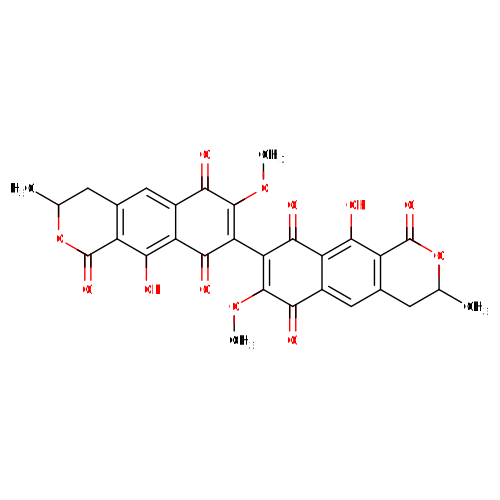
| Common Name | 10-hydroxy-8-{10-hydroxy-7-methoxy-3-methyl-1,6,9-trioxo-3h,4h-naphtho[2,3-c]pyran-8-yl}-7-methoxy-3-methyl-3h,4h-naphtho[2,3-c]pyran-1,6,9-trione |
|---|
| Description | Xanthomegnin belongs to the class of organic compounds known as isochromanequinones. These are polycyclic compounds containing an isochromanequinone, which is structurally characterized by a quinone fused to an isochromane, and forming a naphtho[2,3-c]pyran-6,9-dione skeleton. In humans and animals, oral intake of xanthomegnin leads to kidney and liver abnormalities, often first presenting as jaundice. Xanthomegnin is an extremely weak basic (essentially neutral) compound (based on its pKa). Xanthomegnin is a potentially toxic compound. Xanthomegnin is a mutagenic mycotoxin isolated from Penicillium citreo-viride. It is known to cause nephropathy and death in farm animals exposed to food-borne Penicillium (and Aspergillus fungi). Death may result. 10-hydroxy-8-{10-hydroxy-7-methoxy-3-methyl-1,6,9-trioxo-3h,4h-naphtho[2,3-c]pyran-8-yl}-7-methoxy-3-methyl-3h,4h-naphtho[2,3-c]pyran-1,6,9-trione is found in Aspergillus melleus and Penicillium viridicatum. The compound has been shown to interfere with cellular respiratory processes and has given positive results in tests for genotoxic potential. |
|---|
| Structure | COC1=C(C(=O)C2=C(O)C3=C(CC(C)OC3=O)C=C2C1=O)C1=C(OC)C(=O)C2=CC3=C(C(=O)OC(C)C3)C(O)=C2C1=O InChI=1S/C30H22O12/c1-9-5-11-7-13-17(23(33)15(11)29(37)41-9)25(35)19(27(39-3)21(13)31)20-26(36)18-14(22(32)28(20)40-4)8-12-6-10(2)42-30(38)16(12)24(18)34/h7-10,33-34H,5-6H2,1-4H3 |
|---|
| Synonyms | | Value | Source |
|---|
| 3,3'-Bis(2-methoxy-5-hydroxy-7-(2-hydroxypropyl)-8- carboxyl-1,4-naphthoquinone lactone) | MeSH |
|
|---|
| Chemical Formula | C30H22O12 |
|---|
| Average Mass | 574.4885 Da |
|---|
| Monoisotopic Mass | 574.11113 Da |
|---|
| IUPAC Name | 10-hydroxy-8-{10-hydroxy-7-methoxy-3-methyl-1,6,9-trioxo-1H,3H,4H,6H,9H-naphtho[2,3-c]pyran-8-yl}-7-methoxy-3-methyl-1H,3H,4H,6H,9H-naphtho[2,3-c]pyran-1,6,9-trione |
|---|
| Traditional Name | 10-hydroxy-8-{10-hydroxy-7-methoxy-3-methyl-1,6,9-trioxo-3H,4H-naphtho[2,3-c]pyran-8-yl}-7-methoxy-3-methyl-3H,4H-naphtho[2,3-c]pyran-1,6,9-trione |
|---|
| CAS Registry Number | Not Available |
|---|
| SMILES | COC1=C(C(=O)C2=C(O)C3=C(CC(C)OC3=O)C=C2C1=O)C1=C(OC)C(=O)C2=CC3=C(C(=O)OC(C)C3)C(O)=C2C1=O |
|---|
| InChI Identifier | InChI=1S/C30H22O12/c1-9-5-11-7-13-17(23(33)15(11)29(37)41-9)25(35)19(27(39-3)21(13)31)20-26(36)18-14(22(32)28(20)40-4)8-12-6-10(2)42-30(38)16(12)24(18)34/h7-10,33-34H,5-6H2,1-4H3 |
|---|
| InChI Key | WICHONPZVIYWIJ-UHFFFAOYSA-N |
|---|
| Experimental Spectra |
|---|
|
| Not Available | | Predicted Spectra |
|---|
|
| | Spectrum Type | Description | Depositor ID | Depositor Organization | Depositor | Deposition Date | View |
|---|
| 1D NMR | 13C NMR Spectrum (1D, 25 MHz, H2O, predicted) | Wishart Lab | Wishart Lab | David Wishart | 2021-06-20 | View Spectrum | | 1D NMR | 1H NMR Spectrum (1D, 100 MHz, H2O, predicted) | Wishart Lab | Wishart Lab | David Wishart | 2021-06-20 | View Spectrum | | 1D NMR | 13C NMR Spectrum (1D, 252 MHz, H2O, predicted) | Wishart Lab | Wishart Lab | David Wishart | 2021-06-20 | View Spectrum | | 1D NMR | 1H NMR Spectrum (1D, 1000 MHz, H2O, predicted) | Wishart Lab | Wishart Lab | David Wishart | 2021-06-20 | View Spectrum | | 1D NMR | 13C NMR Spectrum (1D, 50 MHz, H2O, predicted) | Wishart Lab | Wishart Lab | David Wishart | 2021-06-20 | View Spectrum | | 1D NMR | 1H NMR Spectrum (1D, 200 MHz, H2O, predicted) | Wishart Lab | Wishart Lab | David Wishart | 2021-06-20 | View Spectrum | | 1D NMR | 13C NMR Spectrum (1D, 75 MHz, H2O, predicted) | Wishart Lab | Wishart Lab | David Wishart | 2021-06-20 | View Spectrum | | 1D NMR | 1H NMR Spectrum (1D, 300 MHz, H2O, predicted) | Wishart Lab | Wishart Lab | David Wishart | 2021-06-20 | View Spectrum | | 1D NMR | 13C NMR Spectrum (1D, 101 MHz, H2O, predicted) | Wishart Lab | Wishart Lab | David Wishart | 2021-06-20 | View Spectrum | | 1D NMR | 1H NMR Spectrum (1D, 400 MHz, H2O, predicted) | Wishart Lab | Wishart Lab | David Wishart | 2021-06-20 | View Spectrum | | 1D NMR | 13C NMR Spectrum (1D, 126 MHz, H2O, predicted) | Wishart Lab | Wishart Lab | David Wishart | 2021-06-20 | View Spectrum | | 1D NMR | 1H NMR Spectrum (1D, 500 MHz, H2O, predicted) | Wishart Lab | Wishart Lab | David Wishart | 2021-06-20 | View Spectrum | | 1D NMR | 13C NMR Spectrum (1D, 151 MHz, H2O, predicted) | Wishart Lab | Wishart Lab | David Wishart | 2021-06-20 | View Spectrum | | 1D NMR | 1H NMR Spectrum (1D, 600 MHz, H2O, predicted) | Wishart Lab | Wishart Lab | David Wishart | 2021-06-20 | View Spectrum | | 1D NMR | 13C NMR Spectrum (1D, 176 MHz, H2O, predicted) | Wishart Lab | Wishart Lab | David Wishart | 2021-06-20 | View Spectrum | | 1D NMR | 1H NMR Spectrum (1D, 700 MHz, H2O, predicted) | Wishart Lab | Wishart Lab | David Wishart | 2021-06-20 | View Spectrum | | 1D NMR | 13C NMR Spectrum (1D, 201 MHz, H2O, predicted) | Wishart Lab | Wishart Lab | David Wishart | 2021-06-20 | View Spectrum | | 1D NMR | 1H NMR Spectrum (1D, 800 MHz, H2O, predicted) | Wishart Lab | Wishart Lab | David Wishart | 2021-06-20 | View Spectrum | | 1D NMR | 13C NMR Spectrum (1D, 226 MHz, H2O, predicted) | Wishart Lab | Wishart Lab | David Wishart | 2021-06-20 | View Spectrum | | 1D NMR | 1H NMR Spectrum (1D, 900 MHz, H2O, predicted) | Wishart Lab | Wishart Lab | David Wishart | 2021-06-20 | View Spectrum |
| | Chemical Shift Submissions |
|---|
|
| Not Available | | Species |
|---|
| Species of Origin | |
|---|
| Chemical Taxonomy |
|---|
| Description | Belongs to the class of organic compounds known as isochromanequinones. These are polycyclic compounds containing an isochromanequinone, which is structurally characterized by a quinone fused to an isochromane, and forming a naphtho[2,3-c]pyran-6,9-dione skeleton. |
|---|
| Kingdom | Organic compounds |
|---|
| Super Class | Phenylpropanoids and polyketides |
|---|
| Class | Isochromanequinones |
|---|
| Sub Class | Not Available |
|---|
| Direct Parent | Isochromanequinones |
|---|
| Alternative Parents | |
|---|
| Substituents | - Isochromanequinone
- Naphthopyranone
- Naphthopyran
- Naphthoquinone
- Benzopyran
- Isochromane
- Naphthalene
- 2-benzopyran
- Aryl ketone
- Quinone
- 1-hydroxy-4-unsubstituted benzenoid
- Pyranone
- Dicarboxylic acid or derivatives
- Benzenoid
- Pyran
- Vinylogous ester
- Vinylogous acid
- Lactone
- Ketone
- Carboxylic acid ester
- Organoheterocyclic compound
- Oxacycle
- Carboxylic acid derivative
- Hydrocarbon derivative
- Organic oxide
- Organic oxygen compound
- Organooxygen compound
- Aromatic heteropolycyclic compound
|
|---|
| Molecular Framework | Aromatic heteropolycyclic compounds |
|---|
| External Descriptors | Not Available |
|---|
| Physical Properties |
|---|
| State | Not Available |
|---|
| Experimental Properties | | Property | Value | Reference |
|---|
| Melting Point | Not Available | Not Available | | Boiling Point | Not Available | Not Available | | Water Solubility | Not Available | Not Available | | LogP | Not Available | Not Available |
|
|---|
| Predicted Properties | |
|---|