| Record Information |
|---|
| Version | 2.0 |
|---|
| Created at | 2022-09-09 14:55:15 UTC |
|---|
| Updated at | 2022-09-09 14:55:15 UTC |
|---|
| NP-MRD ID | NP0286375 |
|---|
| Secondary Accession Numbers | None |
|---|
| Natural Product Identification |
|---|
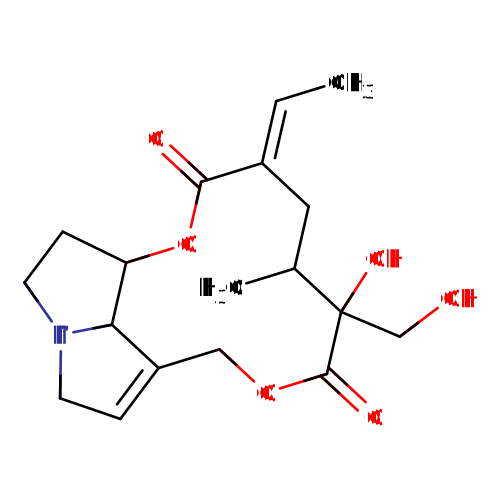
| Common Name | (4z)-4-ethylidene-7-hydroxy-7-(hydroxymethyl)-6-methyl-2,9-dioxa-14-azatricyclo[9.5.1.0¹⁴,¹⁷]heptadec-11-ene-3,8-dione |
|---|
| Description | RETRORSINE, also known as usaramine, belongs to the class of organic compounds known as macrolides and analogues. These are organic compounds containing a lactone ring of at least twelve members. (4z)-4-ethylidene-7-hydroxy-7-(hydroxymethyl)-6-methyl-2,9-dioxa-14-azatricyclo[9.5.1.0¹⁴,¹⁷]heptadec-11-ene-3,8-dione is found in Senecio brasiliensis. (4z)-4-ethylidene-7-hydroxy-7-(hydroxymethyl)-6-methyl-2,9-dioxa-14-azatricyclo[9.5.1.0¹⁴,¹⁷]heptadec-11-ene-3,8-dione was first documented in 2021 (PMID: 35024309). Based on a literature review a significant number of articles have been published on RETRORSINE (PMID: 35917946) (PMID: 35737038) (PMID: 35700647) (PMID: 35598524) (PMID: 35370657) (PMID: 34941681). |
|---|
| Structure | C\C=C1\CC(C)C(O)(CO)C(=O)OCC2=CCN3CCC(OC1=O)C23 InChI=1S/C18H25NO6/c1-3-12-8-11(2)18(23,10-20)17(22)24-9-13-4-6-19-7-5-14(15(13)19)25-16(12)21/h3-4,11,14-15,20,23H,5-10H2,1-2H3/b12-3- |
|---|
| Synonyms | | Value | Source |
|---|
| Retrorsine hydrochloride | MeSH | | Retrorsine, (15E)-isomer | MeSH | | Usaramine | MeSH |
|
|---|
| Chemical Formula | C18H25NO6 |
|---|
| Average Mass | 351.3990 Da |
|---|
| Monoisotopic Mass | 351.16819 Da |
|---|
| IUPAC Name | (4Z)-4-ethylidene-7-hydroxy-7-(hydroxymethyl)-6-methyl-2,9-dioxa-14-azatricyclo[9.5.1.0^{14,17}]heptadec-11-ene-3,8-dione |
|---|
| Traditional Name | (4Z)-4-ethylidene-7-hydroxy-7-(hydroxymethyl)-6-methyl-2,9-dioxa-14-azatricyclo[9.5.1.0^{14,17}]heptadec-11-ene-3,8-dione |
|---|
| CAS Registry Number | Not Available |
|---|
| SMILES | C\C=C1\CC(C)C(O)(CO)C(=O)OCC2=CCN3CCC(OC1=O)C23 |
|---|
| InChI Identifier | InChI=1S/C18H25NO6/c1-3-12-8-11(2)18(23,10-20)17(22)24-9-13-4-6-19-7-5-14(15(13)19)25-16(12)21/h3-4,11,14-15,20,23H,5-10H2,1-2H3/b12-3- |
|---|
| InChI Key | BCJMNZRQJAVDLD-BASWHVEKSA-N |
|---|
| Experimental Spectra |
|---|
|
| Not Available | | Predicted Spectra |
|---|
|
| | Spectrum Type | Description | Depositor ID | Depositor Organization | Depositor | Deposition Date | View |
|---|
| 1D NMR | 13C NMR Spectrum (1D, 25 MHz, H2O, predicted) | Wishart Lab | Wishart Lab | David Wishart | 2021-06-20 | View Spectrum | | 1D NMR | 1H NMR Spectrum (1D, 100 MHz, H2O, predicted) | Wishart Lab | Wishart Lab | David Wishart | 2021-06-20 | View Spectrum | | 1D NMR | 13C NMR Spectrum (1D, 252 MHz, H2O, predicted) | Wishart Lab | Wishart Lab | David Wishart | 2021-06-20 | View Spectrum | | 1D NMR | 1H NMR Spectrum (1D, 1000 MHz, H2O, predicted) | Wishart Lab | Wishart Lab | David Wishart | 2021-06-20 | View Spectrum | | 1D NMR | 13C NMR Spectrum (1D, 50 MHz, H2O, predicted) | Wishart Lab | Wishart Lab | David Wishart | 2021-06-20 | View Spectrum | | 1D NMR | 1H NMR Spectrum (1D, 200 MHz, H2O, predicted) | Wishart Lab | Wishart Lab | David Wishart | 2021-06-20 | View Spectrum | | 1D NMR | 13C NMR Spectrum (1D, 75 MHz, H2O, predicted) | Wishart Lab | Wishart Lab | David Wishart | 2021-06-20 | View Spectrum | | 1D NMR | 1H NMR Spectrum (1D, 300 MHz, H2O, predicted) | Wishart Lab | Wishart Lab | David Wishart | 2021-06-20 | View Spectrum | | 1D NMR | 13C NMR Spectrum (1D, 101 MHz, H2O, predicted) | Wishart Lab | Wishart Lab | David Wishart | 2021-06-20 | View Spectrum | | 1D NMR | 1H NMR Spectrum (1D, 400 MHz, H2O, predicted) | Wishart Lab | Wishart Lab | David Wishart | 2021-06-20 | View Spectrum | | 1D NMR | 13C NMR Spectrum (1D, 126 MHz, H2O, predicted) | Wishart Lab | Wishart Lab | David Wishart | 2021-06-20 | View Spectrum | | 1D NMR | 1H NMR Spectrum (1D, 500 MHz, H2O, predicted) | Wishart Lab | Wishart Lab | David Wishart | 2021-06-20 | View Spectrum | | 1D NMR | 13C NMR Spectrum (1D, 151 MHz, H2O, predicted) | Wishart Lab | Wishart Lab | David Wishart | 2021-06-20 | View Spectrum | | 1D NMR | 1H NMR Spectrum (1D, 600 MHz, H2O, predicted) | Wishart Lab | Wishart Lab | David Wishart | 2021-06-20 | View Spectrum | | 1D NMR | 13C NMR Spectrum (1D, 176 MHz, H2O, predicted) | Wishart Lab | Wishart Lab | David Wishart | 2021-06-20 | View Spectrum | | 1D NMR | 1H NMR Spectrum (1D, 700 MHz, H2O, predicted) | Wishart Lab | Wishart Lab | David Wishart | 2021-06-20 | View Spectrum | | 1D NMR | 13C NMR Spectrum (1D, 201 MHz, H2O, predicted) | Wishart Lab | Wishart Lab | David Wishart | 2021-06-20 | View Spectrum | | 1D NMR | 1H NMR Spectrum (1D, 800 MHz, H2O, predicted) | Wishart Lab | Wishart Lab | David Wishart | 2021-06-20 | View Spectrum | | 1D NMR | 13C NMR Spectrum (1D, 226 MHz, H2O, predicted) | Wishart Lab | Wishart Lab | David Wishart | 2021-06-20 | View Spectrum | | 1D NMR | 1H NMR Spectrum (1D, 900 MHz, H2O, predicted) | Wishart Lab | Wishart Lab | David Wishart | 2021-06-20 | View Spectrum |
| | Chemical Shift Submissions |
|---|
|
| Not Available | | Species |
|---|
| Species of Origin | |
|---|
| Chemical Taxonomy |
|---|
| Description | Belongs to the class of organic compounds known as macrolides and analogues. These are organic compounds containing a lactone ring of at least twelve members. |
|---|
| Kingdom | Organic compounds |
|---|
| Super Class | Phenylpropanoids and polyketides |
|---|
| Class | Macrolides and analogues |
|---|
| Sub Class | Not Available |
|---|
| Direct Parent | Macrolides and analogues |
|---|
| Alternative Parents | |
|---|
| Substituents | - Senecionan-skeleton
- Macrolide
- Alkaloid or derivatives
- Pyrrolizine
- Dicarboxylic acid or derivatives
- N-alkylpyrrolidine
- Pyrrolidine
- Pyrroline
- Tertiary alcohol
- Alpha,beta-unsaturated carboxylic ester
- Enoate ester
- 1,2-diol
- Amino acid or derivatives
- Carboxylic acid ester
- Lactone
- Tertiary amine
- Tertiary aliphatic amine
- Carboxylic acid derivative
- Oxacycle
- Azacycle
- Organoheterocyclic compound
- Primary alcohol
- Organooxygen compound
- Organonitrogen compound
- Organic oxide
- Organic nitrogen compound
- Organic oxygen compound
- Carbonyl group
- Hydrocarbon derivative
- Amine
- Alcohol
- Aliphatic heteropolycyclic compound
|
|---|
| Molecular Framework | Aliphatic heteropolycyclic compounds |
|---|
| External Descriptors | Not Available |
|---|
| Physical Properties |
|---|
| State | Not Available |
|---|
| Experimental Properties | | Property | Value | Reference |
|---|
| Melting Point | Not Available | Not Available | | Boiling Point | Not Available | Not Available | | Water Solubility | Not Available | Not Available | | LogP | Not Available | Not Available |
|
|---|
| Predicted Properties | |
|---|
| General References | - Li W, Cheng T, Jiang T, Zhou M, Gong B, Zhao G, Li J, Tan R, Yang X, Joshi K, Peng Y, Cheng M, Liu T, Wang DO, Zheng J: Hepatic RNA adduction derived from metabolic activation of retrorsine in vitro and in vivo. Chem Biol Interact. 2022 Sep 25;365:110047. doi: 10.1016/j.cbi.2022.110047. Epub 2022 Jul 30. [PubMed:35917946 ]
- Zhu L, Xue J, He Y, Xia Q, Fu PP, Lin G: Correlation Investigation between Pyrrole-DNA and Pyrrole-Protein Adducts in Male ICR Mice Exposed to Retrorsine, a Hepatotoxic Pyrrolizidine Alkaloid. Toxins (Basel). 2022 May 28;14(6):377. doi: 10.3390/toxins14060377. [PubMed:35737038 ]
- Xiao Y, Yi H, Wang G, Chen S, Li X, Wu Q, Zhang S, Deng K, He Y, Yang X: Electrochemiluminescence sensor for point-of-care detection of pyrrolizidine alkaloids. Talanta. 2022 Nov 1;249:123645. doi: 10.1016/j.talanta.2022.123645. Epub 2022 Jun 1. [PubMed:35700647 ]
- Wang Z, Ma J, He Y, Miu KK, Yao S, Tang C, Ye Y, Lin G: Nrf2-mediated liver protection by 18beta-glycyrrhetinic acid against pyrrolizidine alkaloid-induced toxicity through PI3K/Akt/GSK3beta pathway. Phytomedicine. 2022 Jul 20;102:154162. doi: 10.1016/j.phymed.2022.154162. Epub 2022 May 13. [PubMed:35598524 ]
- Wang Z, Ma J, Yao S, He Y, Miu KK, Xia Q, Fu PP, Ye Y, Lin G: Liquorice Extract and 18beta-Glycyrrhetinic Acid Protect Against Experimental Pyrrolizidine Alkaloid-Induced Hepatotoxicity in Rats Through Inhibiting Cytochrome P450-Mediated Metabolic Activation. Front Pharmacol. 2022 Mar 16;13:850859. doi: 10.3389/fphar.2022.850859. eCollection 2022. [PubMed:35370657 ]
- He Y, Ma J, Fan X, Ding L, Ding X, Zhang QY, Lin G: The key role of gut-liver axis in pyrrolizidine alkaloid-induced hepatotoxicity and enterotoxicity. Acta Pharm Sin B. 2021 Dec;11(12):3820-3835. doi: 10.1016/j.apsb.2021.07.013. Epub 2021 Jul 21. [PubMed:35024309 ]
- Pearson AJ, Nicolas JEF, Lancaster JE, Symes CW: Characterization and Lifetime Dietary Risk Assessment of Eighteen Pyrrolizidine Alkaloids and Pyrrolizidine Alkaloid N-Oxides in New Zealand Honey. Toxins (Basel). 2021 Nov 26;13(12):843. doi: 10.3390/toxins13120843. [PubMed:34941681 ]
- Naito Y, Yoshinouchi Y, Sorayama Y, Kohara H, Kitano S, Irie S, Matsusaki M: Constructing vascularized hepatic tissue by cell-assembled viscous tissue sedimentation method and its application for vascular toxicity assessment. Acta Biomater. 2022 Mar 1;140:275-288. doi: 10.1016/j.actbio.2021.11.027. Epub 2021 Nov 24. [PubMed:34826641 ]
- Enge AM, Kaltner F, Gottschalk C, Kin A, Kirstgen M, Geyer J, These A, Hammer H, Potz O, Braeuning A, Hessel-Pras S: Organic Cation Transporter I and Na(+) /taurocholate Co-Transporting Polypeptide are Involved in Retrorsine- and Senecionine-Induced Hepatotoxicity in HepaRG cells. Mol Nutr Food Res. 2022 Jan;66(2):e2100800. doi: 10.1002/mnfr.202100800. Epub 2021 Dec 11. [PubMed:34826203 ]
- Ma J, Zhang C, He Y, Chen X, Lin G: Fasting augments pyrrolizidine alkaloid-induced hepatotoxicity. Arch Toxicol. 2022 Feb;96(2):639-651. doi: 10.1007/s00204-021-03193-y. Epub 2021 Nov 18. [PubMed:34792613 ]
- Li J, Zhou M, Lai X, Wang Y, Zou Y, Li K, Li W, Zheng J: Toxicokinetic and bioavailability studies on retrorsine in mice, and ketoconazole-induced alteration in toxicokinetic properties. Biomed Chromatogr. 2022 Feb;36(2):e5270. doi: 10.1002/bmc.5270. Epub 2021 Nov 22. [PubMed:34727371 ]
- Snyman T, Crowther NJ: The Detection of Toxic Compounds in Extracts of Callilepis laureola (Oxeye Daisy) and Senecio latifolius (Ragwort) by Ultra-Performance Liquid Chromatography-Mass Spectrometry (UPLC-MS/MS). Methods Mol Biol. 2022;2343:381-393. doi: 10.1007/978-1-0716-1558-4_28. [PubMed:34473339 ]
- Zhu L, Zhang C, Zhang W, Xia Q, Ma J, He X, He Y, Fu PP, Jia W, Zhuge Y, Lin G: Developing urinary pyrrole-amino acid adducts as non-invasive biomarkers for identifying pyrrolizidine alkaloids-induced liver injury in human. Arch Toxicol. 2021 Oct;95(10):3191-3204. doi: 10.1007/s00204-021-03129-6. Epub 2021 Aug 14. [PubMed:34390356 ]
- Zhang L, Ge JY, Zheng YW, Sun Z, Wang C, Peng Z, Wu B, Fang M, Furuya K, Ma X, Shao Y, Ohkohchi N, Oda T, Fan J, Pan G, Li D, Hui L: Survival-Assured Liver Injury Preconditioning (SALIC) Enables Robust Expansion of Human Hepatocytes in Fah(-/-) Rag2(-/-) IL2rg(-/-) Rats. Adv Sci (Weinh). 2021 Oct;8(19):e2101188. doi: 10.1002/advs.202101188. Epub 2021 Aug 11. [PubMed:34382351 ]
- Guo L, Zhang L, Xu H, Yu P, Wang Z, Lu D, Chen M, Wu B: Diurnal hepatic CYP3A11 contributes to chronotoxicity of the pyrrolizidine alkaloid retrorsine in mice. Xenobiotica. 2021 Sep;51(9):1019-1028. doi: 10.1080/00498254.2021.1950867. Epub 2021 Jul 26. [PubMed:34311664 ]
- LOTUS database [Link]
|
|---|