| Record Information |
|---|
| Version | 2.0 |
|---|
| Created at | 2022-09-09 14:12:12 UTC |
|---|
| Updated at | 2022-09-09 14:12:12 UTC |
|---|
| NP-MRD ID | NP0285855 |
|---|
| Secondary Accession Numbers | None |
|---|
| Natural Product Identification |
|---|
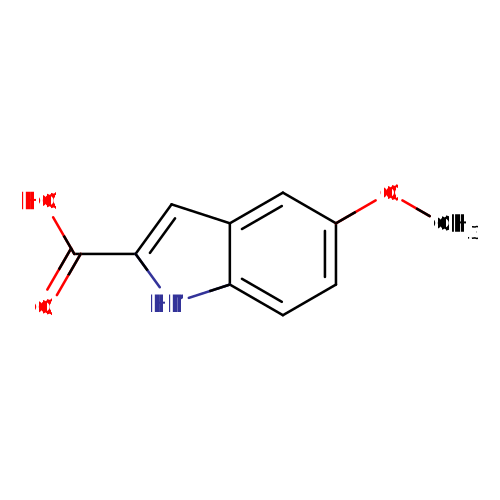
| Common Name | 5-methoxy-1h-indole-2-carboxylic acid |
|---|
| Description | 5-Methoxyindole-2-carboxylic acid, also known as 5-methoxy-2-indolic acid or 5-methoxy-2-indolecarboxylate, belongs to the class of organic compounds known as indolecarboxylic acids and derivatives. Indolecarboxylic acids and derivatives are compounds containing a carboxylic acid group (or a derivative thereof) linked to an indole. 5-Methoxyindole-2-carboxylic acid is a secondary metabolite. Secondary metabolites are metabolically or physiologically non-essential metabolites that may serve a role as defense or signalling molecules. In some cases they are simply molecules that arise from the incomplete metabolism of other secondary metabolites. 5-methoxy-1h-indole-2-carboxylic acid is found in Solanum lycopersicum. 5-methoxy-1h-indole-2-carboxylic acid was first documented in 2012 (PMID: 22551394). Based on a literature review a significant number of articles have been published on 5-Methoxyindole-2-carboxylic acid (PMID: 32551363) (PMID: 31629836) (PMID: 29765243) (PMID: 29709515) (PMID: 29448100) (PMID: 29017857). |
|---|
| Structure | COC1=CC=C2NC(=CC2=C1)C(O)=O InChI=1S/C10H9NO3/c1-14-7-2-3-8-6(4-7)5-9(11-8)10(12)13/h2-5,11H,1H3,(H,12,13) |
|---|
| Synonyms | | Value | Source |
|---|
| 5-Methoxy-2-indolecarboxylic acid | ChEBI | | 5-Methoxy-2-indolic acid | ChEBI | | 5-Methoxy-2-indolecarboxylate | Generator | | 5-Methoxy-2-indolate | Generator | | 5-Methoxyindole-2-carboxylate | Generator |
|
|---|
| Chemical Formula | C10H9NO3 |
|---|
| Average Mass | 191.1860 Da |
|---|
| Monoisotopic Mass | 191.05824 Da |
|---|
| IUPAC Name | 5-methoxy-1H-indole-2-carboxylic acid |
|---|
| Traditional Name | 5-methoxy-1H-indole-2-carboxylic acid |
|---|
| CAS Registry Number | Not Available |
|---|
| SMILES | COC1=CC=C2NC(=CC2=C1)C(O)=O |
|---|
| InChI Identifier | InChI=1S/C10H9NO3/c1-14-7-2-3-8-6(4-7)5-9(11-8)10(12)13/h2-5,11H,1H3,(H,12,13) |
|---|
| InChI Key | YEBJVSLNUMZXRJ-UHFFFAOYSA-N |
|---|
| Experimental Spectra |
|---|
|
| Not Available | | Predicted Spectra |
|---|
|
| | Spectrum Type | Description | Depositor ID | Depositor Organization | Depositor | Deposition Date | View |
|---|
| 1D NMR | 13C NMR Spectrum (1D, 25 MHz, H2O, predicted) | Wishart Lab | Wishart Lab | David Wishart | 2021-06-20 | View Spectrum | | 1D NMR | 1H NMR Spectrum (1D, 100 MHz, H2O, predicted) | Wishart Lab | Wishart Lab | David Wishart | 2021-06-20 | View Spectrum | | 1D NMR | 13C NMR Spectrum (1D, 252 MHz, H2O, predicted) | Wishart Lab | Wishart Lab | David Wishart | 2021-06-20 | View Spectrum | | 1D NMR | 1H NMR Spectrum (1D, 1000 MHz, H2O, predicted) | Wishart Lab | Wishart Lab | David Wishart | 2021-06-20 | View Spectrum | | 1D NMR | 13C NMR Spectrum (1D, 50 MHz, H2O, predicted) | Wishart Lab | Wishart Lab | David Wishart | 2021-06-20 | View Spectrum | | 1D NMR | 1H NMR Spectrum (1D, 200 MHz, H2O, predicted) | Wishart Lab | Wishart Lab | David Wishart | 2021-06-20 | View Spectrum | | 1D NMR | 13C NMR Spectrum (1D, 75 MHz, H2O, predicted) | Wishart Lab | Wishart Lab | David Wishart | 2021-06-20 | View Spectrum | | 1D NMR | 1H NMR Spectrum (1D, 300 MHz, H2O, predicted) | Wishart Lab | Wishart Lab | David Wishart | 2021-06-20 | View Spectrum | | 1D NMR | 13C NMR Spectrum (1D, 101 MHz, H2O, predicted) | Wishart Lab | Wishart Lab | David Wishart | 2021-06-20 | View Spectrum | | 1D NMR | 1H NMR Spectrum (1D, 400 MHz, H2O, predicted) | Wishart Lab | Wishart Lab | David Wishart | 2021-06-20 | View Spectrum | | 1D NMR | 13C NMR Spectrum (1D, 126 MHz, H2O, predicted) | Wishart Lab | Wishart Lab | David Wishart | 2021-06-20 | View Spectrum | | 1D NMR | 1H NMR Spectrum (1D, 500 MHz, H2O, predicted) | Wishart Lab | Wishart Lab | David Wishart | 2021-06-20 | View Spectrum | | 1D NMR | 13C NMR Spectrum (1D, 151 MHz, H2O, predicted) | Wishart Lab | Wishart Lab | David Wishart | 2021-06-20 | View Spectrum | | 1D NMR | 1H NMR Spectrum (1D, 600 MHz, H2O, predicted) | Wishart Lab | Wishart Lab | David Wishart | 2021-06-20 | View Spectrum | | 1D NMR | 13C NMR Spectrum (1D, 176 MHz, H2O, predicted) | Wishart Lab | Wishart Lab | David Wishart | 2021-06-20 | View Spectrum | | 1D NMR | 1H NMR Spectrum (1D, 700 MHz, H2O, predicted) | Wishart Lab | Wishart Lab | David Wishart | 2021-06-20 | View Spectrum | | 1D NMR | 13C NMR Spectrum (1D, 201 MHz, H2O, predicted) | Wishart Lab | Wishart Lab | David Wishart | 2021-06-20 | View Spectrum | | 1D NMR | 1H NMR Spectrum (1D, 800 MHz, H2O, predicted) | Wishart Lab | Wishart Lab | David Wishart | 2021-06-20 | View Spectrum | | 1D NMR | 13C NMR Spectrum (1D, 226 MHz, H2O, predicted) | Wishart Lab | Wishart Lab | David Wishart | 2021-06-20 | View Spectrum | | 1D NMR | 1H NMR Spectrum (1D, 900 MHz, H2O, predicted) | Wishart Lab | Wishart Lab | David Wishart | 2021-06-20 | View Spectrum |
| | Chemical Shift Submissions |
|---|
|
| Not Available | | Species |
|---|
| Species of Origin | |
|---|
| Chemical Taxonomy |
|---|
| Description | Belongs to the class of organic compounds known as indolecarboxylic acids and derivatives. Indolecarboxylic acids and derivatives are compounds containing a carboxylic acid group (or a derivative thereof) linked to an indole. |
|---|
| Kingdom | Organic compounds |
|---|
| Super Class | Organoheterocyclic compounds |
|---|
| Class | Indoles and derivatives |
|---|
| Sub Class | Indolecarboxylic acids and derivatives |
|---|
| Direct Parent | Indolecarboxylic acids and derivatives |
|---|
| Alternative Parents | |
|---|
| Substituents | - Indolecarboxylic acid derivative
- Indole
- Anisole
- Pyrrole-2-carboxylic acid
- Pyrrole-2-carboxylic acid or derivatives
- Alkyl aryl ether
- Benzenoid
- Substituted pyrrole
- Heteroaromatic compound
- Pyrrole
- Carboxylic acid derivative
- Carboxylic acid
- Ether
- Monocarboxylic acid or derivatives
- Azacycle
- Organic oxide
- Organopnictogen compound
- Organic nitrogen compound
- Organonitrogen compound
- Organooxygen compound
- Hydrocarbon derivative
- Organic oxygen compound
- Aromatic heteropolycyclic compound
|
|---|
| Molecular Framework | Aromatic heteropolycyclic compounds |
|---|
| External Descriptors | Not Available |
|---|
| Physical Properties |
|---|
| State | Not Available |
|---|
| Experimental Properties | | Property | Value | Reference |
|---|
| Melting Point | Not Available | Not Available | | Boiling Point | Not Available | Not Available | | Water Solubility | Not Available | Not Available | | LogP | Not Available | Not Available |
|
|---|
| Predicted Properties | |
|---|
| General References | - Darwish HW, Attia MI: New spectrofluorimetric methods for determination of melatonin in the presence of N-2-[1-(3-[2-(acetylamino)ethyl]-5-methoxy-1H-indol-2-ylmethyl)-5-methoxy-1H-indol-3-yl]- ethylacetamide: a contaminant in commercial melatonin preparations. Chem Cent J. 2012 May 2;6(1):36. doi: 10.1186/1752-153X-6-36. [PubMed:22551394 ]
- Li CY, Ma WX, Yan LJ: 5-Methoxyindole-2-Carboylic Acid (MICA) Fails to Retard Development and Progression of Type II Diabetes in ZSF1 Diabetic Rats. React Oxyg Species (Apex). 2020 May 1;9(27):144-147. [PubMed:32551363 ]
- Sumien N, Huang R, Chen Z, Vann PH, Wong JM, Li W, Yang S, Forster MJ, Yan LJ: Effects of dietary 5-methoxyindole-2-carboxylic acid on brain functional recovery after ischemic stroke. Behav Brain Res. 2020 Jan 27;378:112278. doi: 10.1016/j.bbr.2019.112278. Epub 2019 Oct 17. [PubMed:31629836 ]
- Yan LJ: Reexploring 5-methoxyindole-2-carboxylic acid (MICA) as a potential antidiabetic agent. Diabetes Metab Syndr Obes. 2018 May 4;11:183-186. doi: 10.2147/DMSO.S166485. eCollection 2018. [PubMed:29765243 ]
- Ahmad W, Ebert PR: 5-Methoxyindole-2-carboxylic acid (MICA) suppresses Abeta-mediated pathology in C. elegans. Exp Gerontol. 2018 Jul 15;108:215-225. doi: 10.1016/j.exger.2018.04.021. Epub 2018 Apr 27. [PubMed:29709515 ]
- Wu J, Jin Z, Yang X, Yan LJ: Post-ischemic administration of 5-methoxyindole-2-carboxylic acid at the onset of reperfusion affords neuroprotection against stroke injury by preserving mitochondrial function and attenuating oxidative stress. Biochem Biophys Res Commun. 2018 Feb 26;497(1):444-450. doi: 10.1016/j.bbrc.2018.02.106. Epub 2018 Feb 12. [PubMed:29448100 ]
- Wu J, Li R, Li W, Ren M, Thangthaeng N, Sumien N, Liu R, Yang S, Simpkins JW, Forster MJ, Yan LJ: Administration of 5-methoxyindole-2-carboxylic acid that potentially targets mitochondrial dihydrolipoamide dehydrogenase confers cerebral preconditioning against ischemic stroke injury. Free Radic Biol Med. 2017 Dec;113:244-254. doi: 10.1016/j.freeradbiomed.2017.10.008. Epub 2017 Oct 7. [PubMed:29017857 ]
- Sun Z, Park SY, Hwang E, Zhang M, Seo SA, Lin P, Yi TH: Thymus vulgaris alleviates UVB irradiation induced skin damage via inhibition of MAPK/AP-1 and activation of Nrf2-ARE antioxidant system. J Cell Mol Med. 2017 Feb;21(2):336-348. doi: 10.1111/jcmm.12968. Epub 2016 Sep 19. [PubMed:27641753 ]
- Cinar M, Karabacak M, Asiri AM: An experimental and density functional study on conformational and spectroscopic analysis of 5-methoxyindole-2-carboxylic acid. Spectrochim Acta A Mol Biomol Spectrosc. 2015 Feb 25;137:670-6. doi: 10.1016/j.saa.2014.08.090. Epub 2014 Sep 4. [PubMed:25255480 ]
- Siva AB, Panneerdoss S, Sailasree P, Singh DK, Kameshwari DB, Shivaji S: Inhibiting sperm pyruvate dehydrogenase complex and its E3 subunit, dihydrolipoamide dehydrogenase affects fertilization in Syrian hamsters. PLoS One. 2014 May 22;9(5):e97916. doi: 10.1371/journal.pone.0097916. eCollection 2014. [PubMed:24852961 ]
- LOTUS database [Link]
|
|---|