| Record Information |
|---|
| Version | 2.0 |
|---|
| Created at | 2022-09-09 13:31:37 UTC |
|---|
| Updated at | 2022-09-09 13:31:38 UTC |
|---|
| NP-MRD ID | NP0285374 |
|---|
| Secondary Accession Numbers | None |
|---|
| Natural Product Identification |
|---|
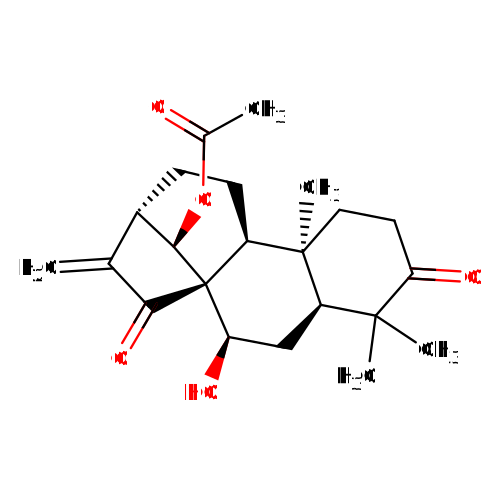
| Common Name | (1r,2r,4s,9r,10s,13s,16r)-2-hydroxy-5,5,9-trimethyl-14-methylidene-6,15-dioxotetracyclo[11.2.1.0¹,¹⁰.0⁴,⁹]hexadecan-16-yl acetate |
|---|
| Description | Glaucocalyxin B belongs to the class of organic compounds known as kaurane diterpenoids. These are diterpene alkaloids with a structure that is based on the kaurane skeleton. Kaurane is a tetracyclic compound that arises by cyclisation of a pimarane precursor followed by rearrangement. It possesses a [3,2,1]-bicyclic ring system with C15-C16 bridge connected to C13, forming the five-membered ring D. (1r,2r,4s,9r,10s,13s,16r)-2-hydroxy-5,5,9-trimethyl-14-methylidene-6,15-dioxotetracyclo[11.2.1.0¹,¹⁰.0⁴,⁹]hexadecan-16-yl acetate is found in Isodon japonicus and Isodon pharicus. (1r,2r,4s,9r,10s,13s,16r)-2-hydroxy-5,5,9-trimethyl-14-methylidene-6,15-dioxotetracyclo[11.2.1.0¹,¹⁰.0⁴,⁹]hexadecan-16-yl acetate was first documented in 2017 (PMID: 29241205). Based on a literature review a significant number of articles have been published on Glaucocalyxin B (PMID: 32744957) (PMID: 30409115) (PMID: 35251480) (PMID: 35100137) (PMID: 34580236) (PMID: 30304556). |
|---|
| Structure | CC(=O)O[C@@H]1[C@H]2CC[C@@H]3[C@]1([C@H](O)C[C@@H]1C(C)(C)C(=O)CC[C@@]31C)C(=O)C2=C InChI=1S/C22H30O5/c1-11-13-6-7-14-21(5)9-8-16(24)20(3,4)15(21)10-17(25)22(14,18(11)26)19(13)27-12(2)23/h13-15,17,19,25H,1,6-10H2,2-5H3/t13-,14-,15+,17+,19+,21-,22-/m0/s1 |
|---|
| Synonyms | Not Available |
|---|
| Chemical Formula | C22H30O5 |
|---|
| Average Mass | 374.4770 Da |
|---|
| Monoisotopic Mass | 374.20932 Da |
|---|
| IUPAC Name | (1R,2R,4S,9R,10S,13S,16R)-2-hydroxy-5,5,9-trimethyl-14-methylidene-6,15-dioxotetracyclo[11.2.1.0^{1,10}.0^{4,9}]hexadecan-16-yl acetate |
|---|
| Traditional Name | (1R,2R,4S,9R,10S,13S,16R)-2-hydroxy-5,5,9-trimethyl-14-methylidene-6,15-dioxotetracyclo[11.2.1.0^{1,10}.0^{4,9}]hexadecan-16-yl acetate |
|---|
| CAS Registry Number | Not Available |
|---|
| SMILES | CC(=O)O[C@@H]1[C@H]2CC[C@@H]3[C@]1([C@H](O)C[C@@H]1C(C)(C)C(=O)CC[C@@]31C)C(=O)C2=C |
|---|
| InChI Identifier | InChI=1S/C22H30O5/c1-11-13-6-7-14-21(5)9-8-16(24)20(3,4)15(21)10-17(25)22(14,18(11)26)19(13)27-12(2)23/h13-15,17,19,25H,1,6-10H2,2-5H3/t13-,14-,15+,17+,19+,21-,22-/m0/s1 |
|---|
| InChI Key | LSUXOKVMORWDLT-KEXKRWMXSA-N |
|---|
| Experimental Spectra |
|---|
|
| Not Available | | Predicted Spectra |
|---|
|
| | Spectrum Type | Description | Depositor ID | Depositor Organization | Depositor | Deposition Date | View |
|---|
| 1D NMR | 13C NMR Spectrum (1D, 25 MHz, H2O, predicted) | Wishart Lab | Wishart Lab | David Wishart | 2021-06-20 | View Spectrum | | 1D NMR | 1H NMR Spectrum (1D, 100 MHz, H2O, predicted) | Wishart Lab | Wishart Lab | David Wishart | 2021-06-20 | View Spectrum | | 1D NMR | 13C NMR Spectrum (1D, 252 MHz, H2O, predicted) | Wishart Lab | Wishart Lab | David Wishart | 2021-06-20 | View Spectrum | | 1D NMR | 1H NMR Spectrum (1D, 1000 MHz, H2O, predicted) | Wishart Lab | Wishart Lab | David Wishart | 2021-06-20 | View Spectrum | | 1D NMR | 13C NMR Spectrum (1D, 50 MHz, H2O, predicted) | Wishart Lab | Wishart Lab | David Wishart | 2021-06-20 | View Spectrum | | 1D NMR | 1H NMR Spectrum (1D, 200 MHz, H2O, predicted) | Wishart Lab | Wishart Lab | David Wishart | 2021-06-20 | View Spectrum | | 1D NMR | 13C NMR Spectrum (1D, 75 MHz, H2O, predicted) | Wishart Lab | Wishart Lab | David Wishart | 2021-06-20 | View Spectrum | | 1D NMR | 1H NMR Spectrum (1D, 300 MHz, H2O, predicted) | Wishart Lab | Wishart Lab | David Wishart | 2021-06-20 | View Spectrum | | 1D NMR | 13C NMR Spectrum (1D, 101 MHz, H2O, predicted) | Wishart Lab | Wishart Lab | David Wishart | 2021-06-20 | View Spectrum | | 1D NMR | 1H NMR Spectrum (1D, 400 MHz, H2O, predicted) | Wishart Lab | Wishart Lab | David Wishart | 2021-06-20 | View Spectrum | | 1D NMR | 13C NMR Spectrum (1D, 126 MHz, H2O, predicted) | Wishart Lab | Wishart Lab | David Wishart | 2021-06-20 | View Spectrum | | 1D NMR | 1H NMR Spectrum (1D, 500 MHz, H2O, predicted) | Wishart Lab | Wishart Lab | David Wishart | 2021-06-20 | View Spectrum | | 1D NMR | 13C NMR Spectrum (1D, 151 MHz, H2O, predicted) | Wishart Lab | Wishart Lab | David Wishart | 2021-06-20 | View Spectrum | | 1D NMR | 1H NMR Spectrum (1D, 600 MHz, H2O, predicted) | Wishart Lab | Wishart Lab | David Wishart | 2021-06-20 | View Spectrum | | 1D NMR | 13C NMR Spectrum (1D, 176 MHz, H2O, predicted) | Wishart Lab | Wishart Lab | David Wishart | 2021-06-20 | View Spectrum | | 1D NMR | 1H NMR Spectrum (1D, 700 MHz, H2O, predicted) | Wishart Lab | Wishart Lab | David Wishart | 2021-06-20 | View Spectrum | | 1D NMR | 13C NMR Spectrum (1D, 201 MHz, H2O, predicted) | Wishart Lab | Wishart Lab | David Wishart | 2021-06-20 | View Spectrum | | 1D NMR | 1H NMR Spectrum (1D, 800 MHz, H2O, predicted) | Wishart Lab | Wishart Lab | David Wishart | 2021-06-20 | View Spectrum | | 1D NMR | 13C NMR Spectrum (1D, 226 MHz, H2O, predicted) | Wishart Lab | Wishart Lab | David Wishart | 2021-06-20 | View Spectrum | | 1D NMR | 1H NMR Spectrum (1D, 900 MHz, H2O, predicted) | Wishart Lab | Wishart Lab | David Wishart | 2021-06-20 | View Spectrum |
| | Chemical Shift Submissions |
|---|
|
| Not Available | | Species |
|---|
| Species of Origin | |
|---|
| Chemical Taxonomy |
|---|
| Description | Belongs to the class of organic compounds known as kaurane diterpenoids. These are diterpene alkaloids with a structure that is based on the kaurane skeleton. Kaurane is a tetracyclic compound that arises by cyclisation of a pimarane precursor followed by rearrangement. It possesses a [3,2,1]-bicyclic ring system with C15-C16 bridge connected to C13, forming the five-membered ring D. |
|---|
| Kingdom | Organic compounds |
|---|
| Super Class | Lipids and lipid-like molecules |
|---|
| Class | Prenol lipids |
|---|
| Sub Class | Diterpenoids |
|---|
| Direct Parent | Kaurane diterpenoids |
|---|
| Alternative Parents | |
|---|
| Substituents | - Kaurane diterpenoid
- Cyclic alcohol
- Cyclic ketone
- Secondary alcohol
- Ketone
- Carboxylic acid ester
- Monocarboxylic acid or derivatives
- Carboxylic acid derivative
- Organic oxygen compound
- Organic oxide
- Hydrocarbon derivative
- Organooxygen compound
- Carbonyl group
- Alcohol
- Aliphatic homopolycyclic compound
|
|---|
| Molecular Framework | Aliphatic homopolycyclic compounds |
|---|
| External Descriptors | Not Available |
|---|
| Physical Properties |
|---|
| State | Not Available |
|---|
| Experimental Properties | | Property | Value | Reference |
|---|
| Melting Point | Not Available | Not Available | | Boiling Point | Not Available | Not Available | | Water Solubility | Not Available | Not Available | | LogP | Not Available | Not Available |
|
|---|
| Predicted Properties | |
|---|
| General References | - Mir RH, Shah AJ, Mohi-Ud-Din R, Pottoo FH, Dar MA, Jachak SM, Masoodi MH: Natural Anti-inflammatory Compounds as Drug Candidates in Alzheimer's Disease. Curr Med Chem. 2021;28(23):4799-4825. doi: 10.2174/0929867327666200730213215. [PubMed:32744957 ]
- Zhao F, Sun M, Zhang W, Jiang C, Teng J, Sheng W, Li M, Zhang A, Duan Y, Xue J: Comparative transcriptome analysis of roots, stems and leaves of Isodon amethystoides reveals candidate genes involved in Wangzaozins biosynthesis. BMC Plant Biol. 2018 Nov 8;18(1):272. doi: 10.1186/s12870-018-1505-0. [PubMed:30409115 ]
- Zhang T, Xu C, Zheng P, Zhang X, Qiu C, Wu F, Chen J, Xiao Z, Zhu J, Zhang J, Zou P, Ni D: Glaucocalyxin B Attenuates Ovarian Cancer Cell Growth and Cisplatin Resistance In Vitro via Activating Oxidative Stress. Oxid Med Cell Longev. 2022 Feb 25;2022:6324292. doi: 10.1155/2022/6324292. eCollection 2022. [PubMed:35251480 ]
- Han C, Yang Y, Sheng Y, Wang J, Zhou X, Li W, Guo L, Zhang C, Ye Q: Correction for: Glaucocalyxin B inhibits cartilage inflammatory injury in rheumatoid arthritis by regulating M1 polarization of synovial macrophages through NF-kappaB pathway. Aging (Albany NY). 2022 Jan 31;14(2):1065-1066. doi: 10.18632/aging.203864. [PubMed:35100137 ]
- Han C, Yang Y, Sheng Y, Wang J, Zhou X, Li W, Guo L, Zhang C, Ye Q: Glaucocalyxin B inhibits cartilage inflammatory injury in rheumatoid arthritis by regulating M1 polarization of synovial macrophages through NF-kappaB pathway. Aging (Albany NY). 2021 Sep 27;13(18):22544-22555. doi: 10.18632/aging.203567. Epub 2021 Sep 27. [PubMed:34580236 ]
- Liu Y, Wu X, An J, Lv W, Geng Y, Lou T, Zhang Y: Glaucocalyxin B protects against oxygen-glucose-deprivation/reperfusion-induced neuronal injury in PC-12 cells. J Cell Biochem. 2019 Apr;120(4):6137-6144. doi: 10.1002/jcb.27901. Epub 2018 Oct 10. [PubMed:30304556 ]
- Xu W, Zheng D, Liu Y, Li J, Yang L, Shang X: Glaucocalyxin B Alleviates Lipopolysaccharide-Induced Parkinson's Disease by Inhibiting TLR/NF-kappaB and Activating Nrf2/HO-1 Pathway. Cell Physiol Biochem. 2017;44(6):2091-2104. doi: 10.1159/000485947. Epub 2017 Dec 12. [PubMed:29241205 ]
- Seo EJ, Fischer N, Efferth T: Phytochemicals as inhibitors of NF-kappaB for treatment of Alzheimer's disease. Pharmacol Res. 2018 Mar;129:262-273. doi: 10.1016/j.phrs.2017.11.030. Epub 2017 Nov 24. [PubMed:29179999 ]
- Huang W, Guan X, Lv Y: Simultaneous determination of glaucocalyxin A and glaucocalyxin B in rat plasma by LC-MS/MS and its application to a pharmacokinetic study after oral administration of Rabdosia japonica extract. Biomed Chromatogr. 2018 Feb;32(2). doi: 10.1002/bmc.4089. Epub 2017 Sep 26. [PubMed:28873500 ]
- Ur Rahman MS, Zhang L, Wu L, Xie Y, Li C, Cao J: Sensitization of gastric cancer cells to alkylating agents by glaucocalyxin B via cell cycle arrest and enhanced cell death. Drug Des Devel Ther. 2017 Aug 22;11:2431-2441. doi: 10.2147/DDDT.S145719. eCollection 2017. [PubMed:28860714 ]
- LOTUS database [Link]
|
|---|