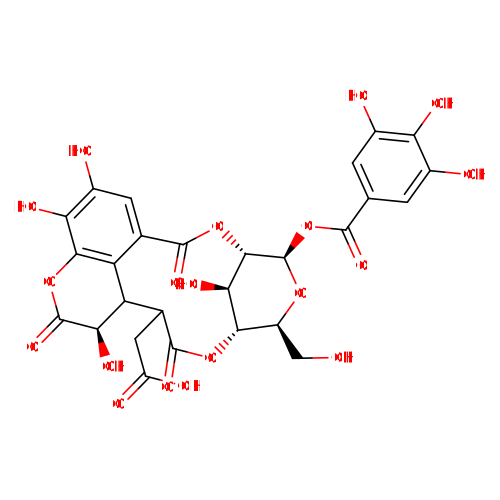
| Record Information |
|---|
| Version | 2.0 |
|---|
| Created at | 2022-09-09 12:53:53 UTC |
|---|
| Updated at | 2022-09-09 12:53:53 UTC |
|---|
| NP-MRD ID | NP0284951 |
|---|
| Secondary Accession Numbers | None |
|---|
| Natural Product Identification |
|---|
| Common Name | [(4s,5r,7s,8r,13r,21r)-13,17,18,21-tetrahydroxy-7-(hydroxymethyl)-2,10,14-trioxo-5-(3,4,5-trihydroxybenzoyloxy)-3,6,9,15-tetraoxatetracyclo[10.7.1.1⁴,⁸.0¹⁶,²⁰]henicosa-1(19),16(20),17-trien-11-yl]acetic acid |
|---|
| Description | Chebulanin belongs to the class of organic compounds known as hydrolyzable tannins. These are tannins with a structure characterized by either of the following models. In model 1, the structure contains galloyl units (in some cases, shikimic acid units) that are linked to diverse polyol carbohydrate-, catechin-, or triterpenoid units. In model 2, contains at least two galloyl units C-C coupled to each other, and do not contain a glycosidically linked catechin unit. [(4s,5r,7s,8r,13r,21r)-13,17,18,21-tetrahydroxy-7-(hydroxymethyl)-2,10,14-trioxo-5-(3,4,5-trihydroxybenzoyloxy)-3,6,9,15-tetraoxatetracyclo[10.7.1.1⁴,⁸.0¹⁶,²⁰]henicosa-1(19),16(20),17-trien-11-yl]acetic acid is found in Euphorbia maculata, Phyllanthus emblica and Terminalia chebula. [(4s,5r,7s,8r,13r,21r)-13,17,18,21-tetrahydroxy-7-(hydroxymethyl)-2,10,14-trioxo-5-(3,4,5-trihydroxybenzoyloxy)-3,6,9,15-tetraoxatetracyclo[10.7.1.1⁴,⁸.0¹⁶,²⁰]henicosa-1(19),16(20),17-trien-11-yl]acetic acid was first documented in 2004 (PMID: 15387468). Based on a literature review a significant number of articles have been published on chebulanin (PMID: 36051270) (PMID: 35830757) (PMID: 32795901) (PMID: 30877065) (PMID: 27383847) (PMID: 26402786). |
|---|
| Structure | OC[C@@H]1O[C@H](OC(=O)C2=CC(O)=C(O)C(O)=C2)[C@H]2OC(=O)C3=CC(O)=C(O)C4=C3C([C@@H](O)C(=O)O4)C(CC(O)=O)C(=O)O[C@@H]1[C@H]2O InChI=1S/C27H24O19/c28-5-12-20-19(37)22(27(42-12)46-23(38)6-1-9(29)16(34)10(30)2-6)45-24(39)7-3-11(31)17(35)21-15(7)14(18(36)26(41)44-21)8(4-13(32)33)25(40)43-20/h1-3,8,12,14,18-20,22,27-31,34-37H,4-5H2,(H,32,33)/t8?,12-,14?,18+,19+,20-,22-,27+/m0/s1 |
|---|
| Synonyms | Not Available |
|---|
| Chemical Formula | C27H24O19 |
|---|
| Average Mass | 652.4700 Da |
|---|
| Monoisotopic Mass | 652.09118 Da |
|---|
| IUPAC Name | 2-[(4S,5R,7S,8R,13R,21R)-13,17,18,21-tetrahydroxy-7-(hydroxymethyl)-2,10,14-trioxo-5-(3,4,5-trihydroxybenzoyloxy)-3,6,9,15-tetraoxatetracyclo[10.7.1.1^{4,8}.0^{16,20}]henicosa-1(19),16(20),17-trien-11-yl]acetic acid |
|---|
| Traditional Name | [(4S,5R,7S,8R,13R,21R)-13,17,18,21-tetrahydroxy-7-(hydroxymethyl)-2,10,14-trioxo-5-(3,4,5-trihydroxybenzoyloxy)-3,6,9,15-tetraoxatetracyclo[10.7.1.1^{4,8}.0^{16,20}]henicosa-1(19),16(20),17-trien-11-yl]acetic acid |
|---|
| CAS Registry Number | Not Available |
|---|
| SMILES | OC[C@@H]1O[C@H](OC(=O)C2=CC(O)=C(O)C(O)=C2)[C@H]2OC(=O)C3=CC(O)=C(O)C4=C3C([C@@H](O)C(=O)O4)C(CC(O)=O)C(=O)O[C@@H]1[C@H]2O |
|---|
| InChI Identifier | InChI=1S/C27H24O19/c28-5-12-20-19(37)22(27(42-12)46-23(38)6-1-9(29)16(34)10(30)2-6)45-24(39)7-3-11(31)17(35)21-15(7)14(18(36)26(41)44-21)8(4-13(32)33)25(40)43-20/h1-3,8,12,14,18-20,22,27-31,34-37H,4-5H2,(H,32,33)/t8?,12-,14?,18+,19+,20-,22-,27+/m0/s1 |
|---|
| InChI Key | HPQIRFXIDGVWBA-SKPOWATKSA-N |
|---|
| Experimental Spectra |
|---|
|
| Not Available | | Predicted Spectra |
|---|
|
| | Spectrum Type | Description | Depositor ID | Depositor Organization | Depositor | Deposition Date | View |
|---|
| 1D NMR | 13C NMR Spectrum (1D, 25 MHz, H2O, predicted) | Wishart Lab | Wishart Lab | David Wishart | 2021-06-20 | View Spectrum | | 1D NMR | 1H NMR Spectrum (1D, 100 MHz, H2O, predicted) | Wishart Lab | Wishart Lab | David Wishart | 2021-06-20 | View Spectrum | | 1D NMR | 13C NMR Spectrum (1D, 252 MHz, H2O, predicted) | Wishart Lab | Wishart Lab | David Wishart | 2021-06-20 | View Spectrum | | 1D NMR | 1H NMR Spectrum (1D, 1000 MHz, H2O, predicted) | Wishart Lab | Wishart Lab | David Wishart | 2021-06-20 | View Spectrum | | 1D NMR | 13C NMR Spectrum (1D, 50 MHz, H2O, predicted) | Wishart Lab | Wishart Lab | David Wishart | 2021-06-20 | View Spectrum | | 1D NMR | 1H NMR Spectrum (1D, 200 MHz, H2O, predicted) | Wishart Lab | Wishart Lab | David Wishart | 2021-06-20 | View Spectrum | | 1D NMR | 13C NMR Spectrum (1D, 75 MHz, H2O, predicted) | Wishart Lab | Wishart Lab | David Wishart | 2021-06-20 | View Spectrum | | 1D NMR | 1H NMR Spectrum (1D, 300 MHz, H2O, predicted) | Wishart Lab | Wishart Lab | David Wishart | 2021-06-20 | View Spectrum | | 1D NMR | 13C NMR Spectrum (1D, 101 MHz, H2O, predicted) | Wishart Lab | Wishart Lab | David Wishart | 2021-06-20 | View Spectrum | | 1D NMR | 1H NMR Spectrum (1D, 400 MHz, H2O, predicted) | Wishart Lab | Wishart Lab | David Wishart | 2021-06-20 | View Spectrum | | 1D NMR | 13C NMR Spectrum (1D, 126 MHz, H2O, predicted) | Wishart Lab | Wishart Lab | David Wishart | 2021-06-20 | View Spectrum | | 1D NMR | 1H NMR Spectrum (1D, 500 MHz, H2O, predicted) | Wishart Lab | Wishart Lab | David Wishart | 2021-06-20 | View Spectrum | | 1D NMR | 13C NMR Spectrum (1D, 151 MHz, H2O, predicted) | Wishart Lab | Wishart Lab | David Wishart | 2021-06-20 | View Spectrum | | 1D NMR | 1H NMR Spectrum (1D, 600 MHz, H2O, predicted) | Wishart Lab | Wishart Lab | David Wishart | 2021-06-20 | View Spectrum | | 1D NMR | 13C NMR Spectrum (1D, 176 MHz, H2O, predicted) | Wishart Lab | Wishart Lab | David Wishart | 2021-06-20 | View Spectrum | | 1D NMR | 1H NMR Spectrum (1D, 700 MHz, H2O, predicted) | Wishart Lab | Wishart Lab | David Wishart | 2021-06-20 | View Spectrum | | 1D NMR | 13C NMR Spectrum (1D, 201 MHz, H2O, predicted) | Wishart Lab | Wishart Lab | David Wishart | 2021-06-20 | View Spectrum | | 1D NMR | 1H NMR Spectrum (1D, 800 MHz, H2O, predicted) | Wishart Lab | Wishart Lab | David Wishart | 2021-06-20 | View Spectrum | | 1D NMR | 13C NMR Spectrum (1D, 226 MHz, H2O, predicted) | Wishart Lab | Wishart Lab | David Wishart | 2021-06-20 | View Spectrum | | 1D NMR | 1H NMR Spectrum (1D, 900 MHz, H2O, predicted) | Wishart Lab | Wishart Lab | David Wishart | 2021-06-20 | View Spectrum |
| | Chemical Shift Submissions |
|---|
|
| Not Available | | Species |
|---|
| Species of Origin | |
|---|
| Chemical Taxonomy |
|---|
| Description | Belongs to the class of organic compounds known as hydrolyzable tannins. These are tannins with a structure characterized by either of the following models. In model 1, the structure contains galloyl units (in some cases, shikimic acid units) that are linked to diverse polyol carbohydrate-, catechin-, or triterpenoid units. In model 2, contains at least two galloyl units C-C coupled to each other, and do not contain a glycosidically linked catechin unit. |
|---|
| Kingdom | Organic compounds |
|---|
| Super Class | Phenylpropanoids and polyketides |
|---|
| Class | Tannins |
|---|
| Sub Class | Hydrolyzable tannins |
|---|
| Direct Parent | Hydrolyzable tannins |
|---|
| Alternative Parents | |
|---|
| Substituents | - Hydrolyzable tannin
- Pentacarboxylic acid or derivatives
- Galloyl ester
- Gallic acid or derivatives
- P-hydroxybenzoic acid alkyl ester
- M-hydroxybenzoic acid ester
- P-hydroxybenzoic acid ester
- Dihydroxybenzoic acid
- 3,4-dihydrocoumarin
- 1-benzopyran
- Benzopyran
- Chromane
- Benzoate ester
- Pyrogallol derivative
- Benzoic acid or derivatives
- Benzenetriol
- Benzoyl
- 1-hydroxy-4-unsubstituted benzenoid
- 1-hydroxy-2-unsubstituted benzenoid
- Phenol
- Benzenoid
- Oxane
- Monosaccharide
- Monocyclic benzene moiety
- Secondary alcohol
- Lactone
- Carboxylic acid ester
- Oxacycle
- Organoheterocyclic compound
- Polyol
- Carboxylic acid
- Carboxylic acid derivative
- Acetal
- Organic oxygen compound
- Organic oxide
- Hydrocarbon derivative
- Primary alcohol
- Organooxygen compound
- Carbonyl group
- Alcohol
- Aromatic heteropolycyclic compound
|
|---|
| Molecular Framework | Aromatic heteropolycyclic compounds |
|---|
| External Descriptors | Not Available |
|---|
| Physical Properties |
|---|
| State | Not Available |
|---|
| Experimental Properties | | Property | Value | Reference |
|---|
| Melting Point | Not Available | Not Available | | Boiling Point | Not Available | Not Available | | Water Solubility | Not Available | Not Available | | LogP | Not Available | Not Available |
|
|---|
| Predicted Properties | |
|---|
| General References | - Hassan Bulbul MR, Uddin Chowdhury MN, Naima TA, Sami SA, Imtiaj MS, Huda N, Uddin MG: A comprehensive review on the diverse pharmacological perspectives of Terminalia chebula Retz. Heliyon. 2022 Aug 14;8(8):e10220. doi: 10.1016/j.heliyon.2022.e10220. eCollection 2022 Aug. [PubMed:36051270 ]
- Kim HJ, Song HK, Park SH, Jang S, Park KS, Song KH, Lee SK, Kim T: Terminalia chebula Retz. extract ameliorates the symptoms of atopic dermatitis by regulating anti-inflammatory factors in vivo and suppressing STAT1/3 and NF-kB signaling in vitro. Phytomedicine. 2022 Sep;104:154318. doi: 10.1016/j.phymed.2022.154318. Epub 2022 Jul 4. [PubMed:35830757 ]
- Liu F, Liu Y, Zhan S, Lv J, Sun F, Weng B, Liu S, Xia P: Chebulanin exerts its anti-inflammatory and anti-arthritic effects via inhibiting NF-kappaB and MAPK activation in collagen-induced arthritis mice. Int Immunopharmacol. 2020 Nov;88:106823. doi: 10.1016/j.intimp.2020.106823. Epub 2020 Aug 11. [PubMed:32795901 ]
- Addotey JN, Lengers I, Jose J, Hensel A: Hyal-1 inhibitors from the leaves of Phyllanthus muellerianus (Kuntze) Excell. J Ethnopharmacol. 2019 May 23;236:326-335. doi: 10.1016/j.jep.2019.03.022. Epub 2019 Mar 12. [PubMed:30877065 ]
- An J, Li T, Dong Y, Li Z, Huo J: Terminalia Chebulanin Attenuates Psoriatic Skin Lesion via Regulation of Heme Oxygenase-1. Cell Physiol Biochem. 2016;39(2):531-43. doi: 10.1159/000445645. Epub 2016 Jul 7. [PubMed:27383847 ]
- Zhao Y, Liu F, Liu Y, Zhou D, Dai Q, Liu S: Anti-Arthritic Effect of Chebulanin on Collagen-Induced Arthritis in Mice. PLoS One. 2015 Sep 24;10(9):e0139052. doi: 10.1371/journal.pone.0139052. eCollection 2015. [PubMed:26402786 ]
- Lee WJ, Moon JS, Kim SI, Kim YT, Nash O, Bahn YS, Kim SU: Inhibition of the calcineurin pathway by two tannins, chebulagic acid and chebulanin, isolated from Harrisonia abyssinica Oliv. J Microbiol Biotechnol. 2014 Oct;24(10):1377-81. doi: 10.4014/jmb.1405.05030. [PubMed:25001554 ]
- Luo W, Wen L, Zhao M, Yang B, Ren J, Shen G, Rao G: Structural identification of isomallotusinin and other phenolics in Phyllanthus emblica L. fruit hull. Food Chem. 2012 Jun 1;132(3):1527-1533. doi: 10.1016/j.foodchem.2011.11.146. Epub 2011 Dec 13. [PubMed:29243645 ]
- Liu M, Katerere DR, Gray AI, Seidel V: Phytochemical and antifungal studies on Terminalia mollis and Terminalia brachystemma. Fitoterapia. 2009 Sep;80(6):369-73. doi: 10.1016/j.fitote.2009.05.006. Epub 2009 May 14. [PubMed:19446614 ]
- Juang LJ, Sheu SJ: Chemical identification of the sources of commercial Fructus Chebulae. Phytochem Anal. 2005 Jul-Aug;16(4):246-51. doi: 10.1002/pca.823. [PubMed:16042149 ]
- Juang LJ, Sheu SJ, Lin TC: Determination of hydrolyzable tannins in the fruit of Terminalia chebula Retz. by high-performance liquid chromatography and capillary electrophoresis. J Sep Sci. 2004 Jun;27(9):718-24. doi: 10.1002/jssc.200401741. [PubMed:15387468 ]
- LOTUS database [Link]
|
|---|