| Record Information |
|---|
| Version | 2.0 |
|---|
| Created at | 2022-09-09 11:34:30 UTC |
|---|
| Updated at | 2022-09-09 11:34:31 UTC |
|---|
| NP-MRD ID | NP0284045 |
|---|
| Secondary Accession Numbers | None |
|---|
| Natural Product Identification |
|---|
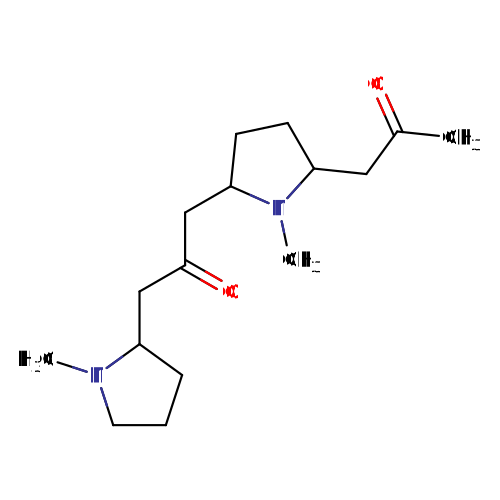
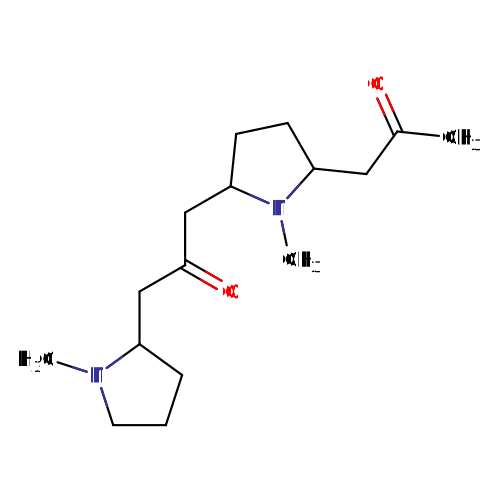
| Common Name | 1-[1-methyl-5-(2-oxopropyl)pyrrolidin-2-yl]-3-(1-methylpyrrolidin-2-yl)propan-2-one |
|---|
| Description | Phygrine belongs to the class of organic compounds known as alkaloids and derivatives. These are naturally occurring chemical compounds that contain mostly basic nitrogen atoms. This group also includes some related compounds with neutral and even weakly acidic properties. Also some synthetic compounds of similar structure are attributed to alkaloids. In addition to carbon, hydrogen and nitrogen, alkaloids may also contain oxygen, sulfur and more rarely other elements such as chlorine, bromine, and phosphorus. Phygrine is a very strong basic compound (based on its pKa). 1-[1-methyl-5-(2-oxopropyl)pyrrolidin-2-yl]-3-(1-methylpyrrolidin-2-yl)propan-2-one is found in Physalis angulata. Phygrine is an alkaloid from roots and aerial parts of Physalis alkekengi (winter cherry), the famine food Physalis angulata (cutleaf ground cherry), Physalis philadelphica (tomatillo), Physalis peruviana (Cape gooseberry), Physalis pubescens (ground cherry) and Physalis pruinosa (strawberry tomato). |
|---|
| Structure | CN1CCCC1CC(=O)CC1CCC(CC(C)=O)N1C InChI=1S/C16H28N2O2/c1-12(19)9-14-6-7-15(18(14)3)11-16(20)10-13-5-4-8-17(13)2/h13-15H,4-11H2,1-3H3 |
|---|
| Synonyms | Not Available |
|---|
| Chemical Formula | C16H28N2O2 |
|---|
| Average Mass | 280.4057 Da |
|---|
| Monoisotopic Mass | 280.21508 Da |
|---|
| IUPAC Name | 1-[1-methyl-5-(2-oxopropyl)pyrrolidin-2-yl]-3-(1-methylpyrrolidin-2-yl)propan-2-one |
|---|
| Traditional Name | 1-[1-methyl-5-(2-oxopropyl)pyrrolidin-2-yl]-3-(1-methylpyrrolidin-2-yl)propan-2-one |
|---|
| CAS Registry Number | Not Available |
|---|
| SMILES | CN1CCCC1CC(=O)CC1CCC(CC(C)=O)N1C |
|---|
| InChI Identifier | InChI=1S/C16H28N2O2/c1-12(19)9-14-6-7-15(18(14)3)11-16(20)10-13-5-4-8-17(13)2/h13-15H,4-11H2,1-3H3 |
|---|
| InChI Key | UBFAEXSSMSJTQV-UHFFFAOYSA-N |
|---|
| Experimental Spectra |
|---|
|
| Not Available | | Predicted Spectra |
|---|
|
| | Spectrum Type | Description | Depositor ID | Depositor Organization | Depositor | Deposition Date | View |
|---|
| 1D NMR | 13C NMR Spectrum (1D, 25 MHz, H2O, predicted) | Wishart Lab | Wishart Lab | David Wishart | 2021-06-20 | View Spectrum | | 1D NMR | 1H NMR Spectrum (1D, 100 MHz, H2O, predicted) | Wishart Lab | Wishart Lab | David Wishart | 2021-06-20 | View Spectrum | | 1D NMR | 13C NMR Spectrum (1D, 252 MHz, H2O, predicted) | Wishart Lab | Wishart Lab | David Wishart | 2021-06-20 | View Spectrum | | 1D NMR | 1H NMR Spectrum (1D, 1000 MHz, H2O, predicted) | Wishart Lab | Wishart Lab | David Wishart | 2021-06-20 | View Spectrum | | 1D NMR | 13C NMR Spectrum (1D, 50 MHz, H2O, predicted) | Wishart Lab | Wishart Lab | David Wishart | 2021-06-20 | View Spectrum | | 1D NMR | 1H NMR Spectrum (1D, 200 MHz, H2O, predicted) | Wishart Lab | Wishart Lab | David Wishart | 2021-06-20 | View Spectrum | | 1D NMR | 13C NMR Spectrum (1D, 75 MHz, H2O, predicted) | Wishart Lab | Wishart Lab | David Wishart | 2021-06-20 | View Spectrum | | 1D NMR | 1H NMR Spectrum (1D, 300 MHz, H2O, predicted) | Wishart Lab | Wishart Lab | David Wishart | 2021-06-20 | View Spectrum | | 1D NMR | 13C NMR Spectrum (1D, 101 MHz, H2O, predicted) | Wishart Lab | Wishart Lab | David Wishart | 2021-06-20 | View Spectrum | | 1D NMR | 1H NMR Spectrum (1D, 400 MHz, H2O, predicted) | Wishart Lab | Wishart Lab | David Wishart | 2021-06-20 | View Spectrum | | 1D NMR | 13C NMR Spectrum (1D, 126 MHz, H2O, predicted) | Wishart Lab | Wishart Lab | David Wishart | 2021-06-20 | View Spectrum | | 1D NMR | 1H NMR Spectrum (1D, 500 MHz, H2O, predicted) | Wishart Lab | Wishart Lab | David Wishart | 2021-06-20 | View Spectrum | | 1D NMR | 13C NMR Spectrum (1D, 151 MHz, H2O, predicted) | Wishart Lab | Wishart Lab | David Wishart | 2021-06-20 | View Spectrum | | 1D NMR | 1H NMR Spectrum (1D, 600 MHz, H2O, predicted) | Wishart Lab | Wishart Lab | David Wishart | 2021-06-20 | View Spectrum | | 1D NMR | 13C NMR Spectrum (1D, 176 MHz, H2O, predicted) | Wishart Lab | Wishart Lab | David Wishart | 2021-06-20 | View Spectrum | | 1D NMR | 1H NMR Spectrum (1D, 700 MHz, H2O, predicted) | Wishart Lab | Wishart Lab | David Wishart | 2021-06-20 | View Spectrum | | 1D NMR | 13C NMR Spectrum (1D, 201 MHz, H2O, predicted) | Wishart Lab | Wishart Lab | David Wishart | 2021-06-20 | View Spectrum | | 1D NMR | 1H NMR Spectrum (1D, 800 MHz, H2O, predicted) | Wishart Lab | Wishart Lab | David Wishart | 2021-06-20 | View Spectrum | | 1D NMR | 13C NMR Spectrum (1D, 226 MHz, H2O, predicted) | Wishart Lab | Wishart Lab | David Wishart | 2021-06-20 | View Spectrum | | 1D NMR | 1H NMR Spectrum (1D, 900 MHz, H2O, predicted) | Wishart Lab | Wishart Lab | David Wishart | 2021-06-20 | View Spectrum |
| | Chemical Shift Submissions |
|---|
|
| Not Available | | Species |
|---|
| Species of Origin | |
|---|
| Chemical Taxonomy |
|---|
| Description | Belongs to the class of organic compounds known as alkaloids and derivatives. These are naturally occurring chemical compounds that contain mostly basic nitrogen atoms. This group also includes some related compounds with neutral and even weakly acidic properties. Also some synthetic compounds of similar structure are attributed to alkaloids. In addition to carbon, hydrogen and nitrogen, alkaloids may also contain oxygen, sulfur and more rarely other elements such as chlorine, bromine, and phosphorus. |
|---|
| Kingdom | Organic compounds |
|---|
| Super Class | Alkaloids and derivatives |
|---|
| Class | Not Available |
|---|
| Sub Class | Not Available |
|---|
| Direct Parent | Alkaloids and derivatives |
|---|
| Alternative Parents | |
|---|
| Substituents | - Alkaloid or derivatives
- Beta-aminoketone
- N-alkylpyrrolidine
- Pyrrolidine
- Ketone
- Tertiary amine
- Tertiary aliphatic amine
- Organoheterocyclic compound
- Azacycle
- Organopnictogen compound
- Organic nitrogen compound
- Amine
- Organic oxygen compound
- Organooxygen compound
- Organonitrogen compound
- Carbonyl group
- Organic oxide
- Hydrocarbon derivative
- Aliphatic heteromonocyclic compound
|
|---|
| Molecular Framework | Aliphatic heteromonocyclic compounds |
|---|
| External Descriptors | Not Available |
|---|
| Physical Properties |
|---|
| State | Not Available |
|---|
| Experimental Properties | | Property | Value | Reference |
|---|
| Melting Point | Not Available | Not Available | | Boiling Point | Not Available | Not Available | | Water Solubility | Not Available | Not Available | | LogP | Not Available | Not Available |
|
|---|
| Predicted Properties | |
|---|