| Record Information |
|---|
| Version | 2.0 |
|---|
| Created at | 2022-09-09 03:17:37 UTC |
|---|
| Updated at | 2022-09-09 03:17:37 UTC |
|---|
| NP-MRD ID | NP0278317 |
|---|
| Secondary Accession Numbers | None |
|---|
| Natural Product Identification |
|---|
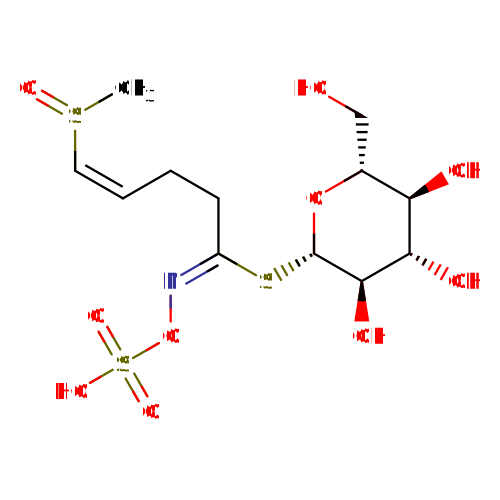
| Common Name | [(z)-[(4e)-5-methanesulfinyl-1-{[(2s,3r,4s,5s,6r)-3,4,5-trihydroxy-6-(hydroxymethyl)oxan-2-yl]sulfanyl}pent-4-en-1-ylidene]amino]oxysulfonic acid |
|---|
| Description | Glucoraphenin belongs to the class of organic compounds known as alkylglucosinolates. These are organic compounds containing a glucosinolate moiety that carries an alkyl chain. [(z)-[(4e)-5-methanesulfinyl-1-{[(2s,3r,4s,5s,6r)-3,4,5-trihydroxy-6-(hydroxymethyl)oxan-2-yl]sulfanyl}pent-4-en-1-ylidene]amino]oxysulfonic acid is found in Brassica aucheri, Brassica oleracea and Raphanus sativus. [(z)-[(4e)-5-methanesulfinyl-1-{[(2s,3r,4s,5s,6r)-3,4,5-trihydroxy-6-(hydroxymethyl)oxan-2-yl]sulfanyl}pent-4-en-1-ylidene]amino]oxysulfonic acid was first documented in 2020 (PMID: 32480264). Based on a literature review a small amount of articles have been published on Glucoraphenin (PMID: 36099817) (PMID: 35686604) (PMID: 35112855) (PMID: 33929187). |
|---|
| Structure | C[S+]([O-])\C=C\CC\C(S[C@@H]1O[C@H](CO)[C@@H](O)[C@H](O)[C@H]1O)=N\OS(O)(=O)=O InChI=1S/C12H21NO10S3/c1-25(18)5-3-2-4-8(13-23-26(19,20)21)24-12-11(17)10(16)9(15)7(6-14)22-12/h3,5,7,9-12,14-17H,2,4,6H2,1H3,(H,19,20,21)/b5-3+,13-8-/t7-,9-,10+,11-,12+,25?/m1/s1 |
|---|
| Synonyms | | Value | Source |
|---|
| 4-Methylsulfinyl-3-butenyl GL | MeSH | | 4-Methylsulfinyl-3-butenyl glucosinolate | MeSH |
|
|---|
| Chemical Formula | C12H21NO10S3 |
|---|
| Average Mass | 435.4800 Da |
|---|
| Monoisotopic Mass | 435.03276 Da |
|---|
| IUPAC Name | {[(Z)-[(4E)-5-methanesulfinyl-1-{[(2S,3R,4S,5S,6R)-3,4,5-trihydroxy-6-(hydroxymethyl)oxan-2-yl]sulfanyl}pent-4-en-1-ylidene]amino]oxy}sulfonic acid |
|---|
| Traditional Name | [(Z)-[(4E)-5-methanesulfinyl-1-{[(2S,3R,4S,5S,6R)-3,4,5-trihydroxy-6-(hydroxymethyl)oxan-2-yl]sulfanyl}pent-4-en-1-ylidene]amino]oxysulfonic acid |
|---|
| CAS Registry Number | Not Available |
|---|
| SMILES | C[S+]([O-])\C=C\CC\C(S[C@@H]1O[C@H](CO)[C@@H](O)[C@H](O)[C@H]1O)=N\OS(O)(=O)=O |
|---|
| InChI Identifier | InChI=1S/C12H21NO10S3/c1-25(18)5-3-2-4-8(13-23-26(19,20)21)24-12-11(17)10(16)9(15)7(6-14)22-12/h3,5,7,9-12,14-17H,2,4,6H2,1H3,(H,19,20,21)/b5-3+,13-8-/t7-,9-,10+,11-,12+,25?/m1/s1 |
|---|
| InChI Key | ZFLXCZJBYSPSKU-MUXZQFKVSA-N |
|---|
| Experimental Spectra |
|---|
|
| Not Available | | Predicted Spectra |
|---|
|
| | Spectrum Type | Description | Depositor ID | Depositor Organization | Depositor | Deposition Date | View |
|---|
| 1D NMR | 13C NMR Spectrum (1D, 25 MHz, H2O, predicted) | Wishart Lab | Wishart Lab | David Wishart | 2021-06-20 | View Spectrum | | 1D NMR | 1H NMR Spectrum (1D, 100 MHz, H2O, predicted) | Wishart Lab | Wishart Lab | David Wishart | 2021-06-20 | View Spectrum | | 1D NMR | 13C NMR Spectrum (1D, 252 MHz, H2O, predicted) | Wishart Lab | Wishart Lab | David Wishart | 2021-06-20 | View Spectrum | | 1D NMR | 1H NMR Spectrum (1D, 1000 MHz, H2O, predicted) | Wishart Lab | Wishart Lab | David Wishart | 2021-06-20 | View Spectrum | | 1D NMR | 13C NMR Spectrum (1D, 50 MHz, H2O, predicted) | Wishart Lab | Wishart Lab | David Wishart | 2021-06-20 | View Spectrum | | 1D NMR | 1H NMR Spectrum (1D, 200 MHz, H2O, predicted) | Wishart Lab | Wishart Lab | David Wishart | 2021-06-20 | View Spectrum | | 1D NMR | 13C NMR Spectrum (1D, 75 MHz, H2O, predicted) | Wishart Lab | Wishart Lab | David Wishart | 2021-06-20 | View Spectrum | | 1D NMR | 1H NMR Spectrum (1D, 300 MHz, H2O, predicted) | Wishart Lab | Wishart Lab | David Wishart | 2021-06-20 | View Spectrum | | 1D NMR | 13C NMR Spectrum (1D, 101 MHz, H2O, predicted) | Wishart Lab | Wishart Lab | David Wishart | 2021-06-20 | View Spectrum | | 1D NMR | 1H NMR Spectrum (1D, 400 MHz, H2O, predicted) | Wishart Lab | Wishart Lab | David Wishart | 2021-06-20 | View Spectrum | | 1D NMR | 13C NMR Spectrum (1D, 126 MHz, H2O, predicted) | Wishart Lab | Wishart Lab | David Wishart | 2021-06-20 | View Spectrum | | 1D NMR | 1H NMR Spectrum (1D, 500 MHz, H2O, predicted) | Wishart Lab | Wishart Lab | David Wishart | 2021-06-20 | View Spectrum | | 1D NMR | 13C NMR Spectrum (1D, 151 MHz, H2O, predicted) | Wishart Lab | Wishart Lab | David Wishart | 2021-06-20 | View Spectrum | | 1D NMR | 1H NMR Spectrum (1D, 600 MHz, H2O, predicted) | Wishart Lab | Wishart Lab | David Wishart | 2021-06-20 | View Spectrum | | 1D NMR | 13C NMR Spectrum (1D, 176 MHz, H2O, predicted) | Wishart Lab | Wishart Lab | David Wishart | 2021-06-20 | View Spectrum | | 1D NMR | 1H NMR Spectrum (1D, 700 MHz, H2O, predicted) | Wishart Lab | Wishart Lab | David Wishart | 2021-06-20 | View Spectrum | | 1D NMR | 13C NMR Spectrum (1D, 201 MHz, H2O, predicted) | Wishart Lab | Wishart Lab | David Wishart | 2021-06-20 | View Spectrum | | 1D NMR | 1H NMR Spectrum (1D, 800 MHz, H2O, predicted) | Wishart Lab | Wishart Lab | David Wishart | 2021-06-20 | View Spectrum | | 1D NMR | 13C NMR Spectrum (1D, 226 MHz, H2O, predicted) | Wishart Lab | Wishart Lab | David Wishart | 2021-06-20 | View Spectrum | | 1D NMR | 1H NMR Spectrum (1D, 900 MHz, H2O, predicted) | Wishart Lab | Wishart Lab | David Wishart | 2021-06-20 | View Spectrum |
| | Chemical Shift Submissions |
|---|
|
| Not Available | | Species |
|---|
| Species of Origin | |
|---|
| Chemical Taxonomy |
|---|
| Description | Belongs to the class of organic compounds known as alkylglucosinolates. These are organic compounds containing a glucosinolate moiety that carries an alkyl chain. |
|---|
| Kingdom | Organic compounds |
|---|
| Super Class | Organic oxygen compounds |
|---|
| Class | Organooxygen compounds |
|---|
| Sub Class | Carbohydrates and carbohydrate conjugates |
|---|
| Direct Parent | Alkylglucosinolates |
|---|
| Alternative Parents | |
|---|
| Substituents | - Alkylglucosinolate
- Glycosyl compound
- S-glycosyl compound
- Oxane
- Monothioacetal
- Organic sulfuric acid or derivatives
- Secondary alcohol
- Sulfoxide
- Oxacycle
- Polyol
- Organoheterocyclic compound
- Sulfenyl compound
- Sulfinyl compound
- Alcohol
- Organosulfur compound
- Organonitrogen compound
- Primary alcohol
- Organic nitrogen compound
- Organic oxide
- Hydrocarbon derivative
- Aliphatic heteromonocyclic compound
|
|---|
| Molecular Framework | Aliphatic heteromonocyclic compounds |
|---|
| External Descriptors | Not Available |
|---|
| Physical Properties |
|---|
| State | Not Available |
|---|
| Experimental Properties | | Property | Value | Reference |
|---|
| Melting Point | Not Available | Not Available | | Boiling Point | Not Available | Not Available | | Water Solubility | Not Available | Not Available | | LogP | Not Available | Not Available |
|
|---|
| Predicted Properties | |
|---|
| General References | - Demir K, Sarikamis G, Cakirer Seyrek G: Effect of LED lights on the growth, nutritional quality and glucosinolate content of broccoli, cabbage and radish microgreens. Food Chem. 2023 Feb 1;401:134088. doi: 10.1016/j.foodchem.2022.134088. Epub 2022 Sep 6. [PubMed:36099817 ]
- Oh MJ, Lee HHL, Lee HB, Do MH, Park M, Lee CH, Park HY: A water soluble extract of radish greens ameliorates high fat diet-induced obesity in mice and inhibits adipogenesis in preadipocytes. Food Funct. 2022 Jul 18;13(14):7494-7506. doi: 10.1039/d1fo04152e. [PubMed:35686604 ]
- Wang L, Jiang H, Qiu Y, Dong Y, Hamouda HI, Balah MA, Mao X: Biochemical Characterization of a Novel Myrosinase Rmyr from Rahnella inusitata for High-Level Preparation of Sulforaphene and Sulforaphane. J Agric Food Chem. 2022 Feb 23;70(7):2303-2311. doi: 10.1021/acs.jafc.1c07646. Epub 2022 Feb 3. [PubMed:35112855 ]
- Wang L, Jiang H, Liang X, Zhou W, Qiu Y, Xue C, Sun J, Mao X: Preparation of Sulforaphene from Radish Seed Extracts with Recombinant Food-Grade Yarrowia lipolytica Harboring High Myrosinase Activity. J Agric Food Chem. 2021 May 12;69(18):5363-5371. doi: 10.1021/acs.jafc.1c01400. Epub 2021 Apr 30. [PubMed:33929187 ]
- Kim SY, Seo HY, Ha JH: A colorimetric sensor array for the discrimination of glucosinolates. Food Chem. 2020 Oct 30;328:127149. doi: 10.1016/j.foodchem.2020.127149. Epub 2020 May 26. [PubMed:32480264 ]
- LOTUS database [Link]
|
|---|