| Record Information |
|---|
| Version | 2.0 |
|---|
| Created at | 2022-09-09 02:51:46 UTC |
|---|
| Updated at | 2022-09-09 02:51:47 UTC |
|---|
| NP-MRD ID | NP0277990 |
|---|
| Secondary Accession Numbers | None |
|---|
| Natural Product Identification |
|---|
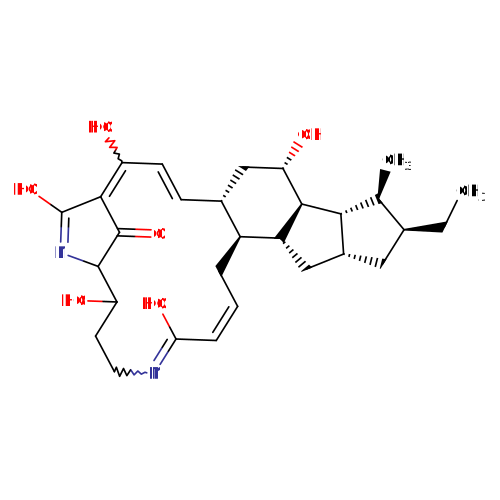
| Common Name | (3e,5s,7s,8r,9s,10s,11s,13r,15r,16s,18z)-11-ethyl-2,7,20,24,27-pentahydroxy-10-methyl-21,26-diazapentacyclo[23.2.1.0⁵,¹⁶.0⁸,¹⁵.0⁹,¹³]octacosa-1,3,18,20,26-pentaen-28-one |
|---|
| Description | Dihydromaltophilin belongs to the class of organic compounds known as macrolactams. These are cyclic amides of amino carboxylic acids, having a 1-azacycloalkan-2-one structure, or analogues having unsaturation or heteroatoms replacing one or more carbon atoms of the ring. They are nitrogen analogues (the a nitrogen atom replacing the o atom of the cyclic carboxylic acid group ) of the naturally occurring macrolides. (3e,5s,7s,8r,9s,10s,11s,13r,15r,16s,18z)-11-ethyl-2,7,20,24,27-pentahydroxy-10-methyl-21,26-diazapentacyclo[23.2.1.0⁵,¹⁶.0⁸,¹⁵.0⁹,¹³]octacosa-1,3,18,20,26-pentaen-28-one was first documented in 2007 (PMID: 17074795). Based on a literature review a significant number of articles have been published on Dihydromaltophilin (PMID: 34204563) (PMID: 21930890) (PMID: 33012119) (PMID: 24890524) (PMID: 21462551) (PMID: 18944294). |
|---|
| Structure | CC[C@H]1C[C@@H]2C[C@H]3[C@H]([C@@H]2[C@H]1C)[C@@H](O)C[C@H]1\C=C\C(O)=C2C(O)=NC(C(O)CCN=C(O)\C=C/C[C@H]31)C2=O InChI=1S/C29H40N2O6/c1-3-15-11-17-12-19-18-5-4-6-23(35)30-10-9-21(33)27-28(36)26(29(37)31-27)20(32)8-7-16(18)13-22(34)25(19)24(17)14(15)2/h4,6-8,14-19,21-22,24-25,27,32-34H,3,5,9-13H2,1-2H3,(H,30,35)(H,31,37)/b6-4-,8-7+,26-20?/t14-,15-,16+,17+,18-,19+,21?,22-,24+,25-,27?/m0/s1 |
|---|
| Synonyms | Not Available |
|---|
| Chemical Formula | C29H40N2O6 |
|---|
| Average Mass | 512.6470 Da |
|---|
| Monoisotopic Mass | 512.28864 Da |
|---|
| IUPAC Name | (3E,5S,7S,8R,9S,10S,11S,13R,15R,16S,18Z)-11-ethyl-2,7,20,24,27-pentahydroxy-10-methyl-21,26-diazapentacyclo[23.2.1.0^{5,16}.0^{8,15}.0^{9,13}]octacosa-1,3,18,20,26-pentaen-28-one |
|---|
| Traditional Name | (3E,5S,7S,8R,9S,10S,11S,13R,15R,16S,18Z)-11-ethyl-2,7,20,24,27-pentahydroxy-10-methyl-21,26-diazapentacyclo[23.2.1.0^{5,16}.0^{8,15}.0^{9,13}]octacosa-1,3,18,20,26-pentaen-28-one |
|---|
| CAS Registry Number | Not Available |
|---|
| SMILES | CC[C@H]1C[C@@H]2C[C@H]3[C@H]([C@@H]2[C@H]1C)[C@@H](O)C[C@H]1\C=C\C(O)=C2C(O)=NC(C(O)CCN=C(O)\C=C/C[C@H]31)C2=O |
|---|
| InChI Identifier | InChI=1S/C29H40N2O6/c1-3-15-11-17-12-19-18-5-4-6-23(35)30-10-9-21(33)27-28(36)26(29(37)31-27)20(32)8-7-16(18)13-22(34)25(19)24(17)14(15)2/h4,6-8,14-19,21-22,24-25,27,32-34H,3,5,9-13H2,1-2H3,(H,30,35)(H,31,37)/b6-4-,8-7+,26-20?/t14-,15-,16+,17+,18-,19+,21?,22-,24+,25-,27?/m0/s1 |
|---|
| InChI Key | VYCDZNHSSDXACI-SGXRADKASA-N |
|---|
| Experimental Spectra |
|---|
|
| Not Available | | Predicted Spectra |
|---|
|
| | Spectrum Type | Description | Depositor ID | Depositor Organization | Depositor | Deposition Date | View |
|---|
| 1D NMR | 13C NMR Spectrum (1D, 25 MHz, H2O, predicted) | Wishart Lab | Wishart Lab | David Wishart | 2021-06-20 | View Spectrum | | 1D NMR | 1H NMR Spectrum (1D, 100 MHz, H2O, predicted) | Wishart Lab | Wishart Lab | David Wishart | 2021-06-20 | View Spectrum | | 1D NMR | 13C NMR Spectrum (1D, 252 MHz, H2O, predicted) | Wishart Lab | Wishart Lab | David Wishart | 2021-06-20 | View Spectrum | | 1D NMR | 1H NMR Spectrum (1D, 1000 MHz, H2O, predicted) | Wishart Lab | Wishart Lab | David Wishart | 2021-06-20 | View Spectrum | | 1D NMR | 13C NMR Spectrum (1D, 50 MHz, H2O, predicted) | Wishart Lab | Wishart Lab | David Wishart | 2021-06-20 | View Spectrum | | 1D NMR | 1H NMR Spectrum (1D, 200 MHz, H2O, predicted) | Wishart Lab | Wishart Lab | David Wishart | 2021-06-20 | View Spectrum | | 1D NMR | 13C NMR Spectrum (1D, 75 MHz, H2O, predicted) | Wishart Lab | Wishart Lab | David Wishart | 2021-06-20 | View Spectrum | | 1D NMR | 1H NMR Spectrum (1D, 300 MHz, H2O, predicted) | Wishart Lab | Wishart Lab | David Wishart | 2021-06-20 | View Spectrum | | 1D NMR | 13C NMR Spectrum (1D, 101 MHz, H2O, predicted) | Wishart Lab | Wishart Lab | David Wishart | 2021-06-20 | View Spectrum | | 1D NMR | 1H NMR Spectrum (1D, 400 MHz, H2O, predicted) | Wishart Lab | Wishart Lab | David Wishart | 2021-06-20 | View Spectrum | | 1D NMR | 13C NMR Spectrum (1D, 126 MHz, H2O, predicted) | Wishart Lab | Wishart Lab | David Wishart | 2021-06-20 | View Spectrum | | 1D NMR | 1H NMR Spectrum (1D, 500 MHz, H2O, predicted) | Wishart Lab | Wishart Lab | David Wishart | 2021-06-20 | View Spectrum | | 1D NMR | 13C NMR Spectrum (1D, 151 MHz, H2O, predicted) | Wishart Lab | Wishart Lab | David Wishart | 2021-06-20 | View Spectrum | | 1D NMR | 1H NMR Spectrum (1D, 600 MHz, H2O, predicted) | Wishart Lab | Wishart Lab | David Wishart | 2021-06-20 | View Spectrum | | 1D NMR | 13C NMR Spectrum (1D, 176 MHz, H2O, predicted) | Wishart Lab | Wishart Lab | David Wishart | 2021-06-20 | View Spectrum | | 1D NMR | 1H NMR Spectrum (1D, 700 MHz, H2O, predicted) | Wishart Lab | Wishart Lab | David Wishart | 2021-06-20 | View Spectrum | | 1D NMR | 13C NMR Spectrum (1D, 201 MHz, H2O, predicted) | Wishart Lab | Wishart Lab | David Wishart | 2021-06-20 | View Spectrum | | 1D NMR | 1H NMR Spectrum (1D, 800 MHz, H2O, predicted) | Wishart Lab | Wishart Lab | David Wishart | 2021-06-20 | View Spectrum | | 1D NMR | 13C NMR Spectrum (1D, 226 MHz, H2O, predicted) | Wishart Lab | Wishart Lab | David Wishart | 2021-06-20 | View Spectrum | | 1D NMR | 1H NMR Spectrum (1D, 900 MHz, H2O, predicted) | Wishart Lab | Wishart Lab | David Wishart | 2021-06-20 | View Spectrum |
| | Chemical Shift Submissions |
|---|
|
| Not Available | | Species |
|---|
| Species of Origin | Not Available |
|---|
| Chemical Taxonomy |
|---|
| Description | Belongs to the class of organic compounds known as macrolactams. These are cyclic amides of amino carboxylic acids, having a 1-azacycloalkan-2-one structure, or analogues having unsaturation or heteroatoms replacing one or more carbon atoms of the ring. They are nitrogen analogues (the a nitrogen atom replacing the o atom of the cyclic carboxylic acid group ) of the naturally occurring macrolides. |
|---|
| Kingdom | Organic compounds |
|---|
| Super Class | Phenylpropanoids and polyketides |
|---|
| Class | Macrolactams |
|---|
| Sub Class | Not Available |
|---|
| Direct Parent | Macrolactams |
|---|
| Alternative Parents | |
|---|
| Substituents | - Macrolactam
- Monoterpenoid
- 3-pyrrolidone
- 2-pyrrolidone
- Pyrrolidone
- Vinylogous acid
- Pyrrolidine
- Cyclic alcohol
- Secondary carboxylic acid amide
- Secondary alcohol
- Lactam
- Ketone
- Carboxamide group
- Azacycle
- Organoheterocyclic compound
- Polyol
- Enol
- Carboxylic acid derivative
- Organic nitrogen compound
- Organic oxygen compound
- Organopnictogen compound
- Organic oxide
- Hydrocarbon derivative
- Organooxygen compound
- Organonitrogen compound
- Carbonyl group
- Alcohol
- Aliphatic heteropolycyclic compound
|
|---|
| Molecular Framework | Aliphatic heteropolycyclic compounds |
|---|
| External Descriptors | Not Available |
|---|
| Physical Properties |
|---|
| State | Not Available |
|---|
| Experimental Properties | | Property | Value | Reference |
|---|
| Melting Point | Not Available | Not Available | | Boiling Point | Not Available | Not Available | | Water Solubility | Not Available | Not Available | | LogP | Not Available | Not Available |
|
|---|
| Predicted Properties | |
|---|
| General References | - Brescia F, Vlassi A, Bejarano A, Seidl B, Marchetti-Deschmann M, Schuhmacher R, Puopolo G: Characterisation of the Antibiotic Profile of Lysobacter capsici AZ78, an Effective Biological Control Agent of Plant Pathogenic Microorganisms. Microorganisms. 2021 Jun 17;9(6). pii: microorganisms9061320. doi: 10.3390/microorganisms9061320. [PubMed:34204563 ]
- Zhang W, Li Y, Qian G, Wang Y, Chen H, Li YZ, Liu F, Shen Y, Du L: Identification and characterization of the anti-methicillin-resistant Staphylococcus aureus WAP-8294A2 biosynthetic gene cluster from Lysobacter enzymogenes OH11. Antimicrob Agents Chemother. 2011 Dec;55(12):5581-9. doi: 10.1128/AAC.05370-11. Epub 2011 Sep 19. [PubMed:21930890 ]
- Li C, Tang B, Cao S, Bao Y, Sun W, Zhao Y, Liu F: Biocontrol ability and action mechanism of dihydromaltophilin against Colletotrichum fructicola causing anthracnose of pear fruit. Pest Manag Sci. 2021 Feb;77(2):1061-1069. doi: 10.1002/ps.6122. Epub 2020 Oct 19. [PubMed:33012119 ]
- Li Y, Chen H, Ding Y, Xie Y, Wang H, Cerny RL, Shen Y, Du L: Iterative assembly of two separate polyketide chains by the same single-module bacterial polyketide synthase in the biosynthesis of HSAF. Angew Chem Int Ed Engl. 2014 Jul 14;53(29):7524-7530. doi: 10.1002/anie.201403500. Epub 2014 May 30. [PubMed:24890524 ]
- Li S, Calvo AM, Yuen GY, Du L, Harris SD: Induction of cell wall thickening by the antifungal compound dihydromaltophilin disrupts fungal growth and is mediated by sphingolipid biosynthesis. J Eukaryot Microbiol. 2009 Mar-Apr;56(2):182-7. doi: 10.1111/j.1550-7408.2008.00384.x. [PubMed:21462551 ]
- Li S, Jochum CC, Yu F, Zaleta-Rivera K, Du L, Harris SD, Yuen GY: An antibiotic complex from Lysobacter enzymogenes strain C3: antimicrobial activity and role in plant disease control. Phytopathology. 2008 Jun;98(6):695-701. doi: 10.1094/PHYTO-98-6-0695. [PubMed:18944294 ]
- Yu F, Zaleta-Rivera K, Zhu X, Huffman J, Millet JC, Harris SD, Yuen G, Li XC, Du L: Structure and biosynthesis of heat-stable antifungal factor (HSAF), a broad-spectrum antimycotic with a novel mode of action. Antimicrob Agents Chemother. 2007 Jan;51(1):64-72. doi: 10.1128/AAC.00931-06. Epub 2006 Oct 30. [PubMed:17074795 ]
- LOTUS database [Link]
|
|---|