| Record Information |
|---|
| Version | 2.0 |
|---|
| Created at | 2022-09-08 23:50:49 UTC |
|---|
| Updated at | 2022-09-08 23:50:49 UTC |
|---|
| NP-MRD ID | NP0275933 |
|---|
| Secondary Accession Numbers | None |
|---|
| Natural Product Identification |
|---|
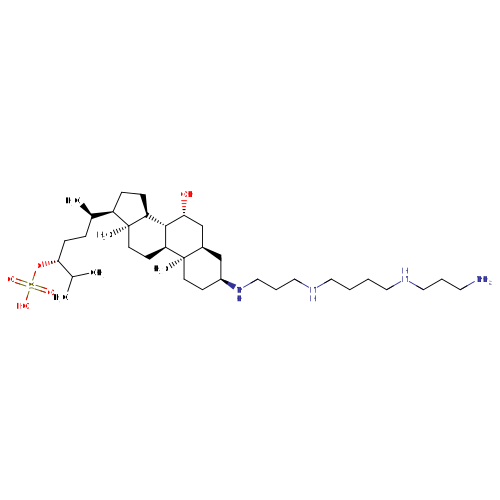
| Common Name | trodusquemine |
|---|
| Description | Trodusquemine belongs to the class of organic compounds known as monohydroxy bile acids, alcohols and derivatives. These are bile acids, alcohols or any of their derivatives bearing a hydroxyl group. Thus, trodusquemine is considered to be a steroid conjugate. trodusquemine is found in Squalus acanthias. trodusquemine was first documented in 2021 (PMID: 34382791). Based on a literature review a significant number of articles have been published on Trodusquemine (PMID: 35255350) (PMID: 35162998) (PMID: 34698757) (PMID: 34380879) (PMID: 34220435) (PMID: 34044147). |
|---|
| Structure | CC(C)[C@@H](CC[C@@H](C)[C@H]1CC[C@H]2[C@@H]3[C@H](O)C[C@H]4C[C@H](CC[C@]4(C)[C@H]3CC[C@]12C)NCCCNCCCCNCCCN)OS(O)(=O)=O InChI=1S/C37H72N4O5S/c1-26(2)34(46-47(43,44)45)13-10-27(3)30-11-12-31-35-32(15-17-37(30,31)5)36(4)16-14-29(24-28(36)25-33(35)42)41-23-9-22-40-20-7-6-19-39-21-8-18-38/h26-35,39-42H,6-25,38H2,1-5H3,(H,43,44,45)/t27-,28-,29+,30-,31+,32+,33-,34-,35+,36+,37-/m1/s1 |
|---|
| Synonyms | | Value | Source |
|---|
| 3-N-1(Spermine)-7, 24-dihydroxy-5-cholestane 24-sulfate | MeSH | | 3beta-N-1(Spermine)-7alpha, 24R-dihydroxy-5alpha-cholestane 24-sulfate | MeSH |
|
|---|
| Chemical Formula | C37H72N4O5S |
|---|
| Average Mass | 685.0700 Da |
|---|
| Monoisotopic Mass | 684.52234 Da |
|---|
| IUPAC Name | {[(3R,6R)-6-[(1S,2S,5S,7R,9R,10R,11S,14R,15R)-5-{[3-({4-[(3-aminopropyl)amino]butyl}amino)propyl]amino}-9-hydroxy-2,15-dimethyltetracyclo[8.7.0.0^{2,7}.0^{11,15}]heptadecan-14-yl]-2-methylheptan-3-yl]oxy}sulfonic acid |
|---|
| Traditional Name | [(3R,6R)-6-[(1S,2S,5S,7R,9R,10R,11S,14R,15R)-5-{[3-({4-[(3-aminopropyl)amino]butyl}amino)propyl]amino}-9-hydroxy-2,15-dimethyltetracyclo[8.7.0.0^{2,7}.0^{11,15}]heptadecan-14-yl]-2-methylheptan-3-yl]oxysulfonic acid |
|---|
| CAS Registry Number | Not Available |
|---|
| SMILES | CC(C)[C@@H](CC[C@@H](C)[C@H]1CC[C@H]2[C@@H]3[C@H](O)C[C@H]4C[C@H](CC[C@]4(C)[C@H]3CC[C@]12C)NCCCNCCCCNCCCN)OS(O)(=O)=O |
|---|
| InChI Identifier | InChI=1S/C37H72N4O5S/c1-26(2)34(46-47(43,44)45)13-10-27(3)30-11-12-31-35-32(15-17-37(30,31)5)36(4)16-14-29(24-28(36)25-33(35)42)41-23-9-22-40-20-7-6-19-39-21-8-18-38/h26-35,39-42H,6-25,38H2,1-5H3,(H,43,44,45)/t27-,28-,29+,30-,31+,32+,33-,34-,35+,36+,37-/m1/s1 |
|---|
| InChI Key | WUJVPODXELZABP-FWJXURDUSA-N |
|---|
| Experimental Spectra |
|---|
|
| Not Available | | Predicted Spectra |
|---|
|
| | Spectrum Type | Description | Depositor ID | Depositor Organization | Depositor | Deposition Date | View |
|---|
| 1D NMR | 13C NMR Spectrum (1D, 25 MHz, H2O, predicted) | Wishart Lab | Wishart Lab | David Wishart | 2021-06-20 | View Spectrum | | 1D NMR | 1H NMR Spectrum (1D, 100 MHz, H2O, predicted) | Wishart Lab | Wishart Lab | David Wishart | 2021-06-20 | View Spectrum | | 1D NMR | 13C NMR Spectrum (1D, 252 MHz, H2O, predicted) | Wishart Lab | Wishart Lab | David Wishart | 2021-06-20 | View Spectrum | | 1D NMR | 1H NMR Spectrum (1D, 1000 MHz, H2O, predicted) | Wishart Lab | Wishart Lab | David Wishart | 2021-06-20 | View Spectrum | | 1D NMR | 13C NMR Spectrum (1D, 50 MHz, H2O, predicted) | Wishart Lab | Wishart Lab | David Wishart | 2021-06-20 | View Spectrum | | 1D NMR | 1H NMR Spectrum (1D, 200 MHz, H2O, predicted) | Wishart Lab | Wishart Lab | David Wishart | 2021-06-20 | View Spectrum | | 1D NMR | 13C NMR Spectrum (1D, 75 MHz, H2O, predicted) | Wishart Lab | Wishart Lab | David Wishart | 2021-06-20 | View Spectrum | | 1D NMR | 1H NMR Spectrum (1D, 300 MHz, H2O, predicted) | Wishart Lab | Wishart Lab | David Wishart | 2021-06-20 | View Spectrum | | 1D NMR | 13C NMR Spectrum (1D, 101 MHz, H2O, predicted) | Wishart Lab | Wishart Lab | David Wishart | 2021-06-20 | View Spectrum | | 1D NMR | 1H NMR Spectrum (1D, 400 MHz, H2O, predicted) | Wishart Lab | Wishart Lab | David Wishart | 2021-06-20 | View Spectrum | | 1D NMR | 13C NMR Spectrum (1D, 126 MHz, H2O, predicted) | Wishart Lab | Wishart Lab | David Wishart | 2021-06-20 | View Spectrum | | 1D NMR | 1H NMR Spectrum (1D, 500 MHz, H2O, predicted) | Wishart Lab | Wishart Lab | David Wishart | 2021-06-20 | View Spectrum | | 1D NMR | 13C NMR Spectrum (1D, 151 MHz, H2O, predicted) | Wishart Lab | Wishart Lab | David Wishart | 2021-06-20 | View Spectrum | | 1D NMR | 1H NMR Spectrum (1D, 600 MHz, H2O, predicted) | Wishart Lab | Wishart Lab | David Wishart | 2021-06-20 | View Spectrum | | 1D NMR | 13C NMR Spectrum (1D, 176 MHz, H2O, predicted) | Wishart Lab | Wishart Lab | David Wishart | 2021-06-20 | View Spectrum | | 1D NMR | 1H NMR Spectrum (1D, 700 MHz, H2O, predicted) | Wishart Lab | Wishart Lab | David Wishart | 2021-06-20 | View Spectrum | | 1D NMR | 13C NMR Spectrum (1D, 201 MHz, H2O, predicted) | Wishart Lab | Wishart Lab | David Wishart | 2021-06-20 | View Spectrum | | 1D NMR | 1H NMR Spectrum (1D, 800 MHz, H2O, predicted) | Wishart Lab | Wishart Lab | David Wishart | 2021-06-20 | View Spectrum | | 1D NMR | 13C NMR Spectrum (1D, 226 MHz, H2O, predicted) | Wishart Lab | Wishart Lab | David Wishart | 2021-06-20 | View Spectrum | | 1D NMR | 1H NMR Spectrum (1D, 900 MHz, H2O, predicted) | Wishart Lab | Wishart Lab | David Wishart | 2021-06-20 | View Spectrum |
| | Chemical Shift Submissions |
|---|
|
| Not Available | | Species |
|---|
| Species of Origin | |
|---|
| Chemical Taxonomy |
|---|
| Description | Belongs to the class of organic compounds known as monohydroxy bile acids, alcohols and derivatives. These are bile acids, alcohols or any of their derivatives bearing a hydroxyl group. |
|---|
| Kingdom | Organic compounds |
|---|
| Super Class | Lipids and lipid-like molecules |
|---|
| Class | Steroids and steroid derivatives |
|---|
| Sub Class | Bile acids, alcohols and derivatives |
|---|
| Direct Parent | Monohydroxy bile acids, alcohols and derivatives |
|---|
| Alternative Parents | |
|---|
| Substituents | - Monohydroxy bile acid, alcohol, or derivatives
- Sulfated steroid skeleton
- Steroidal alkaloid
- Pregnane-type alkaloid
- Hydroxysteroid
- 7-hydroxysteroid
- Azasteroid
- Alkaloid or derivatives
- Sulfuric acid ester
- Alkyl sulfate
- Sulfate-ester
- Sulfuric acid monoester
- Cyclic alcohol
- Organic sulfuric acid or derivatives
- Secondary alcohol
- Secondary amine
- Secondary aliphatic amine
- Primary amine
- Organooxygen compound
- Organonitrogen compound
- Hydrocarbon derivative
- Organic oxide
- Primary aliphatic amine
- Organopnictogen compound
- Organic oxygen compound
- Organic nitrogen compound
- Amine
- Alcohol
- Aliphatic homopolycyclic compound
|
|---|
| Molecular Framework | Aliphatic homopolycyclic compounds |
|---|
| External Descriptors | Not Available |
|---|
| Physical Properties |
|---|
| State | Not Available |
|---|
| Experimental Properties | | Property | Value | Reference |
|---|
| Melting Point | Not Available | Not Available | | Boiling Point | Not Available | Not Available | | Water Solubility | Not Available | Not Available | | LogP | Not Available | Not Available |
|
|---|
| Predicted Properties | |
|---|
| General References | - Singh S, Singh Grewal A, Grover R, Sharma N, Chopra B, Kumar Dhingra A, Arora S, Redhu S, Lather V: Recent updates on development of protein-tyrosine phosphatase 1B inhibitors for treatment of diabetes, obesity and related disorders. Bioorg Chem. 2022 Apr;121:105626. doi: 10.1016/j.bioorg.2022.105626. Epub 2022 Feb 24. [PubMed:35255350 ]
- Kazakova O, Giniyatullina G, Babkov D, Wimmer Z: From Marine Metabolites to the Drugs of the Future: Squalamine, Trodusquemine, Their Steroid and Triterpene Analogues. Int J Mol Sci. 2022 Jan 19;23(3):1075. doi: 10.3390/ijms23031075. [PubMed:35162998 ]
- Limbocker R, Errico S, Barbut D, Knowles TPJ, Vendruscolo M, Chiti F, Zasloff M: Squalamine and trodusquemine: two natural products for neurodegenerative diseases, from physical chemistry to the clinic. Nat Prod Rep. 2022 Apr 20;39(4):742-753. doi: 10.1039/d1np00042j. [PubMed:34698757 ]
- Errico S, Ramshini H, Capitini C, Canale C, Spaziano M, Barbut D, Calamai M, Zasloff M, Oropesa-Nunez R, Vendruscolo M, Chiti F: Quantitative Measurement of the Affinity of Toxic and Nontoxic Misfolded Protein Oligomers for Lipid Bilayers and of its Modulation by Lipid Composition and Trodusquemine. ACS Chem Neurosci. 2021 Sep 1;12(17):3189-3202. doi: 10.1021/acschemneuro.1c00327. Epub 2021 Aug 12. [PubMed:34382791 ]
- Pena-DIaz S, Ventura S: One ring is sufficient to inhibit alpha-synuclein aggregation. Neural Regen Res. 2022 Mar;17(3):508-511. doi: 10.4103/1673-5374.320973. [PubMed:34380879 ]
- Limbocker R, Staats R, Chia S, Ruggeri FS, Mannini B, Xu CK, Perni M, Cascella R, Bigi A, Sasser LR, Block NR, Wright AK, Kreiser RP, Custy ET, Meisl G, Errico S, Habchi J, Flagmeier P, Kartanas T, Hollows JE, Nguyen LT, LeForte K, Barbut D, Kumita JR, Cecchi C, Zasloff M, Knowles TPJ, Dobson CM, Chiti F, Vendruscolo M: Squalamine and Its Derivatives Modulate the Aggregation of Amyloid-beta and alpha-Synuclein and Suppress the Toxicity of Their Oligomers. Front Neurosci. 2021 Jun 18;15:680026. doi: 10.3389/fnins.2021.680026. eCollection 2021. [PubMed:34220435 ]
- Zhang L, Qin Z, Sharmin F, Lin W, Ricke KM, Zasloff MA, Stewart AFR, Chen HH: Tyrosine phosphatase PTP1B impairs presynaptic NMDA receptor-mediated plasticity in a mouse model of Alzheimer's disease. Neurobiol Dis. 2021 Aug;156:105402. doi: 10.1016/j.nbd.2021.105402. Epub 2021 May 24. [PubMed:34044147 ]
- LOTUS database [Link]
|
|---|