| Record Information |
|---|
| Version | 2.0 |
|---|
| Created at | 2022-09-08 16:29:06 UTC |
|---|
| Updated at | 2022-09-08 16:29:06 UTC |
|---|
| NP-MRD ID | NP0270525 |
|---|
| Secondary Accession Numbers | None |
|---|
| Natural Product Identification |
|---|
| Common Name | vita e |
|---|
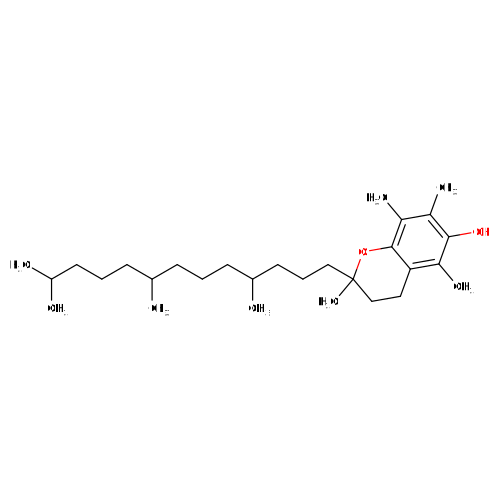
| Description | α-Tocopherol, also known as vitamin e, belongs to the class of organic compounds known as tocopherols. These are vitamin E derivatives containing a saturated trimethyltridecyl chain attached to the carbon C6 atom of a benzopyran ring system. The differ from tocotrienols that contain an unsaturated trimethyltrideca-3,7,11-trien-1-yl chain. α-Tocopherol is an extremely weak basic (essentially neutral) compound (based on its pKa). Outside of the human body, α-tocopherol has been detected, but not quantified in, several different foods, such as german camomiles, summer savories, abiyuchs, common buckwheats, and hyacinth beans. This could make α-tocopherol a potential biomarker for the consumption of these foods. α-Tocopherol has three stereocenters, so it is a chiral molecule. This mix of stereoisomers is often called dl-α-tocopheryl acetate. The SRR may be named 2-epi-α-tocopherol, the diastereomeric mixture of RRR-α-tocopherol and 2-epi-α-tocopherol may be called 2-ambo-α-tocopherol (formerly named dl-α-tocopherol). However, 1 IU of this mixture of diastereomers is not now considered equivalent to 1 IU of natural RRR-α-tocopherol, and the Institute of Medicine and the USDA now convert IUs of the racemic mixture to milligrams of equivalent RRR using 1 IU racemic mixture 0.45 "Mg α-tocopherol". Older name of RRR-α-tocopherol is d-α-tocopherol, but this d/l naming should be no longer used, because whether l-α-tocopherol should mean SSS enantiomer or the SRR diastereomer is not clear, from historical reasons. The mixture of all eight diastereomers is called all-rac-α-tocopherolOne IU of tocopherol is defined as ⅔ milligrams of RRR-α-tocopherol (formerly named d-α-tocopherol, or sometimes ddd-α-tocopherol). The eight stereoisomers of α-tocopherol differ the configuration on these stereocenters. All feature a chromane ring, with a hydroxyl group that can donate a hydrogen atom to reduce free radicals and a hydrophobic side chain which allows for penetration into biological membranes. α-Tocopherol is a type of vitamin E. It has E number "E307". vita e is found in Acca sellowiana, Albifimbria verrucaria, Antidesma pentandrum, Calea jamaicensis, Corymbia citriodora, Cupania americana, Cystoseira barbata, Daphne gnidium, Dictyota dichotoma, Dioscorea alata, Diospyros maritima, Euglena gracilis, Euscaphis japonica, Ficus pumila, Fossombronia alaskana, Goniophlebium mengtzeense, Hemerocallis fulva, Labisia pumila, Litsea acutivena, Machilus zuihoensis, Neolitsea hiiranensis, Oncorhynchus keta, Piper aduncum, Piper guineense, Pittosporum tobira, Rhododendron formosanum, Rhodomyrtus tomentosa, Trichilia claussenii, Vaccinium myrtillus and Xylocarpus granatum. Compared to the others, α-tocopherol is preferentially absorbed and accumulated in humans. |
|---|
| Structure | CC(C)CCCC(C)CCCC(C)CCCC1(C)CCC2=C(C)C(O)=C(C)C(C)=C2O1 InChI=1S/C29H50O2/c1-20(2)12-9-13-21(3)14-10-15-22(4)16-11-18-29(8)19-17-26-25(7)27(30)23(5)24(6)28(26)31-29/h20-22,30H,9-19H2,1-8H3 |
|---|
| Synonyms | |
|---|
| Chemical Formula | C29H50O2 |
|---|
| Average Mass | 430.7170 Da |
|---|
| Monoisotopic Mass | 430.38108 Da |
|---|
| IUPAC Name | 2,5,7,8-tetramethyl-2-(4,8,12-trimethyltridecyl)-3,4-dihydro-2H-1-benzopyran-6-ol |
|---|
| Traditional Name | vita E |
|---|
| CAS Registry Number | Not Available |
|---|
| SMILES | CC(C)CCCC(C)CCCC(C)CCCC1(C)CCC2=C(C)C(O)=C(C)C(C)=C2O1 |
|---|
| InChI Identifier | InChI=1S/C29H50O2/c1-20(2)12-9-13-21(3)14-10-15-22(4)16-11-18-29(8)19-17-26-25(7)27(30)23(5)24(6)28(26)31-29/h20-22,30H,9-19H2,1-8H3 |
|---|
| InChI Key | GVJHHUAWPYXKBD-UHFFFAOYSA-N |
|---|
| Experimental Spectra |
|---|
|
| Not Available | | Predicted Spectra |
|---|
|
| | Spectrum Type | Description | Depositor ID | Depositor Organization | Depositor | Deposition Date | View |
|---|
| 1D NMR | 13C NMR Spectrum (1D, 25 MHz, H2O, predicted) | Wishart Lab | Wishart Lab | David Wishart | 2021-06-20 | View Spectrum | | 1D NMR | 1H NMR Spectrum (1D, 100 MHz, H2O, predicted) | Wishart Lab | Wishart Lab | David Wishart | 2021-06-20 | View Spectrum | | 1D NMR | 13C NMR Spectrum (1D, 252 MHz, H2O, predicted) | Wishart Lab | Wishart Lab | David Wishart | 2021-06-20 | View Spectrum | | 1D NMR | 1H NMR Spectrum (1D, 1000 MHz, H2O, predicted) | Wishart Lab | Wishart Lab | David Wishart | 2021-06-20 | View Spectrum | | 1D NMR | 13C NMR Spectrum (1D, 50 MHz, H2O, predicted) | Wishart Lab | Wishart Lab | David Wishart | 2021-06-20 | View Spectrum | | 1D NMR | 1H NMR Spectrum (1D, 200 MHz, H2O, predicted) | Wishart Lab | Wishart Lab | David Wishart | 2021-06-20 | View Spectrum | | 1D NMR | 13C NMR Spectrum (1D, 75 MHz, H2O, predicted) | Wishart Lab | Wishart Lab | David Wishart | 2021-06-20 | View Spectrum | | 1D NMR | 1H NMR Spectrum (1D, 300 MHz, H2O, predicted) | Wishart Lab | Wishart Lab | David Wishart | 2021-06-20 | View Spectrum | | 1D NMR | 13C NMR Spectrum (1D, 101 MHz, H2O, predicted) | Wishart Lab | Wishart Lab | David Wishart | 2021-06-20 | View Spectrum | | 1D NMR | 1H NMR Spectrum (1D, 400 MHz, H2O, predicted) | Wishart Lab | Wishart Lab | David Wishart | 2021-06-20 | View Spectrum | | 1D NMR | 13C NMR Spectrum (1D, 126 MHz, H2O, predicted) | Wishart Lab | Wishart Lab | David Wishart | 2021-06-20 | View Spectrum | | 1D NMR | 1H NMR Spectrum (1D, 500 MHz, H2O, predicted) | Wishart Lab | Wishart Lab | David Wishart | 2021-06-20 | View Spectrum | | 1D NMR | 13C NMR Spectrum (1D, 151 MHz, H2O, predicted) | Wishart Lab | Wishart Lab | David Wishart | 2021-06-20 | View Spectrum | | 1D NMR | 1H NMR Spectrum (1D, 600 MHz, H2O, predicted) | Wishart Lab | Wishart Lab | David Wishart | 2021-06-20 | View Spectrum | | 1D NMR | 13C NMR Spectrum (1D, 176 MHz, H2O, predicted) | Wishart Lab | Wishart Lab | David Wishart | 2021-06-20 | View Spectrum | | 1D NMR | 1H NMR Spectrum (1D, 700 MHz, H2O, predicted) | Wishart Lab | Wishart Lab | David Wishart | 2021-06-20 | View Spectrum | | 1D NMR | 13C NMR Spectrum (1D, 201 MHz, H2O, predicted) | Wishart Lab | Wishart Lab | David Wishart | 2021-06-20 | View Spectrum | | 1D NMR | 1H NMR Spectrum (1D, 800 MHz, H2O, predicted) | Wishart Lab | Wishart Lab | David Wishart | 2021-06-20 | View Spectrum | | 1D NMR | 13C NMR Spectrum (1D, 226 MHz, H2O, predicted) | Wishart Lab | Wishart Lab | David Wishart | 2021-06-20 | View Spectrum | | 1D NMR | 1H NMR Spectrum (1D, 900 MHz, H2O, predicted) | Wishart Lab | Wishart Lab | David Wishart | 2021-06-20 | View Spectrum |
| | Chemical Shift Submissions |
|---|
|
| Not Available | | Species |
|---|
| Species of Origin | |
|---|
| Chemical Taxonomy |
|---|
| Description | Belongs to the class of organic compounds known as tocopherols. These are vitamin E derivatives containing a saturated trimethyltridecyl chain attached to the carbon C6 atom of a benzopyran ring system. The differ from tocotrienols that contain an unsaturated trimethyltrideca-3,7,11-trien-1-yl chain. |
|---|
| Kingdom | Organic compounds |
|---|
| Super Class | Lipids and lipid-like molecules |
|---|
| Class | Prenol lipids |
|---|
| Sub Class | Quinone and hydroquinone lipids |
|---|
| Direct Parent | Tocopherols |
|---|
| Alternative Parents | |
|---|
| Substituents | - Tocopherol
- Diterpenoid
- 1-benzopyran
- Benzopyran
- Chromane
- Alkyl aryl ether
- Benzenoid
- Oxacycle
- Organoheterocyclic compound
- Ether
- Organic oxygen compound
- Hydrocarbon derivative
- Organooxygen compound
- Aromatic heteropolycyclic compound
|
|---|
| Molecular Framework | Aromatic heteropolycyclic compounds |
|---|
| External Descriptors | |
|---|
| Physical Properties |
|---|
| State | Not Available |
|---|
| Experimental Properties | | Property | Value | Reference |
|---|
| Melting Point | Not Available | Not Available | | Boiling Point | Not Available | Not Available | | Water Solubility | Not Available | Not Available | | LogP | Not Available | Not Available |
|
|---|
| Predicted Properties | |
|---|