| Record Information |
|---|
| Version | 2.0 |
|---|
| Created at | 2022-09-08 15:09:32 UTC |
|---|
| Updated at | 2022-09-08 15:09:33 UTC |
|---|
| NP-MRD ID | NP0269601 |
|---|
| Secondary Accession Numbers | None |
|---|
| Natural Product Identification |
|---|
| Common Name | dioxane |
|---|
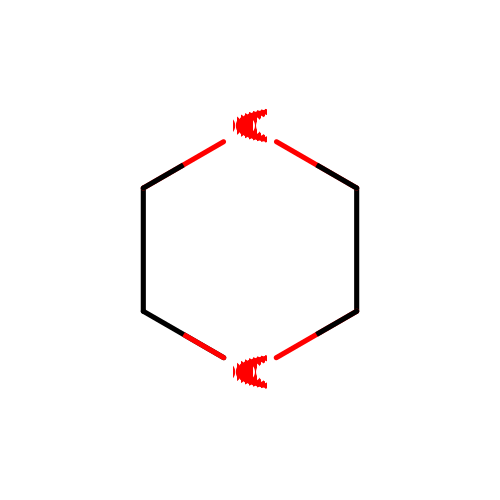
| Description | 1,4-Dioxane, also known as dioxan-1,4 or p-dioxane, belongs to the class of organic compounds known as 1,4-dioxanes. These are organic compounds containing 1,4-dioxane, an aliphatic six-member ring with two oxygen atoms in ring positions 1 and 4. 1,4-Dioxane is an extremely weak basic (essentially neutral) compound (based on its pKa). 1,4-Dioxane is formally rated as a possible carcinogen (by IARC 2B) and is also a potentially toxic compound. dioxane is found in Opuntia ficus-indica and Zingiber mioga. dioxane was first documented in 2003 (PMID: 14550759). A dioxane with oxygen atoms at positions 1 and 4 (PMID: 18044507) (PMID: 20598439). |
|---|
| Structure | InChI=1S/C4H8O2/c1-2-6-4-3-5-1/h1-4H2 |
|---|
| Synonyms | | Value | Source |
|---|
| 1,4-DIETHYLENE dioxide | ChEBI | | 1,4-Dioxacyclohexane | ChEBI | | 1,4-Dioxan | ChEBI | | Di(ethylene oxide) | ChEBI | | Dioxan-1,4 | ChEBI | | Dioxane-1,4 | ChEBI | | Glycol ethylene ether | ChEBI | | p-Dioxane | ChEBI | | Tetrahydro-1,4-dioxin | ChEBI | | Tetrahydro-p-dioxin | ChEBI | | Tetrahydro-para-dioxin | ChEBI | | Dioxane | MeSH | | Diethylene ether | MeSH | | Dioxan | MeSH |
|
|---|
| Chemical Formula | C4H8O2 |
|---|
| Average Mass | 88.1051 Da |
|---|
| Monoisotopic Mass | 88.05243 Da |
|---|
| IUPAC Name | 1,4-dioxane |
|---|
| Traditional Name | dioxane |
|---|
| CAS Registry Number | Not Available |
|---|
| SMILES | C1COCCO1 |
|---|
| InChI Identifier | InChI=1S/C4H8O2/c1-2-6-4-3-5-1/h1-4H2 |
|---|
| InChI Key | RYHBNJHYFVUHQT-UHFFFAOYSA-N |
|---|
| Experimental Spectra |
|---|
|
| | Spectrum Type | Description | Depositor Email | Depositor Organization | Depositor | Deposition Date | View |
|---|
| 1D NMR | 1H NMR Spectrum (1D, 300 MHz, D2O, experimental) | Wishart Lab | Wishart Lab | David Wishart | 2021-06-20 | View Spectrum | | 1D NMR | 13C NMR Spectrum (1D, 15.09 MHz, CDCl3, experimental) | Wishart Lab | Wishart Lab | David Wishart | 2021-06-20 | View Spectrum |
| | Predicted Spectra |
|---|
|
| Not Available | | Chemical Shift Submissions |
|---|
|
| Not Available | | Species |
|---|
| Species of Origin | |
|---|
| Chemical Taxonomy |
|---|
| Description | Belongs to the class of organic compounds known as 1,4-dioxanes. These are organic compounds containing 1,4-dioxane, an aliphatic six-member ring with two oxygen atoms in ring positions 1 and 4. |
|---|
| Kingdom | Organic compounds |
|---|
| Super Class | Organoheterocyclic compounds |
|---|
| Class | Dioxanes |
|---|
| Sub Class | 1,4-dioxanes |
|---|
| Direct Parent | 1,4-dioxanes |
|---|
| Alternative Parents | |
|---|
| Substituents | - Para-dioxane
- Oxacycle
- Ether
- Dialkyl ether
- Organic oxygen compound
- Hydrocarbon derivative
- Organooxygen compound
- Aliphatic heteromonocyclic compound
|
|---|
| Molecular Framework | Aliphatic heteromonocyclic compounds |
|---|
| External Descriptors | |
|---|
| Physical Properties |
|---|
| State | Not Available |
|---|
| Experimental Properties | | Property | Value | Reference |
|---|
| Melting Point | Not Available | Not Available | | Boiling Point | Not Available | Not Available | | Water Solubility | Not Available | Not Available | | LogP | Not Available | Not Available |
|
|---|
| Predicted Properties | |
|---|
| General References | - Stickney JA, Sager SL, Clarkson JR, Smith LA, Locey BJ, Bock MJ, Hartung R, Olp SF: An updated evaluation of the carcinogenic potential of 1,4-dioxane. Regul Toxicol Pharmacol. 2003 Oct;38(2):183-95. doi: 10.1016/s0273-2300(03)00090-4. [PubMed:14550759 ]
- Mahendra S, Petzold CJ, Baidoo EE, Keasling JD, Alvarez-Cohen L: Identification of the intermediates of in vivo oxidation of 1 ,4-dioxane by monooxygenase-containing bacteria. Environ Sci Technol. 2007 Nov 1;41(21):7330-6. doi: 10.1021/es0705745. [PubMed:18044507 ]
- Vescovi T, Coleman HM, Amal R: The effect of pH on UV-based advanced oxidation technologies--1,4-dioxane degradation. J Hazard Mater. 2010 Oct 15;182(1-3):75-9. doi: 10.1016/j.jhazmat.2010.06.001. Epub 2010 Jun 8. [PubMed:20598439 ]
- LOTUS database [Link]
|
|---|