| Record Information |
|---|
| Version | 2.0 |
|---|
| Created at | 2022-09-08 12:03:17 UTC |
|---|
| Updated at | 2022-09-08 12:03:17 UTC |
|---|
| NP-MRD ID | NP0267310 |
|---|
| Secondary Accession Numbers | None |
|---|
| Natural Product Identification |
|---|
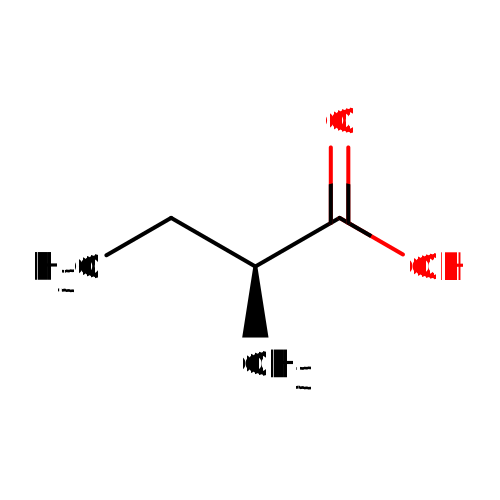
| Common Name | (s)-2-methylbutanoic acid |
|---|
| Description | (S)-2-Methylbutanoic acid, also known as (S)-a-methylbutanoate, belongs to the class of organic compounds known as methyl-branched fatty acids. These are fatty acids with an acyl chain that has a methyl branch. Usually, they are saturated and contain only one or more methyl group. However, branches other than methyl may be present (S)-2-Methylbutanoic acid is a weakly acidic compound (based on its pKa). Outside of the human body, (S)-2-Methylbutanoic acid has been detected, but not quantified in, fats and oils. This could make (S)-2-methylbutanoic acid a potential biomarker for the consumption of these foods. (s)-2-methylbutanoic acid is found in Homo sapiens, Ipomoea capillacea and Lithospermum erythrorhizon. The (S)-enantiomer of 2-methylbutanoic acid (S)-2-Methylbutanoic acid, with regard to humans, has been found to be associated with the diseases such as perillyl alcohol administration for cancer treatment; (S)-2-methylbutanoic acid has also been linked to the inborn metabolic disorder celiac disease. |
|---|
| Structure | InChI=1S/C5H10O2/c1-3-4(2)5(6)7/h4H,3H2,1-2H3,(H,6,7)/t4-/m0/s1 |
|---|
| Synonyms | | Value | Source |
|---|
| (S)-alpha-Methylbutanoic acid | ChEBI | | (S)-a-Methylbutanoate | Generator | | (S)-a-Methylbutanoic acid | Generator | | (S)-alpha-Methylbutanoate | Generator | | (S)-Α-methylbutanoate | Generator | | (S)-Α-methylbutanoic acid | Generator | | (S)-2-Methylbutanoate | Generator | | (+)-(S)-2-Methylbutanoic acid | HMDB | | (+)-2-Methylbutanoic acid | HMDB | | (+)-2-Methylbutyric acid | HMDB | | (+)-alpha-Methylbutyric acid | HMDB | | (2S)-2-Methylbutanoic acid | HMDB | | (S)-(+)-2-Methylbutyric acid | HMDB | | (S)-2-Methylbutyric acid | HMDB | | 2-Methyl-(2S)-butanoic acid | HMDB | | 2-Methyl-(S)-butanoic acid | HMDB | | Butyric acid, 2-methyl-, (S)- (8ci) | HMDB | | Butyric acid, 2-methyl-, L- (6ci) | HMDB | | S-(+)-2-Methylbutanoic acid | HMDB | | (S)-2-Methylbutanoic acid | ChEBI | | (S)-2-Methylbutyrate | Generator |
|
|---|
| Chemical Formula | C5H10O2 |
|---|
| Average Mass | 102.1317 Da |
|---|
| Monoisotopic Mass | 102.06808 Da |
|---|
| IUPAC Name | (2S)-2-methylbutanoic acid |
|---|
| Traditional Name | (S)-2-methylbutanoic acid |
|---|
| CAS Registry Number | Not Available |
|---|
| SMILES | CC[C@H](C)C(O)=O |
|---|
| InChI Identifier | InChI=1S/C5H10O2/c1-3-4(2)5(6)7/h4H,3H2,1-2H3,(H,6,7)/t4-/m0/s1 |
|---|
| InChI Key | WLAMNBDJUVNPJU-BYPYZUCNSA-N |
|---|
| Experimental Spectra |
|---|
|
| Not Available | | Predicted Spectra |
|---|
|
| | Spectrum Type | Description | Depositor ID | Depositor Organization | Depositor | Deposition Date | View |
|---|
| 1D NMR | 13C NMR Spectrum (1D, 25 MHz, H2O, predicted) | Wishart Lab | Wishart Lab | David Wishart | 2021-06-20 | View Spectrum | | 1D NMR | 1H NMR Spectrum (1D, 100 MHz, H2O, predicted) | Wishart Lab | Wishart Lab | David Wishart | 2021-06-20 | View Spectrum | | 1D NMR | 13C NMR Spectrum (1D, 252 MHz, H2O, predicted) | Wishart Lab | Wishart Lab | David Wishart | 2021-06-20 | View Spectrum | | 1D NMR | 1H NMR Spectrum (1D, 1000 MHz, H2O, predicted) | Wishart Lab | Wishart Lab | David Wishart | 2021-06-20 | View Spectrum | | 1D NMR | 13C NMR Spectrum (1D, 50 MHz, H2O, predicted) | Wishart Lab | Wishart Lab | David Wishart | 2021-06-20 | View Spectrum | | 1D NMR | 1H NMR Spectrum (1D, 200 MHz, H2O, predicted) | Wishart Lab | Wishart Lab | David Wishart | 2021-06-20 | View Spectrum | | 1D NMR | 13C NMR Spectrum (1D, 75 MHz, H2O, predicted) | Wishart Lab | Wishart Lab | David Wishart | 2021-06-20 | View Spectrum | | 1D NMR | 1H NMR Spectrum (1D, 300 MHz, H2O, predicted) | Wishart Lab | Wishart Lab | David Wishart | 2021-06-20 | View Spectrum | | 1D NMR | 13C NMR Spectrum (1D, 101 MHz, H2O, predicted) | Wishart Lab | Wishart Lab | David Wishart | 2021-06-20 | View Spectrum | | 1D NMR | 1H NMR Spectrum (1D, 400 MHz, H2O, predicted) | Wishart Lab | Wishart Lab | David Wishart | 2021-06-20 | View Spectrum | | 1D NMR | 13C NMR Spectrum (1D, 126 MHz, H2O, predicted) | Wishart Lab | Wishart Lab | David Wishart | 2021-06-20 | View Spectrum | | 1D NMR | 1H NMR Spectrum (1D, 500 MHz, H2O, predicted) | Wishart Lab | Wishart Lab | David Wishart | 2021-06-20 | View Spectrum | | 1D NMR | 13C NMR Spectrum (1D, 151 MHz, H2O, predicted) | Wishart Lab | Wishart Lab | David Wishart | 2021-06-20 | View Spectrum | | 1D NMR | 1H NMR Spectrum (1D, 600 MHz, H2O, predicted) | Wishart Lab | Wishart Lab | David Wishart | 2021-06-20 | View Spectrum | | 1D NMR | 13C NMR Spectrum (1D, 176 MHz, H2O, predicted) | Wishart Lab | Wishart Lab | David Wishart | 2021-06-20 | View Spectrum | | 1D NMR | 1H NMR Spectrum (1D, 700 MHz, H2O, predicted) | Wishart Lab | Wishart Lab | David Wishart | 2021-06-20 | View Spectrum | | 1D NMR | 13C NMR Spectrum (1D, 201 MHz, H2O, predicted) | Wishart Lab | Wishart Lab | David Wishart | 2021-06-20 | View Spectrum | | 1D NMR | 1H NMR Spectrum (1D, 800 MHz, H2O, predicted) | Wishart Lab | Wishart Lab | David Wishart | 2021-06-20 | View Spectrum | | 1D NMR | 13C NMR Spectrum (1D, 226 MHz, H2O, predicted) | Wishart Lab | Wishart Lab | David Wishart | 2021-06-20 | View Spectrum | | 1D NMR | 1H NMR Spectrum (1D, 900 MHz, H2O, predicted) | Wishart Lab | Wishart Lab | David Wishart | 2021-06-20 | View Spectrum |
| | Chemical Shift Submissions |
|---|
|
| Not Available | | Species |
|---|
| Species of Origin | |
|---|
| Chemical Taxonomy |
|---|
| Description | Belongs to the class of organic compounds known as methyl-branched fatty acids. These are fatty acids with an acyl chain that has a methyl branch. Usually, they are saturated and contain only one or more methyl group. However, branches other than methyl may be present. |
|---|
| Kingdom | Organic compounds |
|---|
| Super Class | Lipids and lipid-like molecules |
|---|
| Class | Fatty Acyls |
|---|
| Sub Class | Fatty acids and conjugates |
|---|
| Direct Parent | Methyl-branched fatty acids |
|---|
| Alternative Parents | |
|---|
| Substituents | - Methyl-branched fatty acid
- Monocarboxylic acid or derivatives
- Carboxylic acid
- Carboxylic acid derivative
- Organic oxygen compound
- Organic oxide
- Hydrocarbon derivative
- Organooxygen compound
- Carbonyl group
- Aliphatic acyclic compound
|
|---|
| Molecular Framework | Aliphatic acyclic compounds |
|---|
| External Descriptors | |
|---|
| Physical Properties |
|---|
| State | Not Available |
|---|
| Experimental Properties | | Property | Value | Reference |
|---|
| Melting Point | Not Available | Not Available | | Boiling Point | Not Available | Not Available | | Water Solubility | Not Available | Not Available | | LogP | Not Available | Not Available |
|
|---|
| Predicted Properties | |
|---|