| Record Information |
|---|
| Version | 2.0 |
|---|
| Created at | 2022-09-08 10:26:29 UTC |
|---|
| Updated at | 2022-09-08 10:26:29 UTC |
|---|
| NP-MRD ID | NP0266186 |
|---|
| Secondary Accession Numbers | None |
|---|
| Natural Product Identification |
|---|
| Common Name | phytofluene |
|---|
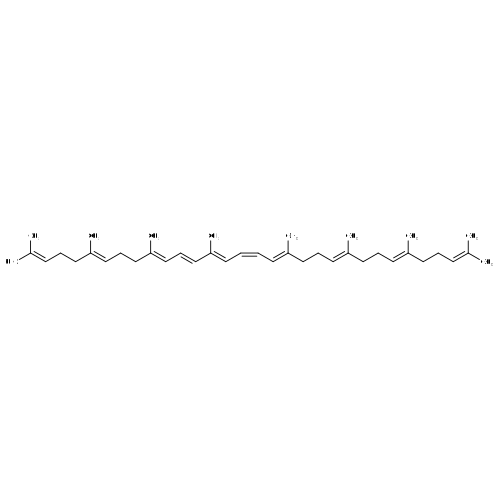
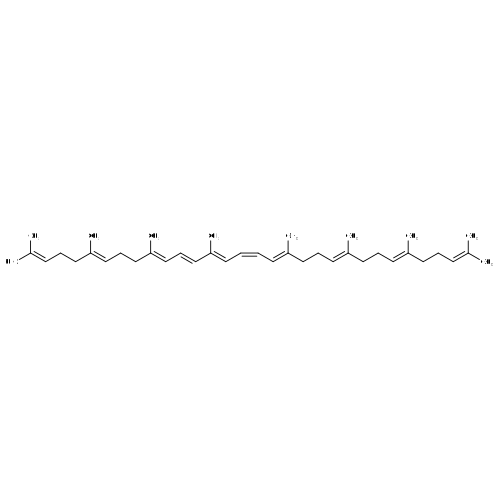
| Description | Phytofluene, also known as (15Z)-phytofluene, belongs to the class of organic compounds known as carotenes. These are a type of unsaturated hydrocarbons containing eight consecutive isoprene units. They are characterized by the presence of two end-groups (mostly cyclohexene rings, but also cyclopentene rings or acyclic groups) linked by a long branched alkyl chain. Carotenes belonging form a subgroup of the carotenoids family. Phytofluene is possibly neutral. It is the second product of carotenoid biosynthesis. Phytofluene exists in all living organisms, ranging from bacteria to humans. In contrast to all other carotenoids, phytoene and phytofluene, the first carotenoid precursors in the biosynthetic pathway of other carotenoids absorb light in the UV range. It is formed from phytoene in a desaturation reaction leading to the formation of five conjugated double bonds. Phytofluene is a colorless carotenoid found naturally in tomatoes and other vegetables. Phytofluene has an absorption spectra in the UVA range, with maximal absorption at 348 nm and with ε1% of 1557. The accumulation of these carotenoids may protect the skin by several mechanisms: Acting as UV absorbers, as antioxidants, as anti-inflammatory agents. Dietary phytoene and phytofluene are accumulated in human skin. Analysis of several fruits and vegetables showed that phytoene and phytofluene are found in majority of fruits and vegetables. phytofluene is found in Acacia acuminata, Brassica napus, Calendula officinalis, Celastrus orbiculatus, Chlorella vulgaris, Citrus maxima, Citrus paradisi, Citrus reticulata, Crocus sativus, Diospyros kaki, Lonicera japonica, Medicago sativa, Pantoea ananatis, Passiflora edulis, Psidium guajava, Rhodomicrobium vannielii, Rhodospirillum rubrum, Rhodotorula glutinis, Rosa villosa and Streptomyces griseus. phytofluene was first documented in 2005 (PMID: 15830922). In the following step, addition of carbon-carbon conjugated double bonds leads to the formation of z-carotene and appearance of visible color. |
|---|
| Structure | CC(C)=CCC\C(C)=C\CC\C(C)=C\CC\C(C)=C\C=C/C=C(\C)/C=C/C=C(\C)CC\C=C(/C)CCC=C(C)C InChI=1S/C40H62/c1-33(2)19-13-23-37(7)27-17-31-39(9)29-15-25-35(5)21-11-12-22-36(6)26-16-30-40(10)32-18-28-38(8)24-14-20-34(3)4/h11-12,15,19-22,25,27-30H,13-14,16-18,23-24,26,31-32H2,1-10H3/b12-11-,25-15+,35-21+,36-22+,37-27+,38-28+,39-29+,40-30+ |
|---|
| Synonyms | | Value | Source |
|---|
| (12E,16Z,18E,22E,26E)-2,6,10,14,19,23,27,31-Octamethyldotriaconta-2,6,10,12,14,16,18,22,26,30-decaene | ChEBI | | (15Z)-Phytofluene | HMDB | | 15-cis-7,7',8,8',11,12-Hexahydro-psi,psi-carotene | HMDB | | 15-cis-7,7',8,8',11,12-Hexahydro-ψ,ψ-carotene | HMDB | | 15-cis-7,7’,8,8’,11,12-hexahydro-ψ,ψ-carotene | HMDB | | 15-cis-Phytofluene | HMDB | | 7,7',8,8',11,12-Hexahydro-psi,psi-carotene | HMDB | | 7,7',8,8',11,12-Hexahydro-ψ,ψ-carotene | HMDB | | 7,7',8,8',11,12-Hexahydrolycopene | HMDB | | 7,7’,8,8’,11,12-hexahydro-ψ,ψ-carotene | HMDB | | 7,7’,8,8’,11,12-hexahydrolycopene | HMDB | | cis-Phytofluene | HMDB | | Phytofluene | ChEBI |
|
|---|
| Chemical Formula | C40H62 |
|---|
| Average Mass | 542.9203 Da |
|---|
| Monoisotopic Mass | 542.48515 Da |
|---|
| IUPAC Name | (6E,10E,12E,14E,16Z,18E,22E,26E)-2,6,10,14,19,23,27,31-octamethyldotriaconta-2,6,10,12,14,16,18,22,26,30-decaene |
|---|
| Traditional Name | phytofluene |
|---|
| CAS Registry Number | Not Available |
|---|
| SMILES | CC(C)=CCC\C(C)=C\CC\C(C)=C\CC\C(C)=C\C=C/C=C(\C)/C=C/C=C(\C)CC\C=C(/C)CCC=C(C)C |
|---|
| InChI Identifier | InChI=1S/C40H62/c1-33(2)19-13-23-37(7)27-17-31-39(9)29-15-25-35(5)21-11-12-22-36(6)26-16-30-40(10)32-18-28-38(8)24-14-20-34(3)4/h11-12,15,19-22,25,27-30H,13-14,16-18,23-24,26,31-32H2,1-10H3/b12-11-,25-15+,35-21+,36-22+,37-27+,38-28+,39-29+,40-30+ |
|---|
| InChI Key | OVSVTCFNLSGAMM-DGFSHVNOSA-N |
|---|
| Experimental Spectra |
|---|
|
| Not Available | | Predicted Spectra |
|---|
|
| | Spectrum Type | Description | Depositor ID | Depositor Organization | Depositor | Deposition Date | View |
|---|
| 1D NMR | 13C NMR Spectrum (1D, 25 MHz, H2O, predicted) | Wishart Lab | Wishart Lab | David Wishart | 2021-06-20 | View Spectrum | | 1D NMR | 1H NMR Spectrum (1D, 100 MHz, H2O, predicted) | Wishart Lab | Wishart Lab | David Wishart | 2021-06-20 | View Spectrum | | 1D NMR | 13C NMR Spectrum (1D, 252 MHz, H2O, predicted) | Wishart Lab | Wishart Lab | David Wishart | 2021-06-20 | View Spectrum | | 1D NMR | 1H NMR Spectrum (1D, 1000 MHz, H2O, predicted) | Wishart Lab | Wishart Lab | David Wishart | 2021-06-20 | View Spectrum | | 1D NMR | 13C NMR Spectrum (1D, 50 MHz, H2O, predicted) | Wishart Lab | Wishart Lab | David Wishart | 2021-06-20 | View Spectrum | | 1D NMR | 1H NMR Spectrum (1D, 200 MHz, H2O, predicted) | Wishart Lab | Wishart Lab | David Wishart | 2021-06-20 | View Spectrum | | 1D NMR | 13C NMR Spectrum (1D, 75 MHz, H2O, predicted) | Wishart Lab | Wishart Lab | David Wishart | 2021-06-20 | View Spectrum | | 1D NMR | 1H NMR Spectrum (1D, 300 MHz, H2O, predicted) | Wishart Lab | Wishart Lab | David Wishart | 2021-06-20 | View Spectrum | | 1D NMR | 13C NMR Spectrum (1D, 101 MHz, H2O, predicted) | Wishart Lab | Wishart Lab | David Wishart | 2021-06-20 | View Spectrum | | 1D NMR | 1H NMR Spectrum (1D, 400 MHz, H2O, predicted) | Wishart Lab | Wishart Lab | David Wishart | 2021-06-20 | View Spectrum | | 1D NMR | 13C NMR Spectrum (1D, 126 MHz, H2O, predicted) | Wishart Lab | Wishart Lab | David Wishart | 2021-06-20 | View Spectrum | | 1D NMR | 1H NMR Spectrum (1D, 500 MHz, H2O, predicted) | Wishart Lab | Wishart Lab | David Wishart | 2021-06-20 | View Spectrum | | 1D NMR | 13C NMR Spectrum (1D, 151 MHz, H2O, predicted) | Wishart Lab | Wishart Lab | David Wishart | 2021-06-20 | View Spectrum | | 1D NMR | 1H NMR Spectrum (1D, 600 MHz, H2O, predicted) | Wishart Lab | Wishart Lab | David Wishart | 2021-06-20 | View Spectrum | | 1D NMR | 13C NMR Spectrum (1D, 176 MHz, H2O, predicted) | Wishart Lab | Wishart Lab | David Wishart | 2021-06-20 | View Spectrum | | 1D NMR | 1H NMR Spectrum (1D, 700 MHz, H2O, predicted) | Wishart Lab | Wishart Lab | David Wishart | 2021-06-20 | View Spectrum | | 1D NMR | 13C NMR Spectrum (1D, 201 MHz, H2O, predicted) | Wishart Lab | Wishart Lab | David Wishart | 2021-06-20 | View Spectrum | | 1D NMR | 1H NMR Spectrum (1D, 800 MHz, H2O, predicted) | Wishart Lab | Wishart Lab | David Wishart | 2021-06-20 | View Spectrum | | 1D NMR | 13C NMR Spectrum (1D, 226 MHz, H2O, predicted) | Wishart Lab | Wishart Lab | David Wishart | 2021-06-20 | View Spectrum | | 1D NMR | 1H NMR Spectrum (1D, 900 MHz, H2O, predicted) | Wishart Lab | Wishart Lab | David Wishart | 2021-06-20 | View Spectrum |
| | Chemical Shift Submissions |
|---|
|
| Not Available | | Species |
|---|
| Species of Origin | |
|---|
| Chemical Taxonomy |
|---|
| Description | Belongs to the class of organic compounds known as carotenes. These are a type of unsaturated hydrocarbons containing eight consecutive isoprene units. They are characterized by the presence of two end-groups (mostly cyclohexene rings, but also cyclopentene rings or acyclic groups) linked by a long branched alkyl chain. Carotenes belonging form a subgroup of the carotenoids family. |
|---|
| Kingdom | Organic compounds |
|---|
| Super Class | Lipids and lipid-like molecules |
|---|
| Class | Prenol lipids |
|---|
| Sub Class | Tetraterpenoids |
|---|
| Direct Parent | Carotenes |
|---|
| Alternative Parents | |
|---|
| Substituents | - Carotene
- Branched unsaturated hydrocarbon
- Unsaturated aliphatic hydrocarbon
- Unsaturated hydrocarbon
- Olefin
- Acyclic olefin
- Hydrocarbon
- Aliphatic acyclic compound
|
|---|
| Molecular Framework | Aliphatic acyclic compounds |
|---|
| External Descriptors | |
|---|
| Physical Properties |
|---|
| State | Not Available |
|---|
| Experimental Properties | | Property | Value | Reference |
|---|
| Melting Point | Not Available | Not Available | | Boiling Point | Not Available | Not Available | | Water Solubility | Not Available | Not Available | | LogP | Not Available | Not Available |
|
|---|
| Predicted Properties | |
|---|