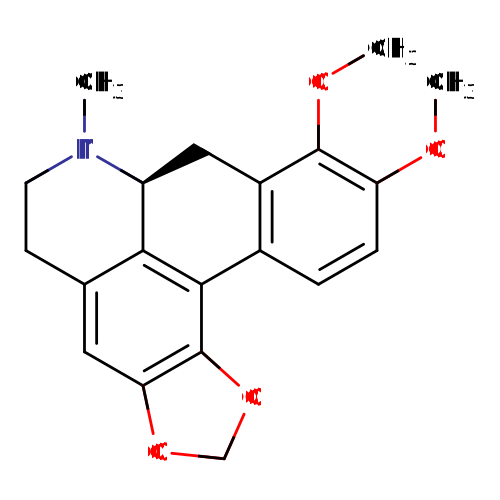
| Record Information |
|---|
| Version | 2.0 |
|---|
| Created at | 2022-09-08 09:15:43 UTC |
|---|
| Updated at | 2022-09-08 09:15:44 UTC |
|---|
| NP-MRD ID | NP0265323 |
|---|
| Secondary Accession Numbers | None |
|---|
| Natural Product Identification |
|---|
| Common Name | (12s)-15,16-dimethoxy-11-methyl-3,5-dioxa-11-azapentacyclo[10.7.1.0²,⁶.0⁸,²⁰.0¹⁴,¹⁹]icosa-1,6,8(20),14,16,18-hexaene |
|---|
| Description | Crebanine belongs to the class of organic compounds known as aporphines. These are quinoline alkaloids containing the dibenzo[de,g]quinoline ring system or a dehydrogenated derivative thereof. (12s)-15,16-dimethoxy-11-methyl-3,5-dioxa-11-azapentacyclo[10.7.1.0²,⁶.0⁸,²⁰.0¹⁴,¹⁹]icosa-1,6,8(20),14,16,18-hexaene is found in Fissistigma oldhamii, Stephania abyssinica, Stephania cephalantha, Stephania venosa and Xylopia aethiopica. (12s)-15,16-dimethoxy-11-methyl-3,5-dioxa-11-azapentacyclo[10.7.1.0²,⁶.0⁸,²⁰.0¹⁴,¹⁹]icosa-1,6,8(20),14,16,18-hexaene was first documented in 2017 (PMID: 28703314). Based on a literature review a small amount of articles have been published on Crebanine (PMID: 34684698) (PMID: 30068871) (PMID: 29577069) (PMID: 29386467). |
|---|
| Structure | COC1=CC=C2C(C[C@@H]3N(C)CCC4=C3C2=C2OCOC2=C4)=C1OC InChI=1S/C20H21NO4/c1-21-7-6-11-8-16-20(25-10-24-16)18-12-4-5-15(22-2)19(23-3)13(12)9-14(21)17(11)18/h4-5,8,14H,6-7,9-10H2,1-3H3/t14-/m0/s1 |
|---|
| Synonyms | Not Available |
|---|
| Chemical Formula | C20H21NO4 |
|---|
| Average Mass | 339.3910 Da |
|---|
| Monoisotopic Mass | 339.14706 Da |
|---|
| IUPAC Name | (12S)-15,16-dimethoxy-11-methyl-3,5-dioxa-11-azapentacyclo[10.7.1.0^{2,6}.0^{8,20}.0^{14,19}]icosa-1,6,8(20),14,16,18-hexaene |
|---|
| Traditional Name | (12S)-15,16-dimethoxy-11-methyl-3,5-dioxa-11-azapentacyclo[10.7.1.0^{2,6}.0^{8,20}.0^{14,19}]icosa-1,6,8(20),14,16,18-hexaene |
|---|
| CAS Registry Number | Not Available |
|---|
| SMILES | COC1=CC=C2C(C[C@@H]3N(C)CCC4=C3C2=C2OCOC2=C4)=C1OC |
|---|
| InChI Identifier | InChI=1S/C20H21NO4/c1-21-7-6-11-8-16-20(25-10-24-16)18-12-4-5-15(22-2)19(23-3)13(12)9-14(21)17(11)18/h4-5,8,14H,6-7,9-10H2,1-3H3/t14-/m0/s1 |
|---|
| InChI Key | UVDQDNQWGQFIAO-AWEZNQCLSA-N |
|---|
| Experimental Spectra |
|---|
|
| Not Available | | Predicted Spectra |
|---|
|
| | Spectrum Type | Description | Depositor ID | Depositor Organization | Depositor | Deposition Date | View |
|---|
| 1D NMR | 13C NMR Spectrum (1D, 25 MHz, H2O, predicted) | Wishart Lab | Wishart Lab | David Wishart | 2021-06-20 | View Spectrum | | 1D NMR | 1H NMR Spectrum (1D, 100 MHz, H2O, predicted) | Wishart Lab | Wishart Lab | David Wishart | 2021-06-20 | View Spectrum | | 1D NMR | 13C NMR Spectrum (1D, 252 MHz, H2O, predicted) | Wishart Lab | Wishart Lab | David Wishart | 2021-06-20 | View Spectrum | | 1D NMR | 1H NMR Spectrum (1D, 1000 MHz, H2O, predicted) | Wishart Lab | Wishart Lab | David Wishart | 2021-06-20 | View Spectrum | | 1D NMR | 13C NMR Spectrum (1D, 50 MHz, H2O, predicted) | Wishart Lab | Wishart Lab | David Wishart | 2021-06-20 | View Spectrum | | 1D NMR | 1H NMR Spectrum (1D, 200 MHz, H2O, predicted) | Wishart Lab | Wishart Lab | David Wishart | 2021-06-20 | View Spectrum | | 1D NMR | 13C NMR Spectrum (1D, 75 MHz, H2O, predicted) | Wishart Lab | Wishart Lab | David Wishart | 2021-06-20 | View Spectrum | | 1D NMR | 1H NMR Spectrum (1D, 300 MHz, H2O, predicted) | Wishart Lab | Wishart Lab | David Wishart | 2021-06-20 | View Spectrum | | 1D NMR | 13C NMR Spectrum (1D, 101 MHz, H2O, predicted) | Wishart Lab | Wishart Lab | David Wishart | 2021-06-20 | View Spectrum | | 1D NMR | 1H NMR Spectrum (1D, 400 MHz, H2O, predicted) | Wishart Lab | Wishart Lab | David Wishart | 2021-06-20 | View Spectrum | | 1D NMR | 13C NMR Spectrum (1D, 126 MHz, H2O, predicted) | Wishart Lab | Wishart Lab | David Wishart | 2021-06-20 | View Spectrum | | 1D NMR | 1H NMR Spectrum (1D, 500 MHz, H2O, predicted) | Wishart Lab | Wishart Lab | David Wishart | 2021-06-20 | View Spectrum | | 1D NMR | 13C NMR Spectrum (1D, 151 MHz, H2O, predicted) | Wishart Lab | Wishart Lab | David Wishart | 2021-06-20 | View Spectrum | | 1D NMR | 1H NMR Spectrum (1D, 600 MHz, H2O, predicted) | Wishart Lab | Wishart Lab | David Wishart | 2021-06-20 | View Spectrum | | 1D NMR | 13C NMR Spectrum (1D, 176 MHz, H2O, predicted) | Wishart Lab | Wishart Lab | David Wishart | 2021-06-20 | View Spectrum | | 1D NMR | 1H NMR Spectrum (1D, 700 MHz, H2O, predicted) | Wishart Lab | Wishart Lab | David Wishart | 2021-06-20 | View Spectrum | | 1D NMR | 13C NMR Spectrum (1D, 201 MHz, H2O, predicted) | Wishart Lab | Wishart Lab | David Wishart | 2021-06-20 | View Spectrum | | 1D NMR | 1H NMR Spectrum (1D, 800 MHz, H2O, predicted) | Wishart Lab | Wishart Lab | David Wishart | 2021-06-20 | View Spectrum | | 1D NMR | 13C NMR Spectrum (1D, 226 MHz, H2O, predicted) | Wishart Lab | Wishart Lab | David Wishart | 2021-06-20 | View Spectrum | | 1D NMR | 1H NMR Spectrum (1D, 900 MHz, H2O, predicted) | Wishart Lab | Wishart Lab | David Wishart | 2021-06-20 | View Spectrum |
| | Chemical Shift Submissions |
|---|
|
| Not Available | | Species |
|---|
| Species of Origin | |
|---|
| Chemical Taxonomy |
|---|
| Description | Belongs to the class of organic compounds known as aporphines. These are quinoline alkaloids containing the dibenzo[de,g]quinoline ring system or a dehydrogenated derivative thereof. |
|---|
| Kingdom | Organic compounds |
|---|
| Super Class | Alkaloids and derivatives |
|---|
| Class | Aporphines |
|---|
| Sub Class | Not Available |
|---|
| Direct Parent | Aporphines |
|---|
| Alternative Parents | |
|---|
| Substituents | - Aporphine
- Benzoquinoline
- Phenanthrene
- Naphthalene
- Quinoline
- Tetrahydroisoquinoline
- Benzodioxole
- Anisole
- Aralkylamine
- Alkyl aryl ether
- Benzenoid
- Tertiary aliphatic amine
- Tertiary amine
- Organoheterocyclic compound
- Azacycle
- Oxacycle
- Acetal
- Ether
- Hydrocarbon derivative
- Organic oxygen compound
- Organopnictogen compound
- Organic nitrogen compound
- Organonitrogen compound
- Amine
- Organooxygen compound
- Aromatic heteropolycyclic compound
|
|---|
| Molecular Framework | Aromatic heteropolycyclic compounds |
|---|
| External Descriptors | Not Available |
|---|
| Physical Properties |
|---|
| State | Not Available |
|---|
| Experimental Properties | | Property | Value | Reference |
|---|
| Melting Point | Not Available | Not Available | | Boiling Point | Not Available | Not Available | | Water Solubility | Not Available | Not Available | | LogP | Not Available | Not Available |
|
|---|
| Predicted Properties | |
|---|
| General References | - Le PM, Srivastava V, Nguyen TT, Pradines B, Madamet M, Mosnier J, Trinh TT, Lee H: Stephanine from Stephania venosa (Blume) Spreng Showed Effective Antiplasmodial and Anticancer Activities, the Latter by Inducing Apoptosis through the Reverse of Mitotic Exit. Phytother Res. 2017 Sep;31(9):1357-1368. doi: 10.1002/ptr.5861. Epub 2017 Jul 13. [PubMed:28703314 ]
- Wang FX, Zhu N, Zhou F, Lin DX: Natural Aporphine Alkaloids with Potential to Impact Metabolic Syndrome. Molecules. 2021 Oct 10;26(20). pii: molecules26206117. doi: 10.3390/molecules26206117. [PubMed:34684698 ]
- Yodkeeree S, Ooppachai C, Pompimon W, Limtrakul Dejkriengkraikul P: O-Methylbulbocapnine and Dicentrine Suppress LPS-Induced Inflammatory Response by Blocking NF-kappaB and AP-1 Activation through Inhibiting MAPKs and Akt Signaling in RAW264.7 Macrophages. Biol Pharm Bull. 2018;41(8):1219-1227. doi: 10.1248/bpb.b18-00037. [PubMed:30068871 ]
- Peng Y, Zhao S, Wu Y, Cao H, Xu Y, Liu X, Shui W, Cheng J, Zhao S, Shen L, Ma J, Quinn RJ, Stevens RC, Zhong G, Liu ZJ: Identification of natural products as novel ligands for the human 5-HT(2C) receptor. Biophys Rep. 2018;4(1):50-61. doi: 10.1007/s41048-018-0047-1. Epub 2018 Mar 9. [PubMed:29577069 ]
- Mon MT, Yodkeeree S, Punfa W, Pompimon W, Limtrakul P: Alkaloids from Stephania venosa as Chemo-Sensitizers in SKOV3 Ovarian Cancer Cells via Akt/NF-kappaB Signaling. Chem Pharm Bull (Tokyo). 2018;66(2):162-169. doi: 10.1248/cpb.c17-00687. [PubMed:29386467 ]
- LOTUS database [Link]
|
|---|