| Record Information |
|---|
| Version | 2.0 |
|---|
| Created at | 2022-09-08 08:18:51 UTC |
|---|
| Updated at | 2022-09-08 08:18:51 UTC |
|---|
| NP-MRD ID | NP0264681 |
|---|
| Secondary Accession Numbers | None |
|---|
| Natural Product Identification |
|---|
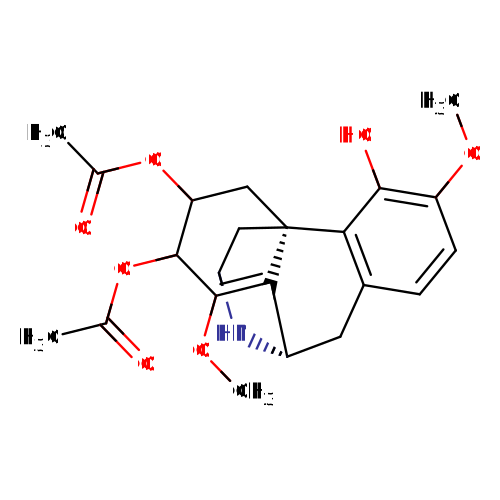
| Common Name | (1s,9s)-12-(acetyloxy)-3-hydroxy-4,11-dimethoxy-17-azatetracyclo[7.5.3.0¹,¹⁰.0²,⁷]heptadeca-2,4,6,10-tetraen-13-yl acetate |
|---|
| Description | FK-3000 belongs to the class of organic compounds known as phenanthrenes and derivatives. These are polycyclic compounds containing a phenanthrene moiety, which is a tricyclic aromatic compound with three non-linearly fused benzene. (1s,9s)-12-(acetyloxy)-3-hydroxy-4,11-dimethoxy-17-azatetracyclo[7.5.3.0¹,¹⁰.0²,⁷]heptadeca-2,4,6,10-tetraen-13-yl acetate is found in Stephania cephalantha. (1s,9s)-12-(acetyloxy)-3-hydroxy-4,11-dimethoxy-17-azatetracyclo[7.5.3.0¹,¹⁰.0²,⁷]heptadeca-2,4,6,10-tetraen-13-yl acetate was first documented in 2012 (PMID: 22738786). Based on a literature review a small amount of articles have been published on FK-3000 (PMID: 25384584) (PMID: 25823424). |
|---|
| Structure | COC1=CC=C2C[C@@H]3NCC[C@]4(CC(OC(C)=O)C(OC(C)=O)C(OC)=C34)C2=C1O InChI=1S/C22H27NO7/c1-11(24)29-16-10-22-7-8-23-14(18(22)21(28-4)20(16)30-12(2)25)9-13-5-6-15(27-3)19(26)17(13)22/h5-6,14,16,20,23,26H,7-10H2,1-4H3/t14-,16?,20?,22-/m0/s1 |
|---|
| Synonyms | Not Available |
|---|
| Chemical Formula | C22H27NO7 |
|---|
| Average Mass | 417.4580 Da |
|---|
| Monoisotopic Mass | 417.17875 Da |
|---|
| IUPAC Name | (1S,9S)-12-(acetyloxy)-3-hydroxy-4,11-dimethoxy-17-azatetracyclo[7.5.3.0^{1,10}.0^{2,7}]heptadeca-2,4,6,10-tetraen-13-yl acetate |
|---|
| Traditional Name | (1S,9S)-12-(acetyloxy)-3-hydroxy-4,11-dimethoxy-17-azatetracyclo[7.5.3.0^{1,10}.0^{2,7}]heptadeca-2,4,6,10-tetraen-13-yl acetate |
|---|
| CAS Registry Number | Not Available |
|---|
| SMILES | COC1=CC=C2C[C@@H]3NCC[C@]4(CC(OC(C)=O)C(OC(C)=O)C(OC)=C34)C2=C1O |
|---|
| InChI Identifier | InChI=1S/C22H27NO7/c1-11(24)29-16-10-22-7-8-23-14(18(22)21(28-4)20(16)30-12(2)25)9-13-5-6-15(27-3)19(26)17(13)22/h5-6,14,16,20,23,26H,7-10H2,1-4H3/t14-,16?,20?,22-/m0/s1 |
|---|
| InChI Key | XAQZCUNTDGRIEM-ZOUNEDFCSA-N |
|---|
| Experimental Spectra |
|---|
|
| Not Available | | Predicted Spectra |
|---|
|
| | Spectrum Type | Description | Depositor ID | Depositor Organization | Depositor | Deposition Date | View |
|---|
| 1D NMR | 13C NMR Spectrum (1D, 25 MHz, H2O, predicted) | Wishart Lab | Wishart Lab | David Wishart | 2021-06-20 | View Spectrum | | 1D NMR | 1H NMR Spectrum (1D, 100 MHz, H2O, predicted) | Wishart Lab | Wishart Lab | David Wishart | 2021-06-20 | View Spectrum | | 1D NMR | 13C NMR Spectrum (1D, 252 MHz, H2O, predicted) | Wishart Lab | Wishart Lab | David Wishart | 2021-06-20 | View Spectrum | | 1D NMR | 1H NMR Spectrum (1D, 1000 MHz, H2O, predicted) | Wishart Lab | Wishart Lab | David Wishart | 2021-06-20 | View Spectrum | | 1D NMR | 13C NMR Spectrum (1D, 50 MHz, H2O, predicted) | Wishart Lab | Wishart Lab | David Wishart | 2021-06-20 | View Spectrum | | 1D NMR | 1H NMR Spectrum (1D, 200 MHz, H2O, predicted) | Wishart Lab | Wishart Lab | David Wishart | 2021-06-20 | View Spectrum | | 1D NMR | 13C NMR Spectrum (1D, 75 MHz, H2O, predicted) | Wishart Lab | Wishart Lab | David Wishart | 2021-06-20 | View Spectrum | | 1D NMR | 1H NMR Spectrum (1D, 300 MHz, H2O, predicted) | Wishart Lab | Wishart Lab | David Wishart | 2021-06-20 | View Spectrum | | 1D NMR | 13C NMR Spectrum (1D, 101 MHz, H2O, predicted) | Wishart Lab | Wishart Lab | David Wishart | 2021-06-20 | View Spectrum | | 1D NMR | 1H NMR Spectrum (1D, 400 MHz, H2O, predicted) | Wishart Lab | Wishart Lab | David Wishart | 2021-06-20 | View Spectrum | | 1D NMR | 13C NMR Spectrum (1D, 126 MHz, H2O, predicted) | Wishart Lab | Wishart Lab | David Wishart | 2021-06-20 | View Spectrum | | 1D NMR | 1H NMR Spectrum (1D, 500 MHz, H2O, predicted) | Wishart Lab | Wishart Lab | David Wishart | 2021-06-20 | View Spectrum | | 1D NMR | 13C NMR Spectrum (1D, 151 MHz, H2O, predicted) | Wishart Lab | Wishart Lab | David Wishart | 2021-06-20 | View Spectrum | | 1D NMR | 1H NMR Spectrum (1D, 600 MHz, H2O, predicted) | Wishart Lab | Wishart Lab | David Wishart | 2021-06-20 | View Spectrum | | 1D NMR | 13C NMR Spectrum (1D, 176 MHz, H2O, predicted) | Wishart Lab | Wishart Lab | David Wishart | 2021-06-20 | View Spectrum | | 1D NMR | 1H NMR Spectrum (1D, 700 MHz, H2O, predicted) | Wishart Lab | Wishart Lab | David Wishart | 2021-06-20 | View Spectrum | | 1D NMR | 13C NMR Spectrum (1D, 201 MHz, H2O, predicted) | Wishart Lab | Wishart Lab | David Wishart | 2021-06-20 | View Spectrum | | 1D NMR | 1H NMR Spectrum (1D, 800 MHz, H2O, predicted) | Wishart Lab | Wishart Lab | David Wishart | 2021-06-20 | View Spectrum | | 1D NMR | 13C NMR Spectrum (1D, 226 MHz, H2O, predicted) | Wishart Lab | Wishart Lab | David Wishart | 2021-06-20 | View Spectrum | | 1D NMR | 1H NMR Spectrum (1D, 900 MHz, H2O, predicted) | Wishart Lab | Wishart Lab | David Wishart | 2021-06-20 | View Spectrum |
| | Chemical Shift Submissions |
|---|
|
| Not Available | | Species |
|---|
| Species of Origin | |
|---|
| Chemical Taxonomy |
|---|
| Description | Belongs to the class of organic compounds known as phenanthrenes and derivatives. These are polycyclic compounds containing a phenanthrene moiety, which is a tricyclic aromatic compound with three non-linearly fused benzene. |
|---|
| Kingdom | Organic compounds |
|---|
| Super Class | Benzenoids |
|---|
| Class | Phenanthrenes and derivatives |
|---|
| Sub Class | Not Available |
|---|
| Direct Parent | Phenanthrenes and derivatives |
|---|
| Alternative Parents | |
|---|
| Substituents | - Phenanthrene
- Benzazocine
- Tetralin
- Anisole
- 1-hydroxy-4-unsubstituted benzenoid
- Aralkylamine
- Alkyl aryl ether
- Piperidine
- Dicarboxylic acid or derivatives
- Carboxylic acid ester
- Amino acid or derivatives
- Azacycle
- Organoheterocyclic compound
- Secondary amine
- Ether
- Secondary aliphatic amine
- Carboxylic acid derivative
- Organic nitrogen compound
- Organic oxygen compound
- Organopnictogen compound
- Organic oxide
- Hydrocarbon derivative
- Organooxygen compound
- Organonitrogen compound
- Carbonyl group
- Amine
- Aromatic heteropolycyclic compound
|
|---|
| Molecular Framework | Aromatic heteropolycyclic compounds |
|---|
| External Descriptors | Not Available |
|---|
| Physical Properties |
|---|
| State | Not Available |
|---|
| Experimental Properties | | Property | Value | Reference |
|---|
| Melting Point | Not Available | Not Available | | Boiling Point | Not Available | Not Available | | Water Solubility | Not Available | Not Available | | LogP | Not Available | Not Available |
|
|---|
| Predicted Properties | |
|---|
| General References | - Li YC, Kim BH, Cho SC, Bang MA, Kim S, Park DH: 6,7-di-O-acetylsinococuline (FK-3000) induces G2/M phase arrest in breast carcinomas through p38 MAPK phosphorylation and CDC25B dephosphorylation. Int J Oncol. 2015 Feb;46(2):578-86. doi: 10.3892/ijo.2014.2739. Epub 2014 Nov 7. [PubMed:25384584 ]
- Xu HD, Cho SC, Bang MA, Bae CS, Choi Y, Li YC, Lim SK, Shim J, Park DH: FK-3000 isolated from Stephania delavayi Diels. inhibits MDA-MB-231 cell proliferation by decreasing NF-kappaB phosphorylation and COX-2 expression. Int J Oncol. 2015;46(6):2309-16. doi: 10.3892/ijo.2015.2940. Epub 2015 Mar 27. [PubMed:25823424 ]
- Lee JH, Chae YJ, Lee KR, Ahn SH, Seo JW, Jin QR, Woo YA, Lee GW, Cho SC, Kwon SW, Park DH: Development of a LC-MS method for quantification of FK-3000 and its application to in vivo pharmacokinetic study in drug development. J Pharm Biomed Anal. 2012 Nov;70:587-91. doi: 10.1016/j.jpba.2012.05.030. Epub 2012 Jun 4. [PubMed:22738786 ]
- LOTUS database [Link]
|
|---|