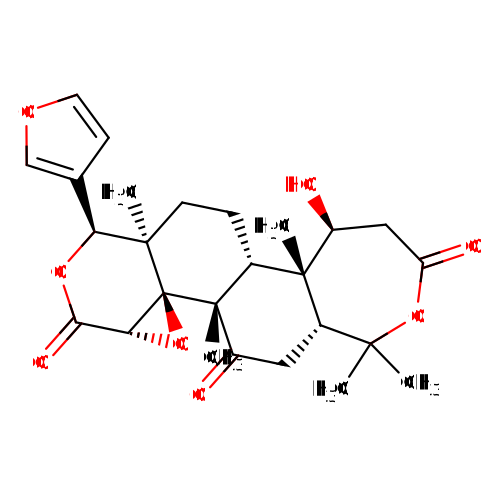
| Record Information |
|---|
| Version | 2.0 |
|---|
| Created at | 2022-09-08 05:47:17 UTC |
|---|
| Updated at | 2022-09-08 05:47:17 UTC |
|---|
| NP-MRD ID | NP0262803 |
|---|
| Secondary Accession Numbers | None |
|---|
| Natural Product Identification |
|---|
| Common Name | (1r,2r,4s,7s,8s,11r,12r,13s,18r)-7-(furan-3-yl)-13-hydroxy-1,8,12,17,17-pentamethyl-3,6,16-trioxapentacyclo[9.9.0.0²,⁴.0²,⁸.0¹²,¹⁸]icosane-5,15,20-trione |
|---|
| Description | Deacetylnomilin belongs to the class of organic compounds known as limonoids. These are highly oxygenated, modified terpenoids with a prototypical structure either containing or derived from a precursor with a 4,4,8-trimethyl-17-furanylsteroid skeleton. All naturally occurring citrus limonoids contain a furan ring attached to the D-ring, at C-17, as well as oxygen containing functional groups at C-3, C-4, C-7, C-16 and C-17. (1r,2r,4s,7s,8s,11r,12r,13s,18r)-7-(furan-3-yl)-13-hydroxy-1,8,12,17,17-pentamethyl-3,6,16-trioxapentacyclo[9.9.0.0²,⁴.0²,⁸.0¹²,¹⁸]icosane-5,15,20-trione is found in Casimiroa edulis, Citrus aurantium, Citrus hanaju, Citrus cavaleriei, Citrus iyo, Citrus junos, Citrus macrophylla, Citrus reticulata, Citrus sphaerocarpa, Citrus sudachi, Citrus trifoliata and Skimmia japonica. (1r,2r,4s,7s,8s,11r,12r,13s,18r)-7-(furan-3-yl)-13-hydroxy-1,8,12,17,17-pentamethyl-3,6,16-trioxapentacyclo[9.9.0.0²,⁴.0²,⁸.0¹²,¹⁸]icosane-5,15,20-trione was first documented in 2003 (PMID: 14710824). Based on a literature review a significant number of articles have been published on Deacetylnomilin (PMID: 19782062) (PMID: 34651409) (PMID: 34335665) (PMID: 34116362) (PMID: 21950163) (PMID: 17542482). |
|---|
| Structure | C[C@@]12CC[C@@H]3[C@]4(C)[C@@H](CC(=O)[C@@]3(C)[C@]11O[C@@H]1C(=O)O[C@H]2C1=COC=C1)C(C)(C)OC(=O)C[C@@H]4O InChI=1S/C26H32O8/c1-22(2)15-10-17(28)25(5)14(24(15,4)16(27)11-18(29)33-22)6-8-23(3)19(13-7-9-31-12-13)32-21(30)20-26(23,25)34-20/h7,9,12,14-16,19-20,27H,6,8,10-11H2,1-5H3/t14-,15+,16+,19+,20-,23+,24-,25+,26-/m1/s1 |
|---|
| Synonyms | Not Available |
|---|
| Chemical Formula | C26H32O8 |
|---|
| Average Mass | 472.5340 Da |
|---|
| Monoisotopic Mass | 472.20972 Da |
|---|
| IUPAC Name | (1R,2R,4S,7R,8S,11R,12R,13S,18R)-7-(furan-3-yl)-13-hydroxy-1,8,12,17,17-pentamethyl-3,6,16-trioxapentacyclo[9.9.0.0^{2,4}.0^{2,8}.0^{12,18}]icosane-5,15,20-trione |
|---|
| Traditional Name | (1R,2R,4S,7R,8S,11R,12R,13S,18R)-7-(furan-3-yl)-13-hydroxy-1,8,12,17,17-pentamethyl-3,6,16-trioxapentacyclo[9.9.0.0^{2,4}.0^{2,8}.0^{12,18}]icosane-5,15,20-trione |
|---|
| CAS Registry Number | Not Available |
|---|
| SMILES | C[C@@]12CC[C@@H]3[C@]4(C)[C@@H](CC(=O)[C@@]3(C)[C@]11O[C@@H]1C(=O)O[C@H]2C1=COC=C1)C(C)(C)OC(=O)C[C@@H]4O |
|---|
| InChI Identifier | InChI=1S/C26H32O8/c1-22(2)15-10-17(28)25(5)14(24(15,4)16(27)11-18(29)33-22)6-8-23(3)19(13-7-9-31-12-13)32-21(30)20-26(23,25)34-20/h7,9,12,14-16,19-20,27H,6,8,10-11H2,1-5H3/t14-,15+,16+,19+,20-,23+,24-,25+,26-/m1/s1 |
|---|
| InChI Key | HWAJASVMTDEFJN-NEFLTLJKSA-N |
|---|
| Experimental Spectra |
|---|
|
| Not Available | | Predicted Spectra |
|---|
|
| | Spectrum Type | Description | Depositor ID | Depositor Organization | Depositor | Deposition Date | View |
|---|
| 1D NMR | 13C NMR Spectrum (1D, 25 MHz, H2O, predicted) | Wishart Lab | Wishart Lab | David Wishart | 2021-06-20 | View Spectrum | | 1D NMR | 1H NMR Spectrum (1D, 100 MHz, H2O, predicted) | Wishart Lab | Wishart Lab | David Wishart | 2021-06-20 | View Spectrum | | 1D NMR | 13C NMR Spectrum (1D, 252 MHz, H2O, predicted) | Wishart Lab | Wishart Lab | David Wishart | 2021-06-20 | View Spectrum | | 1D NMR | 1H NMR Spectrum (1D, 1000 MHz, H2O, predicted) | Wishart Lab | Wishart Lab | David Wishart | 2021-06-20 | View Spectrum | | 1D NMR | 13C NMR Spectrum (1D, 50 MHz, H2O, predicted) | Wishart Lab | Wishart Lab | David Wishart | 2021-06-20 | View Spectrum | | 1D NMR | 1H NMR Spectrum (1D, 200 MHz, H2O, predicted) | Wishart Lab | Wishart Lab | David Wishart | 2021-06-20 | View Spectrum | | 1D NMR | 13C NMR Spectrum (1D, 75 MHz, H2O, predicted) | Wishart Lab | Wishart Lab | David Wishart | 2021-06-20 | View Spectrum | | 1D NMR | 1H NMR Spectrum (1D, 300 MHz, H2O, predicted) | Wishart Lab | Wishart Lab | David Wishart | 2021-06-20 | View Spectrum | | 1D NMR | 13C NMR Spectrum (1D, 101 MHz, H2O, predicted) | Wishart Lab | Wishart Lab | David Wishart | 2021-06-20 | View Spectrum | | 1D NMR | 1H NMR Spectrum (1D, 400 MHz, H2O, predicted) | Wishart Lab | Wishart Lab | David Wishart | 2021-06-20 | View Spectrum | | 1D NMR | 13C NMR Spectrum (1D, 126 MHz, H2O, predicted) | Wishart Lab | Wishart Lab | David Wishart | 2021-06-20 | View Spectrum | | 1D NMR | 1H NMR Spectrum (1D, 500 MHz, H2O, predicted) | Wishart Lab | Wishart Lab | David Wishart | 2021-06-20 | View Spectrum | | 1D NMR | 13C NMR Spectrum (1D, 151 MHz, H2O, predicted) | Wishart Lab | Wishart Lab | David Wishart | 2021-06-20 | View Spectrum | | 1D NMR | 1H NMR Spectrum (1D, 600 MHz, H2O, predicted) | Wishart Lab | Wishart Lab | David Wishart | 2021-06-20 | View Spectrum | | 1D NMR | 13C NMR Spectrum (1D, 176 MHz, H2O, predicted) | Wishart Lab | Wishart Lab | David Wishart | 2021-06-20 | View Spectrum | | 1D NMR | 1H NMR Spectrum (1D, 700 MHz, H2O, predicted) | Wishart Lab | Wishart Lab | David Wishart | 2021-06-20 | View Spectrum | | 1D NMR | 13C NMR Spectrum (1D, 201 MHz, H2O, predicted) | Wishart Lab | Wishart Lab | David Wishart | 2021-06-20 | View Spectrum | | 1D NMR | 1H NMR Spectrum (1D, 800 MHz, H2O, predicted) | Wishart Lab | Wishart Lab | David Wishart | 2021-06-20 | View Spectrum | | 1D NMR | 13C NMR Spectrum (1D, 226 MHz, H2O, predicted) | Wishart Lab | Wishart Lab | David Wishart | 2021-06-20 | View Spectrum | | 1D NMR | 1H NMR Spectrum (1D, 900 MHz, H2O, predicted) | Wishart Lab | Wishart Lab | David Wishart | 2021-06-20 | View Spectrum |
| | Chemical Shift Submissions |
|---|
|
| Not Available | | Species |
|---|
| Species of Origin | |
|---|
| Chemical Taxonomy |
|---|
| Description | Belongs to the class of organic compounds known as limonoids. These are highly oxygenated, modified terpenoids with a prototypical structure either containing or derived from a precursor with a 4,4,8-trimethyl-17-furanylsteroid skeleton. All naturally occurring citrus limonoids contain a furan ring attached to the D-ring, at C-17, as well as oxygen containing functional groups at C-3, C-4, C-7, C-16 and C-17. |
|---|
| Kingdom | Organic compounds |
|---|
| Super Class | Lipids and lipid-like molecules |
|---|
| Class | Prenol lipids |
|---|
| Sub Class | Triterpenoids |
|---|
| Direct Parent | Limonoids |
|---|
| Alternative Parents | |
|---|
| Substituents | - Limonoid skeleton
- Naphthopyran
- Naphthalene
- Caprolactone
- 1,4-dioxepane
- Delta valerolactone
- Dioxepane
- Delta_valerolactone
- Oxepane
- Oxane
- Pyran
- Dicarboxylic acid or derivatives
- Heteroaromatic compound
- Furan
- Secondary alcohol
- Carboxylic acid ester
- Lactone
- Ketone
- Oxacycle
- Organoheterocyclic compound
- Carboxylic acid derivative
- Dialkyl ether
- Oxirane
- Ether
- Organic oxide
- Alcohol
- Hydrocarbon derivative
- Organic oxygen compound
- Carbonyl group
- Organooxygen compound
- Aromatic heteropolycyclic compound
|
|---|
| Molecular Framework | Aromatic heteropolycyclic compounds |
|---|
| External Descriptors | Not Available |
|---|
| Physical Properties |
|---|
| State | Not Available |
|---|
| Experimental Properties | | Property | Value | Reference |
|---|
| Melting Point | Not Available | Not Available | | Boiling Point | Not Available | Not Available | | Water Solubility | Not Available | Not Available | | LogP | Not Available | Not Available |
|
|---|
| Predicted Properties | |
|---|
| General References | - El-Readi MZ, Hamdan D, Farrag N, El-Shazly A, Wink M: Inhibition of P-glycoprotein activity by limonin and other secondary metabolites from Citrus species in human colon and leukaemia cell lines. Eur J Pharmacol. 2010 Jan 25;626(2-3):139-45. doi: 10.1016/j.ejphar.2009.09.040. Epub 2009 Sep 24. [PubMed:19782062 ]
- Tian Q, Schwartz SJ: Mass spectrometry and tandem mass spectrometry of citrus limonoids. Anal Chem. 2003 Oct 15;75(20):5451-60. doi: 10.1021/ac030115w. [PubMed:14710824 ]
- Ling W, Dai T, Zhang J, Liang Y, Yin W, Zhong B, Zhang J: Evaluation of Pomelo Seed Extracts as Natural Antioxidant, Antibacterial, Herbicidal Agents, and Their Functional Components. Chem Biodivers. 2021 Dec;18(12):e2100679. doi: 10.1002/cbdv.202100679. Epub 2021 Oct 27. [PubMed:34651409 ]
- Yan H, Pu ZJ, Zhang ZY, Zhou GS, Zou DQ, Guo S, Li C, Zhan ZL, Duan JA: Research on Biomarkers of Different Growth Periods and Different Drying Processes of Citrus wilsonii Tanaka Based on Plant Metabolomics. Front Plant Sci. 2021 Jul 14;12:700367. doi: 10.3389/fpls.2021.700367. eCollection 2021. [PubMed:34335665 ]
- Giofre SV, Napoli E, Iraci N, Speciale A, Cimino F, Muscara C, Molonia MS, Ruberto G, Saija A: Interaction of selected terpenoids with two SARS-CoV-2 key therapeutic targets: An in silico study through molecular docking and dynamics simulations. Comput Biol Med. 2021 Jul;134:104538. doi: 10.1016/j.compbiomed.2021.104538. Epub 2021 Jun 8. [PubMed:34116362 ]
- Hamdan D, El-Readi MZ, Tahrani A, Herrmann F, Kaufmann D, Farrag N, El-Shazly A, Wink M: Secondary metabolites of ponderosa lemon (Citrus pyriformis) and their antioxidant, anti-inflammatory, and cytotoxic activities. Z Naturforsch C J Biosci. 2011 Jul-Aug;66(7-8):385-93. doi: 10.1515/znc-2011-7-810. [PubMed:21950163 ]
- Mandadi KK, Jayaprakasha GK, Bhat NG, Patil BS: Red Mexican grapefruit: a novel source for bioactive limonoids and their antioxidant activity. Z Naturforsch C J Biosci. 2007 Mar-Apr;62(3-4):179-88. doi: 10.1515/znc-2007-3-405. [PubMed:17542482 ]
- Poulose SM, Harris ED, Patil BS: Antiproliferative effects of citrus limonoids against human neuroblastoma and colonic adenocarcinoma cells. Nutr Cancer. 2006;56(1):103-12. doi: 10.1207/s15327914nc5601_14. [PubMed:17176224 ]
- Tian Q, Li D, Barbacci D, Schwartz SJ, Patil BS: Electron ionization mass spectrometry of citrus limonoids. Rapid Commun Mass Spectrom. 2003;17(22):2517-22. doi: 10.1002/rcm.1218. [PubMed:14608622 ]
- Khalil AT, Maatooq GT, El Sayed KA: Limonoids from Citrus reticulata. Z Naturforsch C J Biosci. 2003 Mar-Apr;58(3-4):165-70. doi: 10.1515/znc-2003-3-403. [PubMed:12710721 ]
- LOTUS database [Link]
|
|---|