| Record Information |
|---|
| Version | 2.0 |
|---|
| Created at | 2022-09-08 04:35:45 UTC |
|---|
| Updated at | 2022-09-08 04:35:45 UTC |
|---|
| NP-MRD ID | NP0261994 |
|---|
| Secondary Accession Numbers | None |
|---|
| Natural Product Identification |
|---|
| Common Name | n-allylnormorphine |
|---|
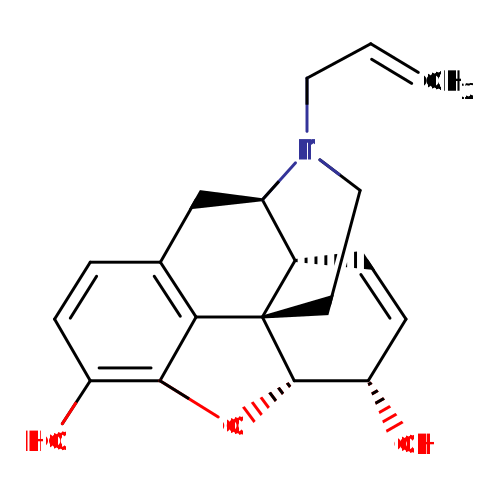
| Description | Nalorphine, also known as nalorphine serb or lethidrone, belongs to the class of organic compounds known as morphinans. These are polycyclic compounds with a four-ring skeleton with three condensed six-member rings forming a partially hydrogenated phenanthrene moiety, one of which is aromatic while the two others are alicyclic. Nalorphine has a number of analogues including niconalorphine (the nicomorphine analogue), diacetylnalorphine (heroin analogue), dihydronalorphine (dihydromorphine) and a number of others and a number of codeine-based ones as well. Nalorphine is a drug which is used to reverse opioid overdose. Due to potent activation of the KOR, nalorphine produces side effects such as dysphoria, anxiety, confusion, and hallucinations, and for this reason, is no longer used medically. Nalorphine is a very strong basic compound (based on its pKa). Nalorphine was the second opioid antagonist to be introduced, preceded by nalodeine (N-allylnorcodeine) in 1915 and followed by naloxone in 1960 and naltrexone in 1963. More recently, it has become much more commonplace to use ethyl chloroformate instead of cyanogen bromide for the Von Braun degradation demethylation step. See for example the list of phenyltropanes or the synthesis of paroxetine for further examples of this. It acts at two opioid receptors — the μ-opioid receptor (MOR) where it has antagonistic effects, and at the κ-opioid receptor (KOR) (Ki 1.6 NM; EC50483nM; Emax 95%) where it exerts high-efficacy partial agonist/near-full agonist characteristics. n-allylnormorphine is found in Papaver somniferum. It was introduced in 1954 and was used as an antidote to reverse opioid overdose and in a challenge test to determine opioid dependence. |
|---|
| Structure | [H][C@@]12OC3=C(O)C=CC4=C3[C@@]11CCN(CC=C)[C@]([H])(C4)[C@]1([H])C=C[C@@H]2O InChI=1S/C19H21NO3/c1-2-8-20-9-7-19-12-4-6-15(22)18(19)23-17-14(21)5-3-11(16(17)19)10-13(12)20/h2-6,12-13,15,18,21-22H,1,7-10H2/t12-,13+,15-,18-,19-/m0/s1 |
|---|
| Synonyms | | Value | Source |
|---|
| Nalorphine serb | Kegg | | Hydrobromide, nalorphine | MeSH | | Lethidrone | MeSH | | Nalorphine hydrochloride | MeSH | | Nalorphine, L-tartrate (1:1) | MeSH | | Nalorphine hydrobromide | MeSH | | Nalorphine, (14 alpha)-isomer | MeSH | | Allylnormorphine | MeSH | | Hydrochloride, nalorphine | MeSH | | Nalorphine | MeSH |
|
|---|
| Chemical Formula | C19H21NO3 |
|---|
| Average Mass | 311.3810 Da |
|---|
| Monoisotopic Mass | 311.15214 Da |
|---|
| IUPAC Name | (1S,5R,13R,14S,17R)-4-(prop-2-en-1-yl)-12-oxa-4-azapentacyclo[9.6.1.0¹,¹³.0⁵,¹⁷.0⁷,¹⁸]octadeca-7(18),8,10,15-tetraene-10,14-diol |
|---|
| Traditional Name | nalorphine |
|---|
| CAS Registry Number | Not Available |
|---|
| SMILES | [H][C@@]12OC3=C(O)C=CC4=C3[C@@]11CCN(CC=C)[C@]([H])(C4)[C@]1([H])C=C[C@@H]2O |
|---|
| InChI Identifier | InChI=1S/C19H21NO3/c1-2-8-20-9-7-19-12-4-6-15(22)18(19)23-17-14(21)5-3-11(16(17)19)10-13(12)20/h2-6,12-13,15,18,21-22H,1,7-10H2/t12-,13+,15-,18-,19-/m0/s1 |
|---|
| InChI Key | UIQMVEYFGZJHCZ-SSTWWWIQSA-N |
|---|
| Experimental Spectra |
|---|
|
| Not Available | | Predicted Spectra |
|---|
|
| | Spectrum Type | Description | Depositor ID | Depositor Organization | Depositor | Deposition Date | View |
|---|
| 1D NMR | 13C NMR Spectrum (1D, 25 MHz, H2O, predicted) | Wishart Lab | Wishart Lab | David Wishart | 2021-06-20 | View Spectrum | | 1D NMR | 1H NMR Spectrum (1D, 100 MHz, H2O, predicted) | Wishart Lab | Wishart Lab | David Wishart | 2021-06-20 | View Spectrum | | 1D NMR | 13C NMR Spectrum (1D, 252 MHz, H2O, predicted) | Wishart Lab | Wishart Lab | David Wishart | 2021-06-20 | View Spectrum | | 1D NMR | 1H NMR Spectrum (1D, 1000 MHz, H2O, predicted) | Wishart Lab | Wishart Lab | David Wishart | 2021-06-20 | View Spectrum | | 1D NMR | 13C NMR Spectrum (1D, 50 MHz, H2O, predicted) | Wishart Lab | Wishart Lab | David Wishart | 2021-06-20 | View Spectrum | | 1D NMR | 1H NMR Spectrum (1D, 200 MHz, H2O, predicted) | Wishart Lab | Wishart Lab | David Wishart | 2021-06-20 | View Spectrum | | 1D NMR | 13C NMR Spectrum (1D, 75 MHz, H2O, predicted) | Wishart Lab | Wishart Lab | David Wishart | 2021-06-20 | View Spectrum | | 1D NMR | 1H NMR Spectrum (1D, 300 MHz, H2O, predicted) | Wishart Lab | Wishart Lab | David Wishart | 2021-06-20 | View Spectrum | | 1D NMR | 13C NMR Spectrum (1D, 101 MHz, H2O, predicted) | Wishart Lab | Wishart Lab | David Wishart | 2021-06-20 | View Spectrum | | 1D NMR | 1H NMR Spectrum (1D, 400 MHz, H2O, predicted) | Wishart Lab | Wishart Lab | David Wishart | 2021-06-20 | View Spectrum | | 1D NMR | 13C NMR Spectrum (1D, 126 MHz, H2O, predicted) | Wishart Lab | Wishart Lab | David Wishart | 2021-06-20 | View Spectrum | | 1D NMR | 1H NMR Spectrum (1D, 500 MHz, H2O, predicted) | Wishart Lab | Wishart Lab | David Wishart | 2021-06-20 | View Spectrum | | 1D NMR | 13C NMR Spectrum (1D, 151 MHz, H2O, predicted) | Wishart Lab | Wishart Lab | David Wishart | 2021-06-20 | View Spectrum | | 1D NMR | 1H NMR Spectrum (1D, 600 MHz, H2O, predicted) | Wishart Lab | Wishart Lab | David Wishart | 2021-06-20 | View Spectrum | | 1D NMR | 13C NMR Spectrum (1D, 176 MHz, H2O, predicted) | Wishart Lab | Wishart Lab | David Wishart | 2021-06-20 | View Spectrum | | 1D NMR | 1H NMR Spectrum (1D, 700 MHz, H2O, predicted) | Wishart Lab | Wishart Lab | David Wishart | 2021-06-20 | View Spectrum | | 1D NMR | 13C NMR Spectrum (1D, 201 MHz, H2O, predicted) | Wishart Lab | Wishart Lab | David Wishart | 2021-06-20 | View Spectrum | | 1D NMR | 1H NMR Spectrum (1D, 800 MHz, H2O, predicted) | Wishart Lab | Wishart Lab | David Wishart | 2021-06-20 | View Spectrum | | 1D NMR | 13C NMR Spectrum (1D, 226 MHz, H2O, predicted) | Wishart Lab | Wishart Lab | David Wishart | 2021-06-20 | View Spectrum | | 1D NMR | 1H NMR Spectrum (1D, 900 MHz, H2O, predicted) | Wishart Lab | Wishart Lab | David Wishart | 2021-06-20 | View Spectrum |
| | Chemical Shift Submissions |
|---|
|
| Not Available | | Species |
|---|
| Species of Origin | |
|---|
| Chemical Taxonomy |
|---|
| Description | Belongs to the class of organic compounds known as morphinans. These are polycyclic compounds with a four-ring skeleton with three condensed six-member rings forming a partially hydrogenated phenanthrene moiety, one of which is aromatic while the two others are alicyclic. |
|---|
| Kingdom | Organic compounds |
|---|
| Super Class | Alkaloids and derivatives |
|---|
| Class | Morphinans |
|---|
| Sub Class | Not Available |
|---|
| Direct Parent | Morphinans |
|---|
| Alternative Parents | |
|---|
| Substituents | - Morphinan
- Phenanthrene
- Tetralin
- Coumaran
- Alkyl aryl ether
- 1-hydroxy-2-unsubstituted benzenoid
- Aralkylamine
- Piperidine
- Benzenoid
- Secondary alcohol
- Tertiary amine
- Tertiary aliphatic amine
- Ether
- Oxacycle
- Azacycle
- Organoheterocyclic compound
- Organopnictogen compound
- Organooxygen compound
- Organonitrogen compound
- Organic oxygen compound
- Alcohol
- Hydrocarbon derivative
- Organic nitrogen compound
- Amine
- Aromatic heteropolycyclic compound
|
|---|
| Molecular Framework | Aromatic heteropolycyclic compounds |
|---|
| External Descriptors | |
|---|
| Physical Properties |
|---|
| State | Not Available |
|---|
| Experimental Properties | | Property | Value | Reference |
|---|
| Melting Point | Not Available | Not Available | | Boiling Point | Not Available | Not Available | | Water Solubility | Not Available | Not Available | | LogP | Not Available | Not Available |
|
|---|
| Predicted Properties | |
|---|