| Record Information |
|---|
| Version | 2.0 |
|---|
| Created at | 2022-09-08 03:12:36 UTC |
|---|
| Updated at | 2022-09-08 03:12:36 UTC |
|---|
| NP-MRD ID | NP0260917 |
|---|
| Secondary Accession Numbers | None |
|---|
| Natural Product Identification |
|---|
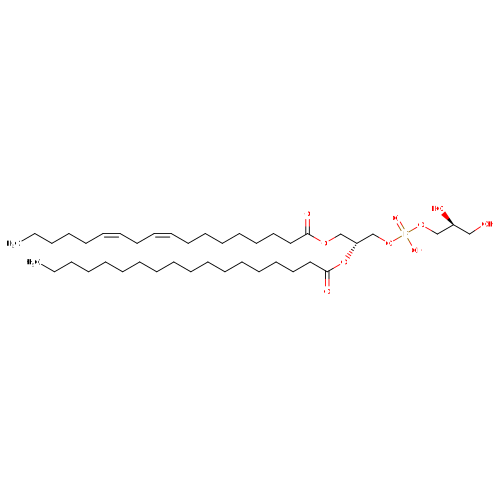
| Common Name | (2s)-2,3-dihydroxypropoxy((2r)-3-[(9z,12z)-octadeca-9,12-dienoyloxy]-2-(octadecanoyloxy)propoxy)phosphinic acid |
|---|
| Description | PG(18:2(9Z,12Z)/18:0), Also known as GPG(18:2/18:0) Or GPG(36:2), Belongs to the class of organic compounds known as phosphatidylglycerols. These are glycerophosphoglycerols in which two fatty acids are bonded to the 1-glycerol moiety through ester linkages. As is the case with diacylglycerols, phosphatidylglycerols can have many different combinations of fatty acids of varying lengths and saturation attached to the C-1 and C-2 positions. Thus, PG(18:2(9Z,12Z)/18:0) Is considered to be a glycerophosphoglycerol lipid molecule. PG(18:2(9Z,12Z)/18:0) Is a very hydrophobic molecule, practically insoluble (in water), and relatively neutral. Within humans, PG(18:2(9Z,12Z)/18:0) Participates in a number of enzymatic reactions. In particular, PG(18:2(9Z,12Z)/18:0) Can be biosynthesized from PGP(18:2(9Z,12Z)/18:0) Through the action of the enzyme phosphatidylglycerophosphatase and protein-tyrosine phosphatase 1. In addition, PG(18:2(9Z,12Z)/18:0) And CDP-DG(18:2(9Z,12Z)/18:0) Can be converted into CL(18:2(9Z,12Z)/18:0/18:2(9Z,12Z)/18:0) And cytidine monophosphate through its interaction with the enzyme cardiolipin synthase. Bioynthesis proceeds by condensation of phosphatidic acid and cytidine triphosphate with elimination of pyrophosphate via the action of phosphatidate cytidyltransferase (or CDP-synthase). In humans, PG(18:2(9Z,12Z)/18:0) Is involved in cardiolipin biosynthesis. Fatty acids containing 16, 18 and 20 carbons are the most common. As is the case with diacylglycerols, phosphatidylglycerols can have many different combinations of fatty acids of varying lengths and saturation attached at the C-1 and C-2 positions. CDP-diacylglycerol then reacts with glycerol-3-phosphate via phosphatidylglycerophosphate synthase to form 3-sn-phosphatidyl-1'-sn-glycerol 3'-phosphoric acid, with the release of cytidine monophosphate (CMP). PG also serves as a precursor for the synthesis of cardiolipin. While most phospholipids have a saturated fatty acid on C-1 and an unsaturated fatty acid on C-2 of the glycerol backbone, the fatty acid distribution at the C-1 and C-2 positions of glycerol within phospholipids is continually in flux, owing to phospholipid degradation and the continuous phospholipid remodeling that occurs while these molecules are in membranes. The linoleic acid moiety is derived from seed oils, while the stearic acid moiety is derived from animal fats, coco butter and sesame oil. (2s)-2,3-dihydroxypropoxy((2r)-3-[(9z,12z)-octadeca-9,12-dienoyloxy]-2-(octadecanoyloxy)propoxy)phosphinic acid is found in Glycine max. It is well established that the concentration of phosphatidylglycerol increases during fetal development. |
|---|
| Structure | [H][C@](O)(CO)COP(O)(=O)OC[C@@]([H])(COC(=O)CCCCCCC\C=C/C\C=C/CCCCC)OC(=O)CCCCCCCCCCCCCCCCC InChI=1S/C42H79O10P/c1-3-5-7-9-11-13-15-17-19-21-23-25-27-29-31-33-41(45)49-37-40(38-51-53(47,48)50-36-39(44)35-43)52-42(46)34-32-30-28-26-24-22-20-18-16-14-12-10-8-6-4-2/h11,13,17,19,39-40,43-44H,3-10,12,14-16,18,20-38H2,1-2H3,(H,47,48)/b13-11-,19-17-/t39-,40+/m0/s1 |
|---|
| Synonyms | | Value | Source |
|---|
| 1-(9Z,12Z-Octadecadienoyl)-2-octadecanoyl-sn-glycero-3-phospho-(1'-glycerol) | HMDB | | 1-Linoleoyl-2-stearoyl-sn-glycero-3-phosphoglycerol | HMDB | | GPG(18:2/18:0) | HMDB | | GPG(18:2N6/18:0) | HMDB | | GPG(18:2W6/18:0) | HMDB | | GPG(36:2) | HMDB | | PG(18:2/18:0) | HMDB | | PG(18:2N6/18:0) | HMDB | | PG(18:2W6/18:0) | HMDB | | PG(36:2) | HMDB | | Phosphatidylglycerol(18:2/18:0) | HMDB | | Phosphatidylglycerol(18:2n6/18:0) | HMDB | | Phosphatidylglycerol(18:2W6/18:0) | HMDB | | Phosphatidylglycerol(36:2) | HMDB | | 1-(9Z,12Z-Octadecadienoyl)-2-octadecanoyl-sn-glycero-3-phosphoglycerol | HMDB | | PG(18:2(9Z,12Z)/18:0) | Lipid Annotator |
|
|---|
| Chemical Formula | C42H79O10P |
|---|
| Average Mass | 775.0444 Da |
|---|
| Monoisotopic Mass | 774.54109 Da |
|---|
| IUPAC Name | [(2S)-2,3-dihydroxypropoxy][(2R)-3-[(9Z,12Z)-octadeca-9,12-dienoyloxy]-2-(octadecanoyloxy)propoxy]phosphinic acid |
|---|
| Traditional Name | (2S)-2,3-dihydroxypropoxy(2R)-3-[(9Z,12Z)-octadeca-9,12-dienoyloxy]-2-(octadecanoyloxy)propoxyphosphinic acid |
|---|
| CAS Registry Number | Not Available |
|---|
| SMILES | [H][C@](O)(CO)COP(O)(=O)OC[C@@]([H])(COC(=O)CCCCCCC\C=C/C\C=C/CCCCC)OC(=O)CCCCCCCCCCCCCCCCC |
|---|
| InChI Identifier | InChI=1S/C42H79O10P/c1-3-5-7-9-11-13-15-17-19-21-23-25-27-29-31-33-41(45)49-37-40(38-51-53(47,48)50-36-39(44)35-43)52-42(46)34-32-30-28-26-24-22-20-18-16-14-12-10-8-6-4-2/h11,13,17,19,39-40,43-44H,3-10,12,14-16,18,20-38H2,1-2H3,(H,47,48)/b13-11-,19-17-/t39-,40+/m0/s1 |
|---|
| InChI Key | CZVJBYZXTBYGJR-XAODMQRJSA-N |
|---|
| Experimental Spectra |
|---|
|
| Not Available | | Predicted Spectra |
|---|
|
| | Spectrum Type | Description | Depositor ID | Depositor Organization | Depositor | Deposition Date | View |
|---|
| 1D NMR | 13C NMR Spectrum (1D, 25 MHz, H2O, predicted) | Wishart Lab | Wishart Lab | David Wishart | 2021-06-20 | View Spectrum | | 1D NMR | 1H NMR Spectrum (1D, 100 MHz, H2O, predicted) | Wishart Lab | Wishart Lab | David Wishart | 2021-06-20 | View Spectrum | | 1D NMR | 13C NMR Spectrum (1D, 252 MHz, H2O, predicted) | Wishart Lab | Wishart Lab | David Wishart | 2021-06-20 | View Spectrum | | 1D NMR | 1H NMR Spectrum (1D, 1000 MHz, H2O, predicted) | Wishart Lab | Wishart Lab | David Wishart | 2021-06-20 | View Spectrum | | 1D NMR | 13C NMR Spectrum (1D, 50 MHz, H2O, predicted) | Wishart Lab | Wishart Lab | David Wishart | 2021-06-20 | View Spectrum | | 1D NMR | 1H NMR Spectrum (1D, 200 MHz, H2O, predicted) | Wishart Lab | Wishart Lab | David Wishart | 2021-06-20 | View Spectrum | | 1D NMR | 13C NMR Spectrum (1D, 75 MHz, H2O, predicted) | Wishart Lab | Wishart Lab | David Wishart | 2021-06-20 | View Spectrum | | 1D NMR | 1H NMR Spectrum (1D, 300 MHz, H2O, predicted) | Wishart Lab | Wishart Lab | David Wishart | 2021-06-20 | View Spectrum | | 1D NMR | 13C NMR Spectrum (1D, 101 MHz, H2O, predicted) | Wishart Lab | Wishart Lab | David Wishart | 2021-06-20 | View Spectrum | | 1D NMR | 1H NMR Spectrum (1D, 400 MHz, H2O, predicted) | Wishart Lab | Wishart Lab | David Wishart | 2021-06-20 | View Spectrum | | 1D NMR | 13C NMR Spectrum (1D, 126 MHz, H2O, predicted) | Wishart Lab | Wishart Lab | David Wishart | 2021-06-20 | View Spectrum | | 1D NMR | 1H NMR Spectrum (1D, 500 MHz, H2O, predicted) | Wishart Lab | Wishart Lab | David Wishart | 2021-06-20 | View Spectrum | | 1D NMR | 13C NMR Spectrum (1D, 151 MHz, H2O, predicted) | Wishart Lab | Wishart Lab | David Wishart | 2021-06-20 | View Spectrum | | 1D NMR | 1H NMR Spectrum (1D, 600 MHz, H2O, predicted) | Wishart Lab | Wishart Lab | David Wishart | 2021-06-20 | View Spectrum | | 1D NMR | 13C NMR Spectrum (1D, 176 MHz, H2O, predicted) | Wishart Lab | Wishart Lab | David Wishart | 2021-06-20 | View Spectrum | | 1D NMR | 1H NMR Spectrum (1D, 700 MHz, H2O, predicted) | Wishart Lab | Wishart Lab | David Wishart | 2021-06-20 | View Spectrum | | 1D NMR | 13C NMR Spectrum (1D, 201 MHz, H2O, predicted) | Wishart Lab | Wishart Lab | David Wishart | 2021-06-20 | View Spectrum | | 1D NMR | 1H NMR Spectrum (1D, 800 MHz, H2O, predicted) | Wishart Lab | Wishart Lab | David Wishart | 2021-06-20 | View Spectrum | | 1D NMR | 13C NMR Spectrum (1D, 226 MHz, H2O, predicted) | Wishart Lab | Wishart Lab | David Wishart | 2021-06-20 | View Spectrum | | 1D NMR | 1H NMR Spectrum (1D, 900 MHz, H2O, predicted) | Wishart Lab | Wishart Lab | David Wishart | 2021-06-20 | View Spectrum |
| | Chemical Shift Submissions |
|---|
|
| Not Available | | Species |
|---|
| Species of Origin | |
|---|
| Chemical Taxonomy |
|---|
| Description | Belongs to the class of organic compounds known as phosphatidylglycerols. These are glycerophosphoglycerols in which two fatty acids are bonded to the 1-glycerol moiety through ester linkages. As is the case with diacylglycerols, phosphatidylglycerols can have many different combinations of fatty acids of varying lengths and saturation attached to the C-1 and C-2 positions. |
|---|
| Kingdom | Organic compounds |
|---|
| Super Class | Lipids and lipid-like molecules |
|---|
| Class | Glycerophospholipids |
|---|
| Sub Class | Glycerophosphoglycerols |
|---|
| Direct Parent | Phosphatidylglycerols |
|---|
| Alternative Parents | |
|---|
| Substituents | - 1,2-diacylglycerophosphoglycerol
- Fatty acid ester
- Dialkyl phosphate
- Dicarboxylic acid or derivatives
- Organic phosphoric acid derivative
- Phosphoric acid ester
- Alkyl phosphate
- Fatty acyl
- 1,2-diol
- Carboxylic acid ester
- Secondary alcohol
- Carboxylic acid derivative
- Organic oxide
- Organooxygen compound
- Alcohol
- Organic oxygen compound
- Primary alcohol
- Carbonyl group
- Hydrocarbon derivative
- Aliphatic acyclic compound
|
|---|
| Molecular Framework | Aliphatic acyclic compounds |
|---|
| External Descriptors | |
|---|
| Physical Properties |
|---|
| State | Not Available |
|---|
| Experimental Properties | | Property | Value | Reference |
|---|
| Melting Point | Not Available | Not Available | | Boiling Point | Not Available | Not Available | | Water Solubility | Not Available | Not Available | | LogP | Not Available | Not Available |
|
|---|
| Predicted Properties | |
|---|