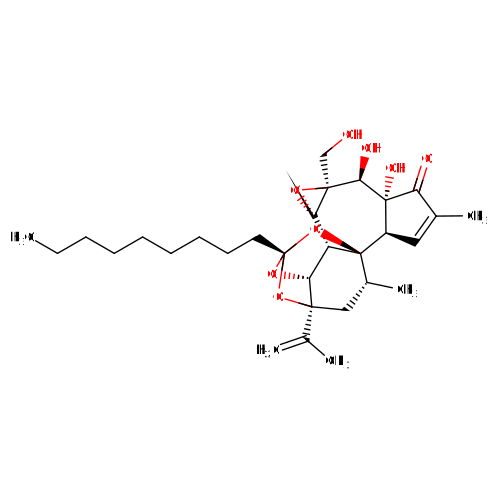
| Record Information |
|---|
| Version | 2.0 |
|---|
| Created at | 2022-09-08 01:41:25 UTC |
|---|
| Updated at | 2022-09-08 01:41:25 UTC |
|---|
| NP-MRD ID | NP0259723 |
|---|
| Secondary Accession Numbers | None |
|---|
| Natural Product Identification |
|---|
| Common Name | wikstrotoxin d |
|---|
| Description | Simplexin belongs to the class of organic compounds known as rhamnofolane and daphnane diterpenoids. These are diterpenoids with a structure based on one the rhamnofolane or daphnane skeleton. The rhamnofolane and daphnane skeletons are closely related, being formally derived from casbane by two cyclizations (6,10 and 5,14) followed by cleavage of the 1,15 (daphnane) or 2,15 (rhamnofolane) cyclopropane bonds. wikstrotoxin d is found in Daphne genkwa, Pimelea simplex and Stellera chamaejasme. wikstrotoxin d was first documented in 2010 (PMID: 21049973). Based on a literature review a significant number of articles have been published on Simplexin (PMID: 32730770) (PMID: 26393897) (PMID: 26102551) (PMID: 35977604) (PMID: 34184103) (PMID: 25535086). |
|---|
| Structure | CCCCCCCCC[C@]12O[C@@H]3[C@@H]4[C@@H]5O[C@]5(CO)[C@@H](O)[C@@]5(O)[C@@H](C=C(C)C5=O)[C@@]4(O1)[C@H](C)C[C@@]3(O2)C(C)=C InChI=1S/C30H44O8/c1-6-7-8-9-10-11-12-13-28-36-23-21-24-27(16-31,35-24)25(33)29(34)20(14-18(4)22(29)32)30(21,38-28)19(5)15-26(23,37-28)17(2)3/h14,19-21,23-25,31,33-34H,2,6-13,15-16H2,1,3-5H3/t19-,20-,21-,23-,24+,25-,26-,27+,28-,29-,30+/m1/s1 |
|---|
| Synonyms | Not Available |
|---|
| Chemical Formula | C30H44O8 |
|---|
| Average Mass | 532.6740 Da |
|---|
| Monoisotopic Mass | 532.30362 Da |
|---|
| IUPAC Name | (1R,2R,6S,7S,8R,10S,11S,12R,14S,16R,18R)-6,7-dihydroxy-8-(hydroxymethyl)-4,18-dimethyl-14-nonyl-16-(prop-1-en-2-yl)-9,13,15,19-tetraoxahexacyclo[12.4.1.0^{1,11}.0^{2,6}.0^{8,10}.0^{12,16}]nonadec-3-en-5-one |
|---|
| Traditional Name | (1R,2R,6S,7S,8R,10S,11S,12R,14S,16R,18R)-6,7-dihydroxy-8-(hydroxymethyl)-4,18-dimethyl-14-nonyl-16-(prop-1-en-2-yl)-9,13,15,19-tetraoxahexacyclo[12.4.1.0^{1,11}.0^{2,6}.0^{8,10}.0^{12,16}]nonadec-3-en-5-one |
|---|
| CAS Registry Number | Not Available |
|---|
| SMILES | CCCCCCCCC[C@]12O[C@@H]3[C@@H]4[C@@H]5O[C@]5(CO)[C@@H](O)[C@@]5(O)[C@@H](C=C(C)C5=O)[C@@]4(O1)[C@H](C)C[C@@]3(O2)C(C)=C |
|---|
| InChI Identifier | InChI=1S/C30H44O8/c1-6-7-8-9-10-11-12-13-28-36-23-21-24-27(16-31,35-24)25(33)29(34)20(14-18(4)22(29)32)30(21,38-28)19(5)15-26(23,37-28)17(2)3/h14,19-21,23-25,31,33-34H,2,6-13,15-16H2,1,3-5H3/t19-,20-,21-,23-,24+,25-,26-,27+,28-,29-,30+/m1/s1 |
|---|
| InChI Key | JAQJQYMDHBSCKO-JDVVNZBPSA-N |
|---|
| Experimental Spectra |
|---|
|
| Not Available | | Predicted Spectra |
|---|
|
| | Spectrum Type | Description | Depositor ID | Depositor Organization | Depositor | Deposition Date | View |
|---|
| 1D NMR | 13C NMR Spectrum (1D, 25 MHz, H2O, predicted) | Wishart Lab | Wishart Lab | David Wishart | 2021-06-20 | View Spectrum | | 1D NMR | 1H NMR Spectrum (1D, 100 MHz, H2O, predicted) | Wishart Lab | Wishart Lab | David Wishart | 2021-06-20 | View Spectrum | | 1D NMR | 13C NMR Spectrum (1D, 252 MHz, H2O, predicted) | Wishart Lab | Wishart Lab | David Wishart | 2021-06-20 | View Spectrum | | 1D NMR | 1H NMR Spectrum (1D, 1000 MHz, H2O, predicted) | Wishart Lab | Wishart Lab | David Wishart | 2021-06-20 | View Spectrum | | 1D NMR | 13C NMR Spectrum (1D, 50 MHz, H2O, predicted) | Wishart Lab | Wishart Lab | David Wishart | 2021-06-20 | View Spectrum | | 1D NMR | 1H NMR Spectrum (1D, 200 MHz, H2O, predicted) | Wishart Lab | Wishart Lab | David Wishart | 2021-06-20 | View Spectrum | | 1D NMR | 13C NMR Spectrum (1D, 75 MHz, H2O, predicted) | Wishart Lab | Wishart Lab | David Wishart | 2021-06-20 | View Spectrum | | 1D NMR | 1H NMR Spectrum (1D, 300 MHz, H2O, predicted) | Wishart Lab | Wishart Lab | David Wishart | 2021-06-20 | View Spectrum | | 1D NMR | 13C NMR Spectrum (1D, 101 MHz, H2O, predicted) | Wishart Lab | Wishart Lab | David Wishart | 2021-06-20 | View Spectrum | | 1D NMR | 1H NMR Spectrum (1D, 400 MHz, H2O, predicted) | Wishart Lab | Wishart Lab | David Wishart | 2021-06-20 | View Spectrum | | 1D NMR | 13C NMR Spectrum (1D, 126 MHz, H2O, predicted) | Wishart Lab | Wishart Lab | David Wishart | 2021-06-20 | View Spectrum | | 1D NMR | 1H NMR Spectrum (1D, 500 MHz, H2O, predicted) | Wishart Lab | Wishart Lab | David Wishart | 2021-06-20 | View Spectrum | | 1D NMR | 13C NMR Spectrum (1D, 151 MHz, H2O, predicted) | Wishart Lab | Wishart Lab | David Wishart | 2021-06-20 | View Spectrum | | 1D NMR | 1H NMR Spectrum (1D, 600 MHz, H2O, predicted) | Wishart Lab | Wishart Lab | David Wishart | 2021-06-20 | View Spectrum | | 1D NMR | 13C NMR Spectrum (1D, 176 MHz, H2O, predicted) | Wishart Lab | Wishart Lab | David Wishart | 2021-06-20 | View Spectrum | | 1D NMR | 1H NMR Spectrum (1D, 700 MHz, H2O, predicted) | Wishart Lab | Wishart Lab | David Wishart | 2021-06-20 | View Spectrum | | 1D NMR | 13C NMR Spectrum (1D, 201 MHz, H2O, predicted) | Wishart Lab | Wishart Lab | David Wishart | 2021-06-20 | View Spectrum | | 1D NMR | 1H NMR Spectrum (1D, 800 MHz, H2O, predicted) | Wishart Lab | Wishart Lab | David Wishart | 2021-06-20 | View Spectrum | | 1D NMR | 13C NMR Spectrum (1D, 226 MHz, H2O, predicted) | Wishart Lab | Wishart Lab | David Wishart | 2021-06-20 | View Spectrum | | 1D NMR | 1H NMR Spectrum (1D, 900 MHz, H2O, predicted) | Wishart Lab | Wishart Lab | David Wishart | 2021-06-20 | View Spectrum |
| | Chemical Shift Submissions |
|---|
|
| Not Available | | Species |
|---|
| Species of Origin | |
|---|
| Chemical Taxonomy |
|---|
| Description | Belongs to the class of organic compounds known as rhamnofolane and daphnane diterpenoids. These are diterpenoids with a structure based on one the rhamnofolane or daphnane skeleton. The rhamnofolane and daphnane skeletons are closely related, being formally derived from casbane by two cyclizations (6,10 and 5,14) followed by cleavage of the 1,15 (daphnane) or 2,15 (rhamnofolane) cyclopropane bonds. |
|---|
| Kingdom | Organic compounds |
|---|
| Super Class | Lipids and lipid-like molecules |
|---|
| Class | Prenol lipids |
|---|
| Sub Class | Diterpenoids |
|---|
| Direct Parent | Rhamnofolane and daphnane diterpenoids |
|---|
| Alternative Parents | |
|---|
| Substituents | - Daphnane diterpenoid
- 1,3-dioxepane
- Carboxylic acid orthoester
- Dioxepane
- Ortho ester
- Meta-dioxane
- Meta-dioxolane
- Cyclic alcohol
- Tertiary alcohol
- Secondary alcohol
- Ketone
- Orthocarboxylic acid derivative
- Ether
- Oxirane
- Dialkyl ether
- Organoheterocyclic compound
- Oxacycle
- Primary alcohol
- Organic oxygen compound
- Carbonyl group
- Alcohol
- Organic oxide
- Organooxygen compound
- Hydrocarbon derivative
- Aliphatic heteropolycyclic compound
|
|---|
| Molecular Framework | Aliphatic heteropolycyclic compounds |
|---|
| External Descriptors | Not Available |
|---|
| Physical Properties |
|---|
| State | Not Available |
|---|
| Experimental Properties | | Property | Value | Reference |
|---|
| Melting Point | Not Available | Not Available | | Boiling Point | Not Available | Not Available | | Water Solubility | Not Available | Not Available | | LogP | Not Available | Not Available |
|
|---|
| Predicted Properties | |
|---|
| General References | - Gordon RJ, Hungerford NL, Laycock B, Fletcher MT: A review on Pimelea poisoning of livestock. Toxicon. 2020 Oct 30;186:46-57. doi: 10.1016/j.toxicon.2020.07.023. Epub 2020 Jul 28. [PubMed:32730770 ]
- Guo J, Tian J, Yao G, Zhu H, Xue Y, Luo Z, Zhang J, Zhang Y, Zhang Y: Three new 1alpha-alkyldaphnane-type diterpenoids from the flower buds of Wikstroemia chamaedaphne. Fitoterapia. 2015 Oct;106:242-6. doi: 10.1016/j.fitote.2015.09.017. Epub 2015 Sep 21. [PubMed:26393897 ]
- Kulakowski D, Kitalong C, Negrin A, Tadao VR, Balick MJ, Kennelly EJ: Traditional preparation of Phaleria nisidai, a Palauan tea, reduces exposure to toxic daphnane-type diterpene esters while maintaining immunomodulatory activity. J Ethnopharmacol. 2015 Sep 15;173:273-9. doi: 10.1016/j.jep.2015.06.023. Epub 2015 Jun 20. [PubMed:26102551 ]
- Hayes PY, Chow S, Somerville MJ, Fletcher MT, De Voss JJ: Daphnane- and tigliane-type diterpenoid esters and orthoesters from Pimelea elongata. J Nat Prod. 2010 Nov 29;73(11):1907-13. doi: 10.1021/np1005746. Epub 2010 Nov 4. [PubMed:21049973 ]
- Guo R, Li Q, Mi SH, Jia SH, Yao GD, Lin B, Huang XX, Liu YY, Song SJ: Target isolation of cytotoxic diterpenoid esters and orthoesters from Daphne tangutica maxim based on molecular networking. Phytochemistry. 2022 Nov;203:113358. doi: 10.1016/j.phytochem.2022.113358. Epub 2022 Aug 14. [PubMed:35977604 ]
- Yuan Y, Hungerford NL, Gauthier E, Ouwerkerk D, Yong KWL, Fletcher MT, Laycock B: Extraction and determination of the Pimelea toxin simplexin in complex plant-polymer biocomposites using ultrahigh-performance liquid chromatography coupled with quadrupole Orbitrap mass spectrometry. Anal Bioanal Chem. 2021 Aug;413(20):5121-5133. doi: 10.1007/s00216-021-03475-5. Epub 2021 Jun 29. [PubMed:34184103 ]
- Namukobe J, Kiremire BT, Byamukama R, Kasenene JM, Akala HM, Kamau E, Dumontet V: Antiplasmodial compounds from the stem bark of Neoboutonia macrocalyx pax. J Ethnopharmacol. 2015 Mar 13;162:317-22. doi: 10.1016/j.jep.2014.12.018. Epub 2014 Dec 19. [PubMed:25535086 ]
- Kulakowski DM, Wu SB, Balick MJ, Kennelly EJ: Merging bioactivity with liquid chromatography-mass spectrometry-based chemometrics to identify minor immunomodulatory compounds from a Micronesian adaptogen, Phaleria nisidai. J Chromatogr A. 2014 Oct 17;1364:74-82. doi: 10.1016/j.chroma.2014.08.049. Epub 2014 Aug 20. [PubMed:25218635 ]
- Fletcher MT, Chow S, Ossedryver SM: Effect of increasing low-dose simplexin exposure in cattle consuming Pimelea trichostachya. J Agric Food Chem. 2014 Jul 30;62(30):7402-6. doi: 10.1021/jf5005644. Epub 2014 Jul 3. [PubMed:24823868 ]
- Wu SL, Su JH, Huang CY, Tai CJ, Sung PJ, Liaw CC, Sheu JH: Simplexins P-S, eunicellin-based diterpenes from the soft coral Klyxum simplex. Mar Drugs. 2012 Jun;10(6):1203-1211. doi: 10.3390/md10061203. Epub 2012 May 25. [PubMed:22822367 ]
- LOTUS database [Link]
|
|---|