| Record Information |
|---|
| Version | 2.0 |
|---|
| Created at | 2022-09-07 23:23:50 UTC |
|---|
| Updated at | 2022-09-07 23:23:50 UTC |
|---|
| NP-MRD ID | NP0258089 |
|---|
| Secondary Accession Numbers | None |
|---|
| Natural Product Identification |
|---|
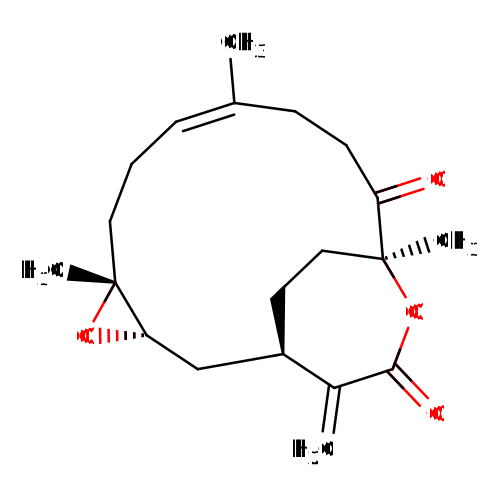
| Common Name | (1r,3s,5s,8e,13r)-5,9,13-trimethyl-16-methylidene-4,14-dioxatricyclo[11.3.2.0³,⁵]octadec-8-ene-12,15-dione |
|---|
| Description | 11-Dehydrosinulariolide belongs to the class of organic compounds known as macrolides and analogues. These are organic compounds containing a lactone ring of at least twelve members. (1r,3s,5s,8e,13r)-5,9,13-trimethyl-16-methylidene-4,14-dioxatricyclo[11.3.2.0³,⁵]octadec-8-ene-12,15-dione is found in Sinularia flexibilis and Sinularia notanda. (1r,3s,5s,8e,13r)-5,9,13-trimethyl-16-methylidene-4,14-dioxatricyclo[11.3.2.0³,⁵]octadec-8-ene-12,15-dione was first documented in 2016 (PMID: 27763504). Based on a literature review a small amount of articles have been published on 11-Dehydrosinulariolide (PMID: 33430021) (PMID: 32992719) (PMID: 30513611) (PMID: 27598175). |
|---|
| Structure | C\C1=C\CC[C@]2(C)O[C@H]2C[C@H]2CC[C@@](C)(OC(=O)C2=C)C(=O)CC1 InChI=1S/C20H28O4/c1-13-6-5-10-20(4)17(23-20)12-15-9-11-19(3,16(21)8-7-13)24-18(22)14(15)2/h6,15,17H,2,5,7-12H2,1,3-4H3/b13-6-/t15-,17+,19-,20+/m1/s1 |
|---|
| Synonyms | Not Available |
|---|
| Chemical Formula | C20H28O4 |
|---|
| Average Mass | 332.4400 Da |
|---|
| Monoisotopic Mass | 332.19876 Da |
|---|
| IUPAC Name | (1R,3S,5S,8E,13R)-5,9,13-trimethyl-16-methylidene-4,14-dioxatricyclo[11.3.2.0^{3,5}]octadec-8-ene-12,15-dione |
|---|
| Traditional Name | (1R,3S,5S,8E,13R)-5,9,13-trimethyl-16-methylidene-4,14-dioxatricyclo[11.3.2.0^{3,5}]octadec-8-ene-12,15-dione |
|---|
| CAS Registry Number | Not Available |
|---|
| SMILES | C\C1=C\CC[C@]2(C)O[C@H]2C[C@H]2CC[C@@](C)(OC(=O)C2=C)C(=O)CC1 |
|---|
| InChI Identifier | InChI=1S/C20H28O4/c1-13-6-5-10-20(4)17(23-20)12-15-9-11-19(3,16(21)8-7-13)24-18(22)14(15)2/h6,15,17H,2,5,7-12H2,1,3-4H3/b13-6-/t15-,17+,19-,20+/m1/s1 |
|---|
| InChI Key | BCEKDLJRXSZZRB-FPTYZNIUSA-N |
|---|
| Experimental Spectra |
|---|
|
| Not Available | | Predicted Spectra |
|---|
|
| | Spectrum Type | Description | Depositor ID | Depositor Organization | Depositor | Deposition Date | View |
|---|
| 1D NMR | 13C NMR Spectrum (1D, 25 MHz, H2O, predicted) | Wishart Lab | Wishart Lab | David Wishart | 2021-06-20 | View Spectrum | | 1D NMR | 1H NMR Spectrum (1D, 100 MHz, H2O, predicted) | Wishart Lab | Wishart Lab | David Wishart | 2021-06-20 | View Spectrum | | 1D NMR | 13C NMR Spectrum (1D, 252 MHz, H2O, predicted) | Wishart Lab | Wishart Lab | David Wishart | 2021-06-20 | View Spectrum | | 1D NMR | 1H NMR Spectrum (1D, 1000 MHz, H2O, predicted) | Wishart Lab | Wishart Lab | David Wishart | 2021-06-20 | View Spectrum | | 1D NMR | 13C NMR Spectrum (1D, 50 MHz, H2O, predicted) | Wishart Lab | Wishart Lab | David Wishart | 2021-06-20 | View Spectrum | | 1D NMR | 1H NMR Spectrum (1D, 200 MHz, H2O, predicted) | Wishart Lab | Wishart Lab | David Wishart | 2021-06-20 | View Spectrum | | 1D NMR | 13C NMR Spectrum (1D, 75 MHz, H2O, predicted) | Wishart Lab | Wishart Lab | David Wishart | 2021-06-20 | View Spectrum | | 1D NMR | 1H NMR Spectrum (1D, 300 MHz, H2O, predicted) | Wishart Lab | Wishart Lab | David Wishart | 2021-06-20 | View Spectrum | | 1D NMR | 13C NMR Spectrum (1D, 101 MHz, H2O, predicted) | Wishart Lab | Wishart Lab | David Wishart | 2021-06-20 | View Spectrum | | 1D NMR | 1H NMR Spectrum (1D, 400 MHz, H2O, predicted) | Wishart Lab | Wishart Lab | David Wishart | 2021-06-20 | View Spectrum | | 1D NMR | 13C NMR Spectrum (1D, 126 MHz, H2O, predicted) | Wishart Lab | Wishart Lab | David Wishart | 2021-06-20 | View Spectrum | | 1D NMR | 1H NMR Spectrum (1D, 500 MHz, H2O, predicted) | Wishart Lab | Wishart Lab | David Wishart | 2021-06-20 | View Spectrum | | 1D NMR | 13C NMR Spectrum (1D, 151 MHz, H2O, predicted) | Wishart Lab | Wishart Lab | David Wishart | 2021-06-20 | View Spectrum | | 1D NMR | 1H NMR Spectrum (1D, 600 MHz, H2O, predicted) | Wishart Lab | Wishart Lab | David Wishart | 2021-06-20 | View Spectrum | | 1D NMR | 13C NMR Spectrum (1D, 176 MHz, H2O, predicted) | Wishart Lab | Wishart Lab | David Wishart | 2021-06-20 | View Spectrum | | 1D NMR | 1H NMR Spectrum (1D, 700 MHz, H2O, predicted) | Wishart Lab | Wishart Lab | David Wishart | 2021-06-20 | View Spectrum | | 1D NMR | 13C NMR Spectrum (1D, 201 MHz, H2O, predicted) | Wishart Lab | Wishart Lab | David Wishart | 2021-06-20 | View Spectrum | | 1D NMR | 1H NMR Spectrum (1D, 800 MHz, H2O, predicted) | Wishart Lab | Wishart Lab | David Wishart | 2021-06-20 | View Spectrum | | 1D NMR | 13C NMR Spectrum (1D, 226 MHz, H2O, predicted) | Wishart Lab | Wishart Lab | David Wishart | 2021-06-20 | View Spectrum | | 1D NMR | 1H NMR Spectrum (1D, 900 MHz, H2O, predicted) | Wishart Lab | Wishart Lab | David Wishart | 2021-06-20 | View Spectrum |
| | Chemical Shift Submissions |
|---|
|
| Not Available | | Species |
|---|
| Species of Origin | |
|---|
| Chemical Taxonomy |
|---|
| Description | Belongs to the class of organic compounds known as macrolides and analogues. These are organic compounds containing a lactone ring of at least twelve members. |
|---|
| Kingdom | Organic compounds |
|---|
| Super Class | Phenylpropanoids and polyketides |
|---|
| Class | Macrolides and analogues |
|---|
| Sub Class | Not Available |
|---|
| Direct Parent | Macrolides and analogues |
|---|
| Alternative Parents | |
|---|
| Substituents | - Macrolide
- Caprolactone
- Alpha-acyloxy ketone
- Oxepane
- Alpha,beta-unsaturated carboxylic ester
- Enoate ester
- Carboxylic acid ester
- Ketone
- Lactone
- Carboxylic acid derivative
- Dialkyl ether
- Oxirane
- Ether
- Oxacycle
- Organoheterocyclic compound
- Monocarboxylic acid or derivatives
- Hydrocarbon derivative
- Organic oxide
- Organic oxygen compound
- Carbonyl group
- Organooxygen compound
- Aliphatic heteropolycyclic compound
|
|---|
| Molecular Framework | Aliphatic heteropolycyclic compounds |
|---|
| External Descriptors | Not Available |
|---|
| Physical Properties |
|---|
| State | Not Available |
|---|
| Experimental Properties | | Property | Value | Reference |
|---|
| Melting Point | Not Available | Not Available | | Boiling Point | Not Available | Not Available | | Water Solubility | Not Available | Not Available | | LogP | Not Available | Not Available |
|
|---|
| Predicted Properties | |
|---|
| General References | - Catanesi M, Caioni G, Castelli V, Benedetti E, d'Angelo M, Cimini A: Benefits under the Sea: The Role of Marine Compounds in Neurodegenerative Disorders. Mar Drugs. 2021 Jan 8;19(1):24. doi: 10.3390/md19010024. [PubMed:33430021 ]
- Chen LW, Chung HL, Wang CC, Su JH, Chen YJ, Lee CJ: Anti-Acne Effects of Cembrene Diterpenoids from the Cultured Soft Coral Sinularia flexibilis. Mar Drugs. 2020 Sep 25;18(10):487. doi: 10.3390/md18100487. [PubMed:32992719 ]
- Lin YC, Su JH, Lin SC, Chang CC, Hsia TC, Tung YT, Lin CC: A Soft Coral-Derived Compound, 11-Dehydrosinulariolide, Induces G2/M Cell Cycle Arrest and Apoptosis in Small Cell Lung Cancer. Mar Drugs. 2018 Nov 30;16(12):479. doi: 10.3390/md16120479. [PubMed:30513611 ]
- Feng CW, Hung HC, Huang SY, Chen CH, Chen YR, Chen CY, Yang SN, Wang HD, Sung PJ, Sheu JH, Tsui KH, Chen WF, Wen ZH: Neuroprotective Effect of the Marine-Derived Compound 11-Dehydrosinulariolide through DJ-1-Related Pathway in In Vitro and In Vivo Models of Parkinson's Disease. Mar Drugs. 2016 Oct 17;14(10):187. doi: 10.3390/md14100187. [PubMed:27763504 ]
- Chen CH, Chen NF, Feng CW, Cheng SY, Hung HC, Tsui KH, Hsu CH, Sung PJ, Chen WF, Wen ZH: A Coral-Derived Compound Improves Functional Recovery after Spinal Cord Injury through Its Antiapoptotic and Anti-Inflammatory Effects. Mar Drugs. 2016 Sep 2;14(9):160. doi: 10.3390/md14090160. [PubMed:27598175 ]
- LOTUS database [Link]
|
|---|