| Record Information |
|---|
| Version | 2.0 |
|---|
| Created at | 2022-09-07 21:21:09 UTC |
|---|
| Updated at | 2022-09-07 21:21:10 UTC |
|---|
| NP-MRD ID | NP0256500 |
|---|
| Secondary Accession Numbers | None |
|---|
| Natural Product Identification |
|---|
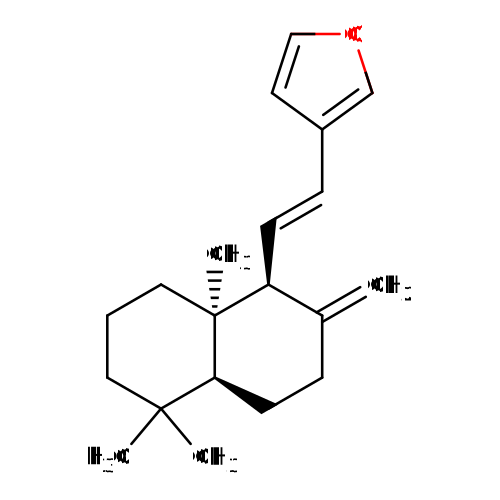
| Common Name | 3-[(1e)-2-[(1s,4as,8as)-5,5,8a-trimethyl-2-methylidene-hexahydro-1h-naphthalen-1-yl]ethenyl]furan |
|---|
| Description | Coronarin E belongs to the class of organic compounds known as colensane and clerodane diterpenoids. These are diterpenoids with a structure based on the clerodane or the colensane skeleton. Clerodanes arise from labdanes by two methyl migrations. 3-[(1e)-2-[(1s,4as,8as)-5,5,8a-trimethyl-2-methylidene-hexahydro-1h-naphthalen-1-yl]ethenyl]furan is found in Alpinia chinensis, Curcuma comosa, Hedychium coronarium, Hedychium gardnerianum and Hedychium spicatum. 3-[(1e)-2-[(1s,4as,8as)-5,5,8a-trimethyl-2-methylidene-hexahydro-1h-naphthalen-1-yl]ethenyl]furan was first documented in 2010 (PMID: 19960422). Based on a literature review a small amount of articles have been published on Coronarin E (PMID: 34143941) (PMID: 35670907) (PMID: 33041813) (PMID: 27352383). |
|---|
| Structure | CC1(C)CCC[C@@]2(C)[C@H]1CCC(=C)[C@@H]2\C=C\C1=COC=C1 InChI=1S/C20H28O/c1-15-6-9-18-19(2,3)11-5-12-20(18,4)17(15)8-7-16-10-13-21-14-16/h7-8,10,13-14,17-18H,1,5-6,9,11-12H2,2-4H3/b8-7+/t17-,18-,20+/m0/s1 |
|---|
| Synonyms | | Value | Source |
|---|
| (+)-Coronarin e | MeSH |
|
|---|
| Chemical Formula | C20H28O |
|---|
| Average Mass | 284.4430 Da |
|---|
| Monoisotopic Mass | 284.21402 Da |
|---|
| IUPAC Name | 3-[(E)-2-[(1S,4aS,8aS)-5,5,8a-trimethyl-2-methylidene-decahydronaphthalen-1-yl]ethenyl]furan |
|---|
| Traditional Name | 3-[(E)-2-[(1S,4aS,8aS)-5,5,8a-trimethyl-2-methylidene-hexahydro-1H-naphthalen-1-yl]ethenyl]furan |
|---|
| CAS Registry Number | Not Available |
|---|
| SMILES | CC1(C)CCC[C@@]2(C)[C@H]1CCC(=C)[C@@H]2\C=C\C1=COC=C1 |
|---|
| InChI Identifier | InChI=1S/C20H28O/c1-15-6-9-18-19(2,3)11-5-12-20(18,4)17(15)8-7-16-10-13-21-14-16/h7-8,10,13-14,17-18H,1,5-6,9,11-12H2,2-4H3/b8-7+/t17-,18-,20+/m0/s1 |
|---|
| InChI Key | QXVXYNOIXUIXBI-NDLVVHCESA-N |
|---|
| Experimental Spectra |
|---|
|
| Not Available | | Predicted Spectra |
|---|
|
| | Spectrum Type | Description | Depositor ID | Depositor Organization | Depositor | Deposition Date | View |
|---|
| 1D NMR | 13C NMR Spectrum (1D, 25 MHz, H2O, predicted) | Wishart Lab | Wishart Lab | David Wishart | 2021-06-20 | View Spectrum | | 1D NMR | 1H NMR Spectrum (1D, 100 MHz, H2O, predicted) | Wishart Lab | Wishart Lab | David Wishart | 2021-06-20 | View Spectrum | | 1D NMR | 13C NMR Spectrum (1D, 252 MHz, H2O, predicted) | Wishart Lab | Wishart Lab | David Wishart | 2021-06-20 | View Spectrum | | 1D NMR | 1H NMR Spectrum (1D, 1000 MHz, H2O, predicted) | Wishart Lab | Wishart Lab | David Wishart | 2021-06-20 | View Spectrum | | 1D NMR | 13C NMR Spectrum (1D, 50 MHz, H2O, predicted) | Wishart Lab | Wishart Lab | David Wishart | 2021-06-20 | View Spectrum | | 1D NMR | 1H NMR Spectrum (1D, 200 MHz, H2O, predicted) | Wishart Lab | Wishart Lab | David Wishart | 2021-06-20 | View Spectrum | | 1D NMR | 13C NMR Spectrum (1D, 75 MHz, H2O, predicted) | Wishart Lab | Wishart Lab | David Wishart | 2021-06-20 | View Spectrum | | 1D NMR | 1H NMR Spectrum (1D, 300 MHz, H2O, predicted) | Wishart Lab | Wishart Lab | David Wishart | 2021-06-20 | View Spectrum | | 1D NMR | 13C NMR Spectrum (1D, 101 MHz, H2O, predicted) | Wishart Lab | Wishart Lab | David Wishart | 2021-06-20 | View Spectrum | | 1D NMR | 1H NMR Spectrum (1D, 400 MHz, H2O, predicted) | Wishart Lab | Wishart Lab | David Wishart | 2021-06-20 | View Spectrum | | 1D NMR | 13C NMR Spectrum (1D, 126 MHz, H2O, predicted) | Wishart Lab | Wishart Lab | David Wishart | 2021-06-20 | View Spectrum | | 1D NMR | 1H NMR Spectrum (1D, 500 MHz, H2O, predicted) | Wishart Lab | Wishart Lab | David Wishart | 2021-06-20 | View Spectrum | | 1D NMR | 13C NMR Spectrum (1D, 151 MHz, H2O, predicted) | Wishart Lab | Wishart Lab | David Wishart | 2021-06-20 | View Spectrum | | 1D NMR | 1H NMR Spectrum (1D, 600 MHz, H2O, predicted) | Wishart Lab | Wishart Lab | David Wishart | 2021-06-20 | View Spectrum | | 1D NMR | 13C NMR Spectrum (1D, 176 MHz, H2O, predicted) | Wishart Lab | Wishart Lab | David Wishart | 2021-06-20 | View Spectrum | | 1D NMR | 1H NMR Spectrum (1D, 700 MHz, H2O, predicted) | Wishart Lab | Wishart Lab | David Wishart | 2021-06-20 | View Spectrum | | 1D NMR | 13C NMR Spectrum (1D, 201 MHz, H2O, predicted) | Wishart Lab | Wishart Lab | David Wishart | 2021-06-20 | View Spectrum | | 1D NMR | 1H NMR Spectrum (1D, 800 MHz, H2O, predicted) | Wishart Lab | Wishart Lab | David Wishart | 2021-06-20 | View Spectrum | | 1D NMR | 13C NMR Spectrum (1D, 226 MHz, H2O, predicted) | Wishart Lab | Wishart Lab | David Wishart | 2021-06-20 | View Spectrum | | 1D NMR | 1H NMR Spectrum (1D, 900 MHz, H2O, predicted) | Wishart Lab | Wishart Lab | David Wishart | 2021-06-20 | View Spectrum |
| | Chemical Shift Submissions |
|---|
|
| Not Available | | Species |
|---|
| Species of Origin | |
|---|
| Chemical Taxonomy |
|---|
| Description | Belongs to the class of organic compounds known as colensane and clerodane diterpenoids. These are diterpenoids with a structure based on the clerodane or the colensane skeleton. Clerodanes arise from labdanes by two methyl migrations. |
|---|
| Kingdom | Organic compounds |
|---|
| Super Class | Lipids and lipid-like molecules |
|---|
| Class | Prenol lipids |
|---|
| Sub Class | Diterpenoids |
|---|
| Direct Parent | Colensane and clerodane diterpenoids |
|---|
| Alternative Parents | |
|---|
| Substituents | - Clerodane diterpenoid
- Heteroaromatic compound
- Furan
- Oxacycle
- Organoheterocyclic compound
- Organic oxygen compound
- Hydrocarbon derivative
- Organooxygen compound
- Aromatic heteropolycyclic compound
|
|---|
| Molecular Framework | Aromatic heteropolycyclic compounds |
|---|
| External Descriptors | Not Available |
|---|
| Physical Properties |
|---|
| State | Not Available |
|---|
| Experimental Properties | | Property | Value | Reference |
|---|
| Melting Point | Not Available | Not Available | | Boiling Point | Not Available | Not Available | | Water Solubility | Not Available | Not Available | | LogP | Not Available | Not Available |
|
|---|
| Predicted Properties | |
|---|
| General References | - Kumrit I, Suksamrarn A, Meepawpan P, Songsri S, Nuntawong N: Labdane-type diterpenes from Hedychium gardnerianum with potent cytotoxicity against human small cell lung cancer cells. Phytother Res. 2010 Jul;24(7):1009-13. doi: 10.1002/ptr.3057. [PubMed:19960422 ]
- Subramanyan S, Deepika S, Ajith A, Joseph Gracy A, Dan M, Maiti KK, Varma RL, Radhakrishnan KV: Antiproliferative labdane diterpenes from the rhizomes of Hedychium flavescens Carey ex Roscoe. Chem Biol Drug Des. 2021 Oct;98(4):501-506. doi: 10.1111/cbdd.13906. Epub 2021 Jun 29. [PubMed:34143941 ]
- Nag A, Verma P, Paul S, Kundu R: In Silico Analysis of the Apoptotic and HPV Inhibitory Roles of Some Selected Phytochemicals Detected from the Rhizomes of Greater Cardamom. Appl Biochem Biotechnol. 2022 Oct;194(10):4867-4891. doi: 10.1007/s12010-022-04006-3. Epub 2022 Jun 7. [PubMed:35670907 ]
- Tian M, Wu X, Lu T, Zhao X, Wei F, Deng G, Zhou Y: Phytochemical Analysis, Antioxidant, Antibacterial, Cytotoxic, and Enzyme Inhibitory Activities of Hedychium flavum Rhizome. Front Pharmacol. 2020 Sep 17;11:572659. doi: 10.3389/fphar.2020.572659. eCollection 2020. [PubMed:33041813 ]
- Chen LG, Su PJ, Tsai PW, Yang LL, Wang CC: Intermedin A, a New Labdane Diterpene Isolated from Alpinia intermedia, Prolonged the Survival Time of P-388D1 Tumor-Bearing CDF1 Mice. Planta Med. 2017 Jan;83(1-02):151-157. doi: 10.1055/s-0042-109779. Epub 2016 Jun 28. [PubMed:27352383 ]
- LOTUS database [Link]
|
|---|