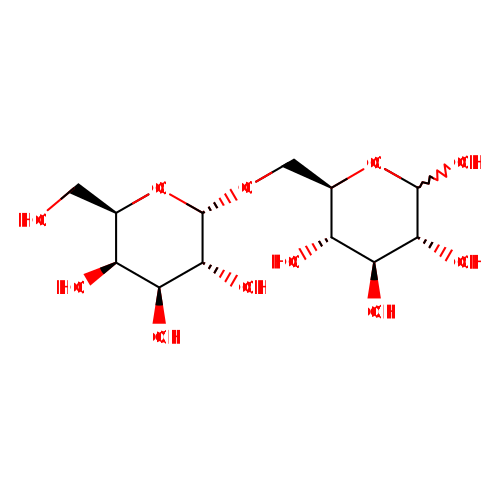
| Record Information |
|---|
| Version | 2.0 |
|---|
| Created at | 2022-09-07 19:23:56 UTC |
|---|
| Updated at | 2022-09-07 19:23:56 UTC |
|---|
| NP-MRD ID | NP0255047 |
|---|
| Secondary Accession Numbers | None |
|---|
| Natural Product Identification |
|---|
| Common Name | d-melibiose |
|---|
| Description | d-melibiose is found in Arabidopsis thaliana, Daphnia pulex, Medicago sativa and Paris polyphylla. d-melibiose was first documented in 1957 (PMID: 13416199). |
|---|
| Structure | OC[C@H]1O[C@H](OC[C@H]2OC(O)[C@H](O)[C@@H](O)[C@@H]2O)[C@H](O)[C@@H](O)[C@H]1O InChI=1S/C12H22O11/c13-1-3-5(14)8(17)10(19)12(23-3)21-2-4-6(15)7(16)9(18)11(20)22-4/h3-20H,1-2H2/t3-,4-,5+,6-,7+,8+,9-,10-,11?,12+/m1/s1 |
|---|
| Synonyms | | Value | Source |
|---|
| (Gal)1 (GLC)1 | ChEBI | | 6-O-(alpha-D-Galactopyranosyl)-D-glucopyranose | ChEBI | | 6-O-alpha-D-Galactopyranosyl-D-glucopyranose | ChEBI | | alpha-D-Gal-(1->6)-D-GLC | ChEBI | | alpha-D-Galactosyl-(1->6)-D-glucose | ChEBI | | alpha-D-Galp-(1->6)-D-GLCP | ChEBI | | D-Melibiose | ChEBI | | D-Mellibiose | ChEBI | | Gal-alpha(1,6)GLC | ChEBI | | 6-O-(a-D-Galactopyranosyl)-D-glucopyranose | Generator | | 6-O-(α-D-galactopyranosyl)-D-glucopyranose | Generator | | 6-O-a-D-Galactopyranosyl-D-glucopyranose | Generator | | 6-O-α-D-galactopyranosyl-D-glucopyranose | Generator | | a-D-Gal-(1->6)-D-GLC | Generator | | α-D-gal-(1->6)-D-GLC | Generator | | a-D-Galactosyl-(1->6)-D-glucose | Generator | | α-D-galactosyl-(1->6)-D-glucose | Generator | | a-D-Galp-(1->6)-D-GLCP | Generator | | α-D-galp-(1->6)-D-GLCP | Generator | | Gal-a(1,6)GLC | Generator | | Gal-α(1,6)GLC | Generator | | 6-(a-D-galactosido)-D-Glucose | HMDB | | 6-(a-delta-galactosido)-delta-Glucose | HMDB | | 6-(D-galactosido)-D-Glucose | HMDB | | 6-(D-galactosido)-delta-Glucose | HMDB | | 6-O-a-D-Galactopyranosyl-D-glucose | HMDB | | 6-O-alpha-D-Galactopyranosyl-D-glucose | HMDB | | 6-O-alpha-delta-Galactopyranosyl-delta-glucose | HMDB | | 6-O-Hexopyranosylhexose | HMDB | | alpha-D-Melibiose | HMDB | | alpha-delta-Melibiose | HMDB | | alpha-Melibiose | HMDB | | D-(+)-Melibiose | HMDB | | delta-(+)-Melibiose | HMDB | | delta-Melibiose | HMDB | | Mellibiose | HMDB |
|
|---|
| Chemical Formula | C12H22O11 |
|---|
| Average Mass | 342.2965 Da |
|---|
| Monoisotopic Mass | 342.11621 Da |
|---|
| IUPAC Name | (3R,4S,5S,6R)-6-({[(2S,3R,4S,5R,6R)-3,4,5-trihydroxy-6-(hydroxymethyl)oxan-2-yl]oxy}methyl)oxane-2,3,4,5-tetrol |
|---|
| Traditional Name | D-melibiose |
|---|
| CAS Registry Number | Not Available |
|---|
| SMILES | OC[C@H]1O[C@H](OC[C@H]2OC(O)[C@H](O)[C@@H](O)[C@@H]2O)[C@H](O)[C@@H](O)[C@H]1O |
|---|
| InChI Identifier | InChI=1S/C12H22O11/c13-1-3-5(14)8(17)10(19)12(23-3)21-2-4-6(15)7(16)9(18)11(20)22-4/h3-20H,1-2H2/t3-,4-,5+,6-,7+,8+,9-,10-,11?,12+/m1/s1 |
|---|
| InChI Key | DLRVVLDZNNYCBX-ABXHMFFYSA-N |
|---|
| Experimental Spectra |
|---|
|
| | Spectrum Type | Description | Depositor Email | Depositor Organization | Depositor | Deposition Date | View |
|---|
| 1D NMR | 1H NMR Spectrum (1D, 500 MHz, H2O, experimental) | Wishart Lab | Wishart Lab | David Wishart | 2021-06-20 | View Spectrum | | 1D NMR | 13C NMR Spectrum (1D, 400 MHz, H2O, experimental) | Wishart Lab | Wishart Lab | David Wishart | 2021-06-20 | View Spectrum | | 2D NMR | [1H, 13C]-HSQC NMR Spectrum (2D, 600 MHz, H2O, experimental) | Wishart Lab | Wishart Lab | David Wishart | 2021-06-20 | View Spectrum |
| | Predicted Spectra |
|---|
|
| Not Available | | Chemical Shift Submissions |
|---|
|
| Not Available | | Species |
|---|
| Species of Origin | |
|---|
| Chemical Taxonomy |
|---|
| Description | This compound belongs to the class of organic compounds known as o-glycosyl compounds. These are glycoside in which a sugar group is bonded through one carbon to another group via a O-glycosidic bond. |
|---|
| Kingdom | Organic compounds |
|---|
| Super Class | Organic oxygen compounds |
|---|
| Class | Organooxygen compounds |
|---|
| Sub Class | Carbohydrates and carbohydrate conjugates |
|---|
| Direct Parent | O-glycosyl compounds |
|---|
| Alternative Parents | |
|---|
| Substituents | - O-glycosyl compound
- Disaccharide
- Oxane
- Secondary alcohol
- Hemiacetal
- Oxacycle
- Organoheterocyclic compound
- Polyol
- Acetal
- Hydrocarbon derivative
- Primary alcohol
- Alcohol
- Aliphatic heteromonocyclic compound
|
|---|
| Molecular Framework | Aliphatic heteromonocyclic compounds |
|---|
| External Descriptors | |
|---|
| Physical Properties |
|---|
| State | Not Available |
|---|
| Experimental Properties | | Property | Value | Reference |
|---|
| Melting Point | Not Available | Not Available | | Boiling Point | Not Available | Not Available | | Water Solubility | Not Available | Not Available | | LogP | Not Available | Not Available |
|
|---|
| Predicted Properties | |
|---|