| Record Information |
|---|
| Version | 2.0 |
|---|
| Created at | 2022-09-07 12:52:00 UTC |
|---|
| Updated at | 2022-09-07 12:52:00 UTC |
|---|
| NP-MRD ID | NP0250119 |
|---|
| Secondary Accession Numbers | None |
|---|
| Natural Product Identification |
|---|
| Common Name | diadinoxanthin |
|---|
| Description | Diadinoxanthin belongs to the class of organic compounds known as triterpenoids. These are terpene molecules containing six isoprene units. Thus, diadinoxanthin is considered to be an isoprenoid. diadinoxanthin is found in Corbicula japonica, Euglena gracilis, Euglena sanguinea, Euglena viridis, Eutreptiella gymnastica, Grammatophora oceanica, Gymnodinium catenatum, Heterosigma akashiwo, Meretrix petechialis, Pelagococcus subviridis, Rhinogobius brunneus and Thoracosphaera heimii. diadinoxanthin was first documented in 2021 (PMID: 34683379). Based on a literature review a significant number of articles have been published on Diadinoxanthin (PMID: 36005496) (PMID: 35951151) (PMID: 35557488) (PMID: 35092009) (PMID: 34822985) (PMID: 34651379). |
|---|
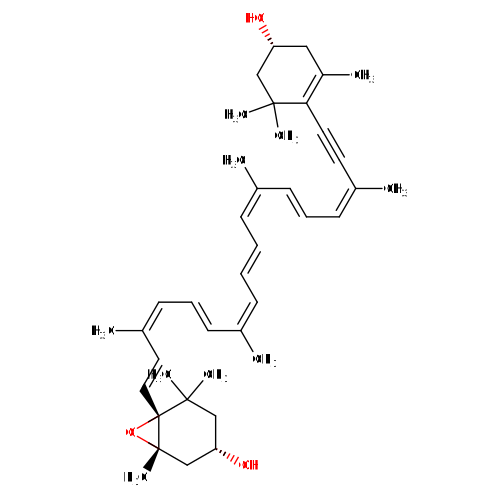
| Structure | C\C(\C=C\C=C(/C)\C=C\[C@@]12O[C@]1(C)C[C@@H](O)CC2(C)C)=C/C=C/C=C(\C)/C=C/C=C(\C)C#CC1=C(C)C[C@@H](O)CC1(C)C InChI=1S/C40H54O3/c1-29(17-13-19-31(3)21-22-36-33(5)25-34(41)26-37(36,6)7)15-11-12-16-30(2)18-14-20-32(4)23-24-40-38(8,9)27-35(42)28-39(40,10)43-40/h11-20,23-24,34-35,41-42H,25-28H2,1-10H3/b12-11+,17-13+,18-14+,24-23+,29-15+,30-16+,31-19+,32-20+/t34-,35+,39-,40+/m1/s1 |
|---|
| Synonyms | | Value | Source |
|---|
| Diadinoxanthin a | Kegg |
|
|---|
| Chemical Formula | C40H54O3 |
|---|
| Average Mass | 582.8690 Da |
|---|
| Monoisotopic Mass | 582.40730 Da |
|---|
| IUPAC Name | (1R,3S,6S)-6-[(1E,3E,5E,7E,9E,11E,13E,15E)-18-[(4R)-4-hydroxy-2,6,6-trimethylcyclohex-1-en-1-yl]-3,7,12,16-tetramethyloctadeca-1,3,5,7,9,11,13,15-octaen-17-yn-1-yl]-1,5,5-trimethyl-7-oxabicyclo[4.1.0]heptan-3-ol |
|---|
| Traditional Name | (1R,3S,6S)-6-[(1E,3E,5E,7E,9E,11E,13E,15E)-18-[(4R)-4-hydroxy-2,6,6-trimethylcyclohex-1-en-1-yl]-3,7,12,16-tetramethyloctadeca-1,3,5,7,9,11,13,15-octaen-17-yn-1-yl]-1,5,5-trimethyl-7-oxabicyclo[4.1.0]heptan-3-ol |
|---|
| CAS Registry Number | Not Available |
|---|
| SMILES | C\C(\C=C\C=C(/C)\C=C\[C@@]12O[C@]1(C)C[C@@H](O)CC2(C)C)=C/C=C/C=C(\C)/C=C/C=C(\C)C#CC1=C(C)C[C@@H](O)CC1(C)C |
|---|
| InChI Identifier | InChI=1S/C40H54O3/c1-29(17-13-19-31(3)21-22-36-33(5)25-34(41)26-37(36,6)7)15-11-12-16-30(2)18-14-20-32(4)23-24-40-38(8,9)27-35(42)28-39(40,10)43-40/h11-20,23-24,34-35,41-42H,25-28H2,1-10H3/b12-11+,17-13+,18-14+,24-23+,29-15+,30-16+,31-19+,32-20+/t34-,35+,39-,40+/m1/s1 |
|---|
| InChI Key | OGHZCSINIMWCSB-GHIQLMQGSA-N |
|---|
| Experimental Spectra |
|---|
|
| Not Available | | Predicted Spectra |
|---|
|
| | Spectrum Type | Description | Depositor ID | Depositor Organization | Depositor | Deposition Date | View |
|---|
| 1D NMR | 13C NMR Spectrum (1D, 25 MHz, H2O, predicted) | Wishart Lab | Wishart Lab | David Wishart | 2021-06-20 | View Spectrum | | 1D NMR | 1H NMR Spectrum (1D, 100 MHz, H2O, predicted) | Wishart Lab | Wishart Lab | David Wishart | 2021-06-20 | View Spectrum | | 1D NMR | 13C NMR Spectrum (1D, 252 MHz, H2O, predicted) | Wishart Lab | Wishart Lab | David Wishart | 2021-06-20 | View Spectrum | | 1D NMR | 1H NMR Spectrum (1D, 1000 MHz, H2O, predicted) | Wishart Lab | Wishart Lab | David Wishart | 2021-06-20 | View Spectrum | | 1D NMR | 13C NMR Spectrum (1D, 50 MHz, H2O, predicted) | Wishart Lab | Wishart Lab | David Wishart | 2021-06-20 | View Spectrum | | 1D NMR | 1H NMR Spectrum (1D, 200 MHz, H2O, predicted) | Wishart Lab | Wishart Lab | David Wishart | 2021-06-20 | View Spectrum | | 1D NMR | 13C NMR Spectrum (1D, 75 MHz, H2O, predicted) | Wishart Lab | Wishart Lab | David Wishart | 2021-06-20 | View Spectrum | | 1D NMR | 1H NMR Spectrum (1D, 300 MHz, H2O, predicted) | Wishart Lab | Wishart Lab | David Wishart | 2021-06-20 | View Spectrum | | 1D NMR | 13C NMR Spectrum (1D, 101 MHz, H2O, predicted) | Wishart Lab | Wishart Lab | David Wishart | 2021-06-20 | View Spectrum | | 1D NMR | 1H NMR Spectrum (1D, 400 MHz, H2O, predicted) | Wishart Lab | Wishart Lab | David Wishart | 2021-06-20 | View Spectrum | | 1D NMR | 13C NMR Spectrum (1D, 126 MHz, H2O, predicted) | Wishart Lab | Wishart Lab | David Wishart | 2021-06-20 | View Spectrum | | 1D NMR | 1H NMR Spectrum (1D, 500 MHz, H2O, predicted) | Wishart Lab | Wishart Lab | David Wishart | 2021-06-20 | View Spectrum | | 1D NMR | 13C NMR Spectrum (1D, 151 MHz, H2O, predicted) | Wishart Lab | Wishart Lab | David Wishart | 2021-06-20 | View Spectrum | | 1D NMR | 1H NMR Spectrum (1D, 600 MHz, H2O, predicted) | Wishart Lab | Wishart Lab | David Wishart | 2021-06-20 | View Spectrum | | 1D NMR | 13C NMR Spectrum (1D, 176 MHz, H2O, predicted) | Wishart Lab | Wishart Lab | David Wishart | 2021-06-20 | View Spectrum | | 1D NMR | 1H NMR Spectrum (1D, 700 MHz, H2O, predicted) | Wishart Lab | Wishart Lab | David Wishart | 2021-06-20 | View Spectrum | | 1D NMR | 13C NMR Spectrum (1D, 201 MHz, H2O, predicted) | Wishart Lab | Wishart Lab | David Wishart | 2021-06-20 | View Spectrum | | 1D NMR | 1H NMR Spectrum (1D, 800 MHz, H2O, predicted) | Wishart Lab | Wishart Lab | David Wishart | 2021-06-20 | View Spectrum | | 1D NMR | 13C NMR Spectrum (1D, 226 MHz, H2O, predicted) | Wishart Lab | Wishart Lab | David Wishart | 2021-06-20 | View Spectrum | | 1D NMR | 1H NMR Spectrum (1D, 900 MHz, H2O, predicted) | Wishart Lab | Wishart Lab | David Wishart | 2021-06-20 | View Spectrum |
| | Chemical Shift Submissions |
|---|
|
| Not Available | | Species |
|---|
| Species of Origin | |
|---|
| Chemical Taxonomy |
|---|
| Description | Belongs to the class of organic compounds known as triterpenoids. These are terpene molecules containing six isoprene units. |
|---|
| Kingdom | Organic compounds |
|---|
| Super Class | Lipids and lipid-like molecules |
|---|
| Class | Prenol lipids |
|---|
| Sub Class | Triterpenoids |
|---|
| Direct Parent | Triterpenoids |
|---|
| Alternative Parents | |
|---|
| Substituents | - Triterpenoid
- Oxepane
- Cyclic alcohol
- Secondary alcohol
- Oxacycle
- Organoheterocyclic compound
- Ether
- Oxirane
- Dialkyl ether
- Organic oxygen compound
- Hydrocarbon derivative
- Organooxygen compound
- Alcohol
- Aliphatic heteropolycyclic compound
|
|---|
| Molecular Framework | Aliphatic heteropolycyclic compounds |
|---|
| External Descriptors | Not Available |
|---|
| Physical Properties |
|---|
| State | Not Available |
|---|
| Experimental Properties | | Property | Value | Reference |
|---|
| Melting Point | Not Available | Not Available | | Boiling Point | Not Available | Not Available | | Water Solubility | Not Available | Not Available | | LogP | Not Available | Not Available |
|
|---|
| Predicted Properties | |
|---|
| General References | - Guerin S, Raguenes L, Croteau D, Babin M, Lavaud J: Potential for the Production of Carotenoids of Interest in the Polar Diatom Fragilariopsis cylindrus. Mar Drugs. 2022 Jul 29;20(8):491. doi: 10.3390/md20080491. [PubMed:36005496 ]
- Kagatani K, Nagao R, Shen JR, Yamano Y, Takaichi S, Akimoto S: Excitation relaxation dynamics of carotenoids constituting the diadinoxanthin cycle. Photosynth Res. 2022 Oct;154(1):13-19. doi: 10.1007/s11120-022-00944-5. Epub 2022 Aug 11. [PubMed:35951151 ]
- Goss R, Volke D, Werner LE, Kunz R, Kansy M, Hoffmann R, Wilhelm C: Isolation of fucoxanthin chlorophyll protein complexes of the centric diatom Thalassiosira pseudonana associated with the xanthophyll cycle enzyme diadinoxanthin de-epoxidase. IUBMB Life. 2023 Jan;75(1):66-76. doi: 10.1002/iub.2650. Epub 2022 May 26. [PubMed:35557488 ]
- Seydoux C, Storti M, Giovagnetti V, Matuszynska A, Guglielmino E, Zhao X, Giustini C, Pan Y, Blommaert L, Angulo J, Ruban AV, Hu H, Bailleul B, Courtois F, Allorent G, Finazzi G: Impaired photoprotection in Phaeodactylum tricornutum KEA3 mutants reveals the proton regulatory circuit of diatoms light acclimation. New Phytol. 2022 Apr;234(2):578-591. doi: 10.1111/nph.18003. Epub 2022 Feb 21. [PubMed:35092009 ]
- Li Y, Sun H, Wang Y, Yang S, Wang J, Wu T, Lu X, Chu Y, Chen F: Integrated metabolic tools reveal carbon alternative in Isochrysis zhangjiangensis for fucoxanthin improvement. Bioresour Technol. 2022 Mar;347:126401. doi: 10.1016/j.biortech.2021.126401. Epub 2021 Nov 23. [PubMed:34822985 ]
- Brun P, Piovan A, Caniato R, Dalla Costa V, Pauletto A, Filippini R: Anti-Inflammatory Activities of Euglena gracilis Extracts. Microorganisms. 2021 Sep 29;9(10):2058. doi: 10.3390/microorganisms9102058. [PubMed:34683379 ]
- Buck JM, Kroth PG, Lepetit B: Identification of sequence motifs in Lhcx proteins that confer qE-based photoprotection in the diatom Phaeodactylum tricornutum. Plant J. 2021 Dec;108(6):1721-1734. doi: 10.1111/tpj.15539. Epub 2021 Nov 3. [PubMed:34651379 ]
- Tamaki S, Mochida K, Suzuki K: Diverse Biosynthetic Pathways and Protective Functions against Environmental Stress of Antioxidants in Microalgae. Plants (Basel). 2021 Jun 19;10(6):1250. doi: 10.3390/plants10061250. [PubMed:34205386 ]
- Blommaert L, Chafai L, Bailleul B: The fine-tuning of NPQ in diatoms relies on the regulation of both xanthophyll cycle enzymes. Sci Rep. 2021 Jun 17;11(1):12750. doi: 10.1038/s41598-021-91483-x. [PubMed:34140542 ]
- Nagao R, Yokono M, Kato KH, Ueno Y, Shen JR, Akimoto S: High-light modification of excitation-energy-relaxation processes in the green flagellate Euglena gracilis. Photosynth Res. 2021 Sep;149(3):303-311. doi: 10.1007/s11120-021-00849-9. Epub 2021 May 26. [PubMed:34037905 ]
- LOTUS database [Link]
|
|---|