| Record Information |
|---|
| Version | 2.0 |
|---|
| Created at | 2022-09-07 12:31:52 UTC |
|---|
| Updated at | 2022-09-07 12:31:52 UTC |
|---|
| NP-MRD ID | NP0249852 |
|---|
| Secondary Accession Numbers | None |
|---|
| Natural Product Identification |
|---|
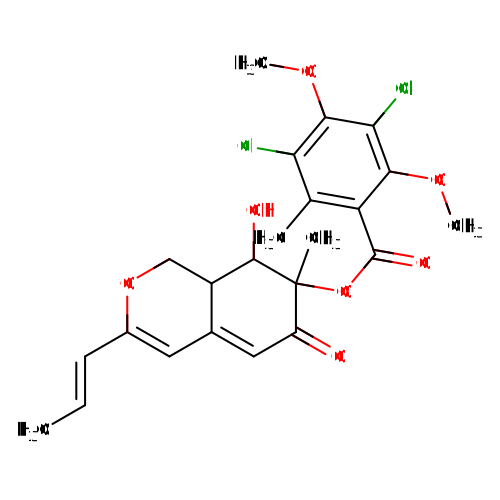
| Common Name | 8-hydroxy-7-methyl-6-oxo-3-(prop-1-en-1-yl)-8,8a-dihydro-1h-isochromen-7-yl 3,5-dichloro-2,4-dimethoxy-6-methylbenzoate |
|---|
| Description | 8-Hydroxy-7-methyl-6-oxo-3-(prop-1-en-1-yl)-6,7,8,8a-tetrahydro-1H-isochromen-7-yl 3,5-dichloro-2,4-dimethoxy-6-methylbenzoate belongs to the class of organic compounds known as azaphilones. These are a structurally variable family of fungal polyketide metabolites possessing a highly oxygenated pyranoquinone bicyclic core, usually known as isochromene, and a quaternary carbon center. 8-hydroxy-7-methyl-6-oxo-3-(prop-1-en-1-yl)-8,8a-dihydro-1h-isochromen-7-yl 3,5-dichloro-2,4-dimethoxy-6-methylbenzoate is found in Aspergillus falconensis. 8-Hydroxy-7-methyl-6-oxo-3-(prop-1-en-1-yl)-6,7,8,8a-tetrahydro-1H-isochromen-7-yl 3,5-dichloro-2,4-dimethoxy-6-methylbenzoate is an extremely weak basic (essentially neutral) compound (based on its pKa). |
|---|
| Structure | COC1=C(Cl)C(C)=C(C(=O)OC2(C)C(O)C3COC(C=CC)=CC3=CC2=O)C(OC)=C1Cl InChI=1S/C23H24Cl2O7/c1-6-7-13-8-12-9-15(26)23(3,21(27)14(12)10-31-13)32-22(28)16-11(2)17(24)20(30-5)18(25)19(16)29-4/h6-9,14,21,27H,10H2,1-5H3 |
|---|
| Synonyms | | Value | Source |
|---|
| 8-Hydroxy-7-methyl-6-oxo-3-(prop-1-en-1-yl)-6,7,8,8a-tetrahydro-1H-isochromen-7-yl 3,5-dichloro-2,4-dimethoxy-6-methylbenzoic acid | Generator |
|
|---|
| Chemical Formula | C23H24Cl2O7 |
|---|
| Average Mass | 483.3400 Da |
|---|
| Monoisotopic Mass | 482.08991 Da |
|---|
| IUPAC Name | 8-hydroxy-7-methyl-6-oxo-3-(prop-1-en-1-yl)-6,7,8,8a-tetrahydro-1H-isochromen-7-yl 3,5-dichloro-2,4-dimethoxy-6-methylbenzoate |
|---|
| Traditional Name | 8-hydroxy-7-methyl-6-oxo-3-(prop-1-en-1-yl)-8,8a-dihydro-1H-isochromen-7-yl 3,5-dichloro-2,4-dimethoxy-6-methylbenzoate |
|---|
| CAS Registry Number | Not Available |
|---|
| SMILES | COC1=C(Cl)C(C)=C(C(=O)OC2(C)C(O)C3COC(C=CC)=CC3=CC2=O)C(OC)=C1Cl |
|---|
| InChI Identifier | InChI=1S/C23H24Cl2O7/c1-6-7-13-8-12-9-15(26)23(3,21(27)14(12)10-31-13)32-22(28)16-11(2)17(24)20(30-5)18(25)19(16)29-4/h6-9,14,21,27H,10H2,1-5H3 |
|---|
| InChI Key | UPGFIGSJKQUWJR-UHFFFAOYSA-N |
|---|
| Experimental Spectra |
|---|
|
| Not Available | | Predicted Spectra |
|---|
|
| | Spectrum Type | Description | Depositor ID | Depositor Organization | Depositor | Deposition Date | View |
|---|
| 1D NMR | 13C NMR Spectrum (1D, 25 MHz, H2O, predicted) | Wishart Lab | Wishart Lab | David Wishart | 2021-06-20 | View Spectrum | | 1D NMR | 1H NMR Spectrum (1D, 100 MHz, H2O, predicted) | Wishart Lab | Wishart Lab | David Wishart | 2021-06-20 | View Spectrum | | 1D NMR | 13C NMR Spectrum (1D, 252 MHz, H2O, predicted) | Wishart Lab | Wishart Lab | David Wishart | 2021-06-20 | View Spectrum | | 1D NMR | 1H NMR Spectrum (1D, 1000 MHz, H2O, predicted) | Wishart Lab | Wishart Lab | David Wishart | 2021-06-20 | View Spectrum | | 1D NMR | 13C NMR Spectrum (1D, 50 MHz, H2O, predicted) | Wishart Lab | Wishart Lab | David Wishart | 2021-06-20 | View Spectrum | | 1D NMR | 1H NMR Spectrum (1D, 200 MHz, H2O, predicted) | Wishart Lab | Wishart Lab | David Wishart | 2021-06-20 | View Spectrum | | 1D NMR | 13C NMR Spectrum (1D, 75 MHz, H2O, predicted) | Wishart Lab | Wishart Lab | David Wishart | 2021-06-20 | View Spectrum | | 1D NMR | 1H NMR Spectrum (1D, 300 MHz, H2O, predicted) | Wishart Lab | Wishart Lab | David Wishart | 2021-06-20 | View Spectrum | | 1D NMR | 13C NMR Spectrum (1D, 101 MHz, H2O, predicted) | Wishart Lab | Wishart Lab | David Wishart | 2021-06-20 | View Spectrum | | 1D NMR | 1H NMR Spectrum (1D, 400 MHz, H2O, predicted) | Wishart Lab | Wishart Lab | David Wishart | 2021-06-20 | View Spectrum | | 1D NMR | 13C NMR Spectrum (1D, 126 MHz, H2O, predicted) | Wishart Lab | Wishart Lab | David Wishart | 2021-06-20 | View Spectrum | | 1D NMR | 1H NMR Spectrum (1D, 500 MHz, H2O, predicted) | Wishart Lab | Wishart Lab | David Wishart | 2021-06-20 | View Spectrum | | 1D NMR | 13C NMR Spectrum (1D, 151 MHz, H2O, predicted) | Wishart Lab | Wishart Lab | David Wishart | 2021-06-20 | View Spectrum | | 1D NMR | 1H NMR Spectrum (1D, 600 MHz, H2O, predicted) | Wishart Lab | Wishart Lab | David Wishart | 2021-06-20 | View Spectrum | | 1D NMR | 13C NMR Spectrum (1D, 176 MHz, H2O, predicted) | Wishart Lab | Wishart Lab | David Wishart | 2021-06-20 | View Spectrum | | 1D NMR | 1H NMR Spectrum (1D, 700 MHz, H2O, predicted) | Wishart Lab | Wishart Lab | David Wishart | 2021-06-20 | View Spectrum | | 1D NMR | 13C NMR Spectrum (1D, 201 MHz, H2O, predicted) | Wishart Lab | Wishart Lab | David Wishart | 2021-06-20 | View Spectrum | | 1D NMR | 1H NMR Spectrum (1D, 800 MHz, H2O, predicted) | Wishart Lab | Wishart Lab | David Wishart | 2021-06-20 | View Spectrum | | 1D NMR | 13C NMR Spectrum (1D, 226 MHz, H2O, predicted) | Wishart Lab | Wishart Lab | David Wishart | 2021-06-20 | View Spectrum | | 1D NMR | 1H NMR Spectrum (1D, 900 MHz, H2O, predicted) | Wishart Lab | Wishart Lab | David Wishart | 2021-06-20 | View Spectrum |
| | Chemical Shift Submissions |
|---|
|
| Not Available | | Species |
|---|
| Species of Origin | |
|---|
| Chemical Taxonomy |
|---|
| Description | Belongs to the class of organic compounds known as azaphilones. These are a structurally variable family of fungal polyketide metabolites possessing a highly oxygenated pyranoquinone bicyclic core, usually known as isochromene, and a quaternary carbon center. |
|---|
| Kingdom | Organic compounds |
|---|
| Super Class | Organoheterocyclic compounds |
|---|
| Class | Azaphilones |
|---|
| Sub Class | Not Available |
|---|
| Direct Parent | Azaphilones |
|---|
| Alternative Parents | |
|---|
| Substituents | - Azaphilone
- O-methoxybenzoic acid or derivatives
- P-methoxybenzoic acid or derivatives
- Benzoate ester
- M-dimethoxybenzene
- Dimethoxybenzene
- Halobenzoic acid or derivatives
- 3-halobenzoic acid or derivatives
- Benzoic acid or derivatives
- Phenoxy compound
- Benzoyl
- Anisole
- 1,3-dichlorobenzene
- Methoxybenzene
- Phenol ether
- Alkyl aryl ether
- Cyclohexenone
- Chlorobenzene
- Halobenzene
- Toluene
- Benzenoid
- Aryl chloride
- Monocyclic benzene moiety
- Aryl halide
- Ketone
- Carboxylic acid ester
- Cyclic ketone
- Secondary alcohol
- Oxacycle
- Ether
- Carboxylic acid derivative
- Alcohol
- Carbonyl group
- Organohalogen compound
- Organochloride
- Organooxygen compound
- Hydrocarbon derivative
- Organic oxide
- Organic oxygen compound
- Aromatic heteropolycyclic compound
|
|---|
| Molecular Framework | Aromatic heteropolycyclic compounds |
|---|
| External Descriptors | Not Available |
|---|
| Physical Properties |
|---|
| State | Not Available |
|---|
| Experimental Properties | | Property | Value | Reference |
|---|
| Melting Point | Not Available | Not Available | | Boiling Point | Not Available | Not Available | | Water Solubility | Not Available | Not Available | | LogP | Not Available | Not Available |
|
|---|
| Predicted Properties | |
|---|