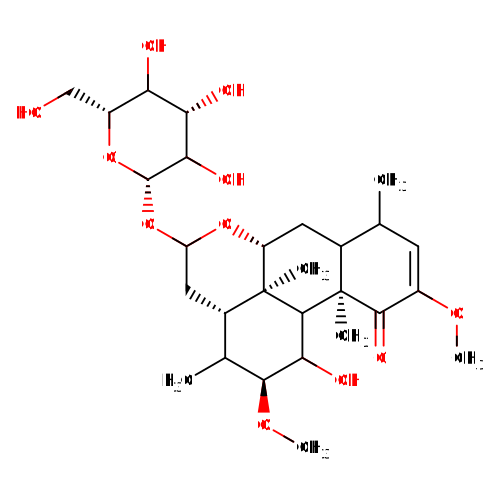
| Record Information |
|---|
| Version | 2.0 |
|---|
| Created at | 2022-09-07 09:36:24 UTC |
|---|
| Updated at | 2022-09-07 09:36:24 UTC |
|---|
| NP-MRD ID | NP0247673 |
|---|
| Secondary Accession Numbers | None |
|---|
| Natural Product Identification |
|---|
| Common Name | (2s,9r,13s,15s,17s)-16-hydroxy-4,15-dimethoxy-2,6,14,17-tetramethyl-11-{[(2s,4s,6r)-3,4,5-trihydroxy-6-(hydroxymethyl)oxan-2-yl]oxy}-10-oxatetracyclo[7.7.1.0²,⁷.0¹³,¹⁷]heptadec-4-en-3-one |
|---|
| Description | (2S,9R,13S,15S,17S)-16-hydroxy-4,15-dimethoxy-2,6,14,17-tetramethyl-11-{[(2S,4S,6R)-3,4,5-trihydroxy-6-(hydroxymethyl)oxan-2-yl]oxy}-10-oxatetracyclo[7.7.1.0²,⁷.0¹³,¹⁷]Heptadec-4-en-3-one belongs to the class of organic compounds known as quassinoids. These are a group of compounds chemically degraded from triterpenes. According to their basic skeleton, quassinoids are categorized into five distinct groups, C-18, C-19, C-20, C-22 and C-25 types. The C-20 quassinoids can be further classified into two types, tetracyclic and the pentacyclic. The tetracyclic variety does not have oxygenation at C-20, while the pentacyclic quassinoids possess additional oxygenation at C-20 that allows for the formation of an additional ring. (2s,9r,13s,15s,17s)-16-hydroxy-4,15-dimethoxy-2,6,14,17-tetramethyl-11-{[(2s,4s,6r)-3,4,5-trihydroxy-6-(hydroxymethyl)oxan-2-yl]oxy}-10-oxatetracyclo[7.7.1.0²,⁷.0¹³,¹⁷]heptadec-4-en-3-one is found in Picrasma quassioides. Based on a literature review very few articles have been published on (2S,9R,13S,15S,17S)-16-hydroxy-4,15-dimethoxy-2,6,14,17-tetramethyl-11-{[(2S,4S,6R)-3,4,5-trihydroxy-6-(hydroxymethyl)oxan-2-yl]oxy}-10-oxatetracyclo[7.7.1.0²,⁷.0¹³,¹⁷]Heptadec-4-en-3-one. |
|---|
| Structure | CO[C@H]1C(C)[C@@H]2CC(O[C@@H]3O[C@H](CO)C(O)[C@H](O)C3O)O[C@@H]3CC4C(C)C=C(OC)C(=O)[C@]4(C)C(C1O)[C@]23C InChI=1S/C28H44O11/c1-11-7-15(35-5)25(34)28(4)13(11)8-17-27(3)14(12(2)23(36-6)22(33)24(27)28)9-18(38-17)39-26-21(32)20(31)19(30)16(10-29)37-26/h7,11-14,16-24,26,29-33H,8-10H2,1-6H3/t11?,12?,13?,14-,16+,17+,18?,19?,20-,21?,22?,23-,24?,26-,27+,28-/m0/s1 |
|---|
| Synonyms | Not Available |
|---|
| Chemical Formula | C28H44O11 |
|---|
| Average Mass | 556.6490 Da |
|---|
| Monoisotopic Mass | 556.28836 Da |
|---|
| IUPAC Name | (2S,9R,13S,15S,17S)-16-hydroxy-4,15-dimethoxy-2,6,14,17-tetramethyl-11-{[(2S,4S,6R)-3,4,5-trihydroxy-6-(hydroxymethyl)oxan-2-yl]oxy}-10-oxatetracyclo[7.7.1.0^{2,7}.0^{13,17}]heptadec-4-en-3-one |
|---|
| Traditional Name | (2S,9R,13S,15S,17S)-16-hydroxy-4,15-dimethoxy-2,6,14,17-tetramethyl-11-{[(2S,4S,6R)-3,4,5-trihydroxy-6-(hydroxymethyl)oxan-2-yl]oxy}-10-oxatetracyclo[7.7.1.0^{2,7}.0^{13,17}]heptadec-4-en-3-one |
|---|
| CAS Registry Number | Not Available |
|---|
| SMILES | CO[C@H]1C(C)[C@@H]2CC(O[C@@H]3O[C@H](CO)C(O)[C@H](O)C3O)O[C@@H]3CC4C(C)C=C(OC)C(=O)[C@]4(C)C(C1O)[C@]23C |
|---|
| InChI Identifier | InChI=1S/C28H44O11/c1-11-7-15(35-5)25(34)28(4)13(11)8-17-27(3)14(12(2)23(36-6)22(33)24(27)28)9-18(38-17)39-26-21(32)20(31)19(30)16(10-29)37-26/h7,11-14,16-24,26,29-33H,8-10H2,1-6H3/t11?,12?,13?,14-,16+,17+,18?,19?,20-,21?,22?,23-,24?,26-,27+,28-/m0/s1 |
|---|
| InChI Key | QHIOXCRKDHYVLE-FPKCDKLGSA-N |
|---|
| Experimental Spectra |
|---|
|
| Not Available | | Predicted Spectra |
|---|
|
| | Spectrum Type | Description | Depositor ID | Depositor Organization | Depositor | Deposition Date | View |
|---|
| 1D NMR | 13C NMR Spectrum (1D, 25 MHz, H2O, predicted) | Wishart Lab | Wishart Lab | David Wishart | 2021-06-20 | View Spectrum | | 1D NMR | 1H NMR Spectrum (1D, 100 MHz, H2O, predicted) | Wishart Lab | Wishart Lab | David Wishart | 2021-06-20 | View Spectrum | | 1D NMR | 13C NMR Spectrum (1D, 252 MHz, H2O, predicted) | Wishart Lab | Wishart Lab | David Wishart | 2021-06-20 | View Spectrum | | 1D NMR | 1H NMR Spectrum (1D, 1000 MHz, H2O, predicted) | Wishart Lab | Wishart Lab | David Wishart | 2021-06-20 | View Spectrum | | 1D NMR | 13C NMR Spectrum (1D, 50 MHz, H2O, predicted) | Wishart Lab | Wishart Lab | David Wishart | 2021-06-20 | View Spectrum | | 1D NMR | 1H NMR Spectrum (1D, 200 MHz, H2O, predicted) | Wishart Lab | Wishart Lab | David Wishart | 2021-06-20 | View Spectrum | | 1D NMR | 13C NMR Spectrum (1D, 75 MHz, H2O, predicted) | Wishart Lab | Wishart Lab | David Wishart | 2021-06-20 | View Spectrum | | 1D NMR | 1H NMR Spectrum (1D, 300 MHz, H2O, predicted) | Wishart Lab | Wishart Lab | David Wishart | 2021-06-20 | View Spectrum | | 1D NMR | 13C NMR Spectrum (1D, 101 MHz, H2O, predicted) | Wishart Lab | Wishart Lab | David Wishart | 2021-06-20 | View Spectrum | | 1D NMR | 1H NMR Spectrum (1D, 400 MHz, H2O, predicted) | Wishart Lab | Wishart Lab | David Wishart | 2021-06-20 | View Spectrum | | 1D NMR | 13C NMR Spectrum (1D, 126 MHz, H2O, predicted) | Wishart Lab | Wishart Lab | David Wishart | 2021-06-20 | View Spectrum | | 1D NMR | 1H NMR Spectrum (1D, 500 MHz, H2O, predicted) | Wishart Lab | Wishart Lab | David Wishart | 2021-06-20 | View Spectrum | | 1D NMR | 13C NMR Spectrum (1D, 151 MHz, H2O, predicted) | Wishart Lab | Wishart Lab | David Wishart | 2021-06-20 | View Spectrum | | 1D NMR | 1H NMR Spectrum (1D, 600 MHz, H2O, predicted) | Wishart Lab | Wishart Lab | David Wishart | 2021-06-20 | View Spectrum | | 1D NMR | 13C NMR Spectrum (1D, 176 MHz, H2O, predicted) | Wishart Lab | Wishart Lab | David Wishart | 2021-06-20 | View Spectrum | | 1D NMR | 1H NMR Spectrum (1D, 700 MHz, H2O, predicted) | Wishart Lab | Wishart Lab | David Wishart | 2021-06-20 | View Spectrum | | 1D NMR | 13C NMR Spectrum (1D, 201 MHz, H2O, predicted) | Wishart Lab | Wishart Lab | David Wishart | 2021-06-20 | View Spectrum | | 1D NMR | 1H NMR Spectrum (1D, 800 MHz, H2O, predicted) | Wishart Lab | Wishart Lab | David Wishart | 2021-06-20 | View Spectrum | | 1D NMR | 13C NMR Spectrum (1D, 226 MHz, H2O, predicted) | Wishart Lab | Wishart Lab | David Wishart | 2021-06-20 | View Spectrum | | 1D NMR | 1H NMR Spectrum (1D, 900 MHz, H2O, predicted) | Wishart Lab | Wishart Lab | David Wishart | 2021-06-20 | View Spectrum |
| | Chemical Shift Submissions |
|---|
|
| Not Available | | Species |
|---|
| Species of Origin | |
|---|
| Chemical Taxonomy |
|---|
| Description | Belongs to the class of organic compounds known as quassinoids. These are a group of compounds chemically degraded from triterpenes. According to their basic skeleton, quassinoids are categorized into five distinct groups, C-18, C-19, C-20, C-22 and C-25 types. The C-20 quassinoids can be further classified into two types, tetracyclic and the pentacyclic. The tetracyclic variety does not have oxygenation at C-20, while the pentacyclic quassinoids possess additional oxygenation at C-20 that allows for the formation of an additional ring. |
|---|
| Kingdom | Organic compounds |
|---|
| Super Class | Lipids and lipid-like molecules |
|---|
| Class | Prenol lipids |
|---|
| Sub Class | Terpene lactones |
|---|
| Direct Parent | Quassinoids |
|---|
| Alternative Parents | |
|---|
| Substituents | - Triterpenoid
- Quassinoid
- Naphthopyran
- Hexose monosaccharide
- O-glycosyl compound
- Glycosyl compound
- Naphthalene
- Cyclohexenone
- Pyran
- Oxane
- Monosaccharide
- Cyclic alcohol
- Secondary alcohol
- Ketone
- Oxacycle
- Organoheterocyclic compound
- Polyol
- Ether
- Dialkyl ether
- Acetal
- Organic oxygen compound
- Organic oxide
- Hydrocarbon derivative
- Primary alcohol
- Organooxygen compound
- Carbonyl group
- Alcohol
- Aliphatic heteropolycyclic compound
|
|---|
| Molecular Framework | Aliphatic heteropolycyclic compounds |
|---|
| External Descriptors | Not Available |
|---|
| Physical Properties |
|---|
| State | Not Available |
|---|
| Experimental Properties | | Property | Value | Reference |
|---|
| Melting Point | Not Available | Not Available | | Boiling Point | Not Available | Not Available | | Water Solubility | Not Available | Not Available | | LogP | Not Available | Not Available |
|
|---|
| Predicted Properties | |
|---|