| Record Information |
|---|
| Version | 2.0 |
|---|
| Created at | 2022-09-07 08:22:30 UTC |
|---|
| Updated at | 2022-09-07 08:22:30 UTC |
|---|
| NP-MRD ID | NP0246792 |
|---|
| Secondary Accession Numbers | None |
|---|
| Natural Product Identification |
|---|
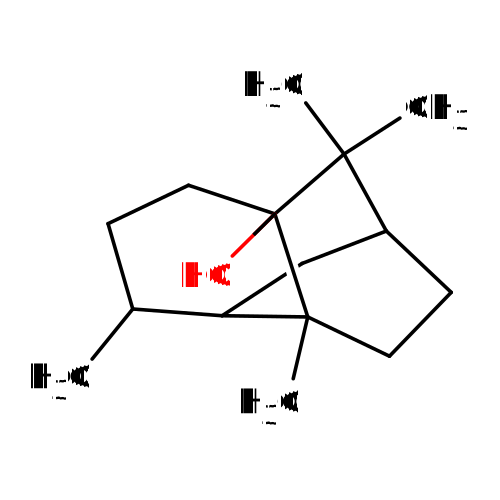
| Common Name | 2,2,6,8-tetramethyltricyclo[5.3.1.0³,⁸]undecan-3-ol |
|---|
| Description | Patchouli alcohol, also known as patchoulol, belongs to the class of organic compounds known as tertiary alcohols. Tertiary alcohols are compounds in which a hydroxy group, -OH, is attached to a saturated carbon atom R3COH (R not H ). Patchoulol is also used in the synthesis of the chemotherapy drug Taxol. 2. The discrepancy had resulted from an unanticipated skeletal rearrangement that had occurred in the Büchi synthesis when patchoulene was treated with peroxy acid, an operation that by accident generated the correct architecture of the natural product. The (−)-optical isomer is one of the organic compounds responsible for the typical patchouli scent. Patchouli alcohol is an extremely weak basic (essentially neutral) compound (based on its pKa). Patchouli oil is an important material in perfumery. After several years of careful study Büchi and co-workers proposed the structure of patchouli alcohol to correspond to 1, based on degradation studies from his earlier work, verified later by synthesis of material which corresponded to the natural authentic sample of patchouli alcohol. They had undertaken an X-ray analysis of the patchouli alcohol diester of chromic acid, with the objective of determining the Cr-O-C angles. A serendipitous finding by Dunitz and co-workers revealed a contradictory structure. During early structural investigation the presence of a saturated tricyclic tertiary alcohol was established. Patchoulol or patchouli alcohol (C15H26O) is a sesquiterpene alcohol found in patchouli. 1. Instead they proposed together with Büchi the novel structure. Patchouli alcohol was first isolated in 1869 by Gal and its chemical composition later correctly formulated as C15H26O by Montgolfier. 2,2,6,8-tetramethyltricyclo[5.3.1.0³,⁸]undecan-3-ol is found in Nardostachys jatamansi, Pogostemon cablin and Valeriana fauriei. Contains embedded [2.2.2]Propellane motif. |
|---|
| Structure | CC1CCC2(O)C(C)(C)C3CCC2(C)C1C3 InChI=1S/C15H26O/c1-10-5-8-15(16)13(2,3)11-6-7-14(15,4)12(10)9-11/h10-12,16H,5-9H2,1-4H3 |
|---|
| Synonyms | | Value | Source |
|---|
| Patchoulol | MeSH | | Patchouli alcohol | MeSH |
|
|---|
| Chemical Formula | C15H26O |
|---|
| Average Mass | 222.3720 Da |
|---|
| Monoisotopic Mass | 222.19837 Da |
|---|
| IUPAC Name | 2,2,6,8-tetramethyltricyclo[5.3.1.0³,⁸]undecan-3-ol |
|---|
| Traditional Name | 2,2,6,8-tetramethyltricyclo[5.3.1.0³,⁸]undecan-3-ol |
|---|
| CAS Registry Number | Not Available |
|---|
| SMILES | CC1CCC2(O)C(C)(C)C3CCC2(C)C1C3 |
|---|
| InChI Identifier | InChI=1S/C15H26O/c1-10-5-8-15(16)13(2,3)11-6-7-14(15,4)12(10)9-11/h10-12,16H,5-9H2,1-4H3 |
|---|
| InChI Key | GGHMUJBZYLPWFD-UHFFFAOYSA-N |
|---|
| Experimental Spectra |
|---|
|
| Not Available | | Predicted Spectra |
|---|
|
| | Spectrum Type | Description | Depositor ID | Depositor Organization | Depositor | Deposition Date | View |
|---|
| 1D NMR | 13C NMR Spectrum (1D, 25 MHz, H2O, predicted) | Wishart Lab | Wishart Lab | David Wishart | 2021-06-20 | View Spectrum | | 1D NMR | 1H NMR Spectrum (1D, 100 MHz, H2O, predicted) | Wishart Lab | Wishart Lab | David Wishart | 2021-06-20 | View Spectrum | | 1D NMR | 13C NMR Spectrum (1D, 252 MHz, H2O, predicted) | Wishart Lab | Wishart Lab | David Wishart | 2021-06-20 | View Spectrum | | 1D NMR | 1H NMR Spectrum (1D, 1000 MHz, H2O, predicted) | Wishart Lab | Wishart Lab | David Wishart | 2021-06-20 | View Spectrum | | 1D NMR | 13C NMR Spectrum (1D, 50 MHz, H2O, predicted) | Wishart Lab | Wishart Lab | David Wishart | 2021-06-20 | View Spectrum | | 1D NMR | 1H NMR Spectrum (1D, 200 MHz, H2O, predicted) | Wishart Lab | Wishart Lab | David Wishart | 2021-06-20 | View Spectrum | | 1D NMR | 13C NMR Spectrum (1D, 75 MHz, H2O, predicted) | Wishart Lab | Wishart Lab | David Wishart | 2021-06-20 | View Spectrum | | 1D NMR | 1H NMR Spectrum (1D, 300 MHz, H2O, predicted) | Wishart Lab | Wishart Lab | David Wishart | 2021-06-20 | View Spectrum | | 1D NMR | 13C NMR Spectrum (1D, 101 MHz, H2O, predicted) | Wishart Lab | Wishart Lab | David Wishart | 2021-06-20 | View Spectrum | | 1D NMR | 1H NMR Spectrum (1D, 400 MHz, H2O, predicted) | Wishart Lab | Wishart Lab | David Wishart | 2021-06-20 | View Spectrum | | 1D NMR | 13C NMR Spectrum (1D, 126 MHz, H2O, predicted) | Wishart Lab | Wishart Lab | David Wishart | 2021-06-20 | View Spectrum | | 1D NMR | 1H NMR Spectrum (1D, 500 MHz, H2O, predicted) | Wishart Lab | Wishart Lab | David Wishart | 2021-06-20 | View Spectrum | | 1D NMR | 13C NMR Spectrum (1D, 151 MHz, H2O, predicted) | Wishart Lab | Wishart Lab | David Wishart | 2021-06-20 | View Spectrum | | 1D NMR | 1H NMR Spectrum (1D, 600 MHz, H2O, predicted) | Wishart Lab | Wishart Lab | David Wishart | 2021-06-20 | View Spectrum | | 1D NMR | 13C NMR Spectrum (1D, 176 MHz, H2O, predicted) | Wishart Lab | Wishart Lab | David Wishart | 2021-06-20 | View Spectrum | | 1D NMR | 1H NMR Spectrum (1D, 700 MHz, H2O, predicted) | Wishart Lab | Wishart Lab | David Wishart | 2021-06-20 | View Spectrum | | 1D NMR | 13C NMR Spectrum (1D, 201 MHz, H2O, predicted) | Wishart Lab | Wishart Lab | David Wishart | 2021-06-20 | View Spectrum | | 1D NMR | 1H NMR Spectrum (1D, 800 MHz, H2O, predicted) | Wishart Lab | Wishart Lab | David Wishart | 2021-06-20 | View Spectrum | | 1D NMR | 13C NMR Spectrum (1D, 226 MHz, H2O, predicted) | Wishart Lab | Wishart Lab | David Wishart | 2021-06-20 | View Spectrum | | 1D NMR | 1H NMR Spectrum (1D, 900 MHz, H2O, predicted) | Wishart Lab | Wishart Lab | David Wishart | 2021-06-20 | View Spectrum |
| | Chemical Shift Submissions |
|---|
|
| Not Available | | Species |
|---|
| Species of Origin | |
|---|
| Chemical Taxonomy |
|---|
| Description | Belongs to the class of organic compounds known as tertiary alcohols. Tertiary alcohols are compounds in which a hydroxy group, -OH, is attached to a saturated carbon atom R3COH (R not H ). |
|---|
| Kingdom | Organic compounds |
|---|
| Super Class | Organic oxygen compounds |
|---|
| Class | Organooxygen compounds |
|---|
| Sub Class | Alcohols and polyols |
|---|
| Direct Parent | Tertiary alcohols |
|---|
| Alternative Parents | |
|---|
| Substituents | - Tertiary alcohol
- Cyclic alcohol
- Hydrocarbon derivative
- Aliphatic homopolycyclic compound
|
|---|
| Molecular Framework | Aliphatic homopolycyclic compounds |
|---|
| External Descriptors | |
|---|
| Physical Properties |
|---|
| State | Not Available |
|---|
| Experimental Properties | | Property | Value | Reference |
|---|
| Melting Point | Not Available | Not Available | | Boiling Point | Not Available | Not Available | | Water Solubility | Not Available | Not Available | | LogP | Not Available | Not Available |
|
|---|
| Predicted Properties | |
|---|