| Record Information |
|---|
| Version | 2.0 |
|---|
| Created at | 2022-09-07 07:20:59 UTC |
|---|
| Updated at | 2022-09-07 07:20:59 UTC |
|---|
| NP-MRD ID | NP0246039 |
|---|
| Secondary Accession Numbers | None |
|---|
| Natural Product Identification |
|---|
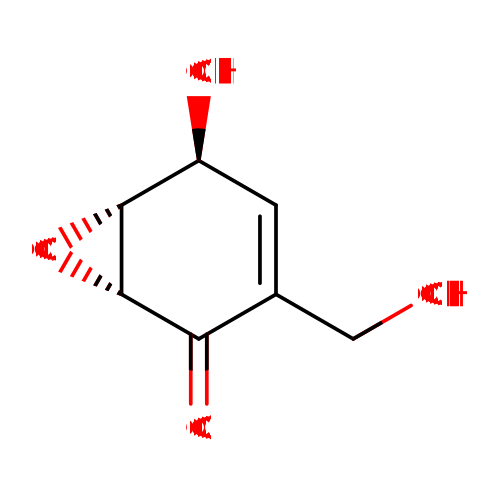
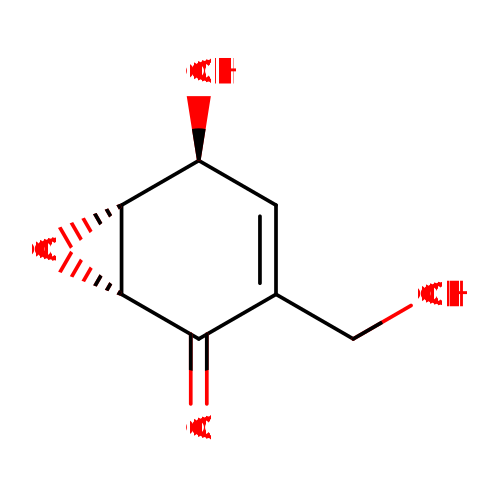
| Common Name | (1r,5s,6r)-5-hydroxy-3-(hydroxymethyl)-7-oxabicyclo[4.1.0]hept-3-en-2-one |
|---|
| Description | (+)-Isoepoxydon belongs to the class of organic compounds known as cyclohexenones. Cyclohexenones are compounds containing a cylohexenone moiety, which is a six-membered aliphatic ring that carries a ketone and has one endocyclic double bond (+)-isoepoxydon is a secondary metabolite. Secondary metabolites are metabolically or physiologically non-essential metabolites that may serve a role as defense or signalling molecules. In some cases they are simply molecules that arise from the incomplete metabolism of other secondary metabolites. (1r,5s,6r)-5-hydroxy-3-(hydroxymethyl)-7-oxabicyclo[4.1.0]hept-3-en-2-one is found in Arthrinium arundinis, Pestalotiopsis longiseta, Poronia punctata and Ulva intestinalis. (1r,5s,6r)-5-hydroxy-3-(hydroxymethyl)-7-oxabicyclo[4.1.0]hept-3-en-2-one was first documented in 1979 (PMID: 43192). Based on a literature review a significant number of articles have been published on (+)-isoepoxydon (PMID: 35528279) (PMID: 30903915) (PMID: 29030968) (PMID: 26788884) (PMID: 26513254) (PMID: 24334092). |
|---|
| Structure | OCC1=C[C@H](O)[C@H]2O[C@H]2C1=O InChI=1S/C7H8O4/c8-2-3-1-4(9)6-7(11-6)5(3)10/h1,4,6-9H,2H2/t4-,6+,7-/m0/s1 |
|---|
| Synonyms | | Value | Source |
|---|
| (1R,5S,6R)-5-Hydroxy-3-(hydroxymethyl)-7-oxabicyclo[4.1.0]hept-3-en-2-one | ChEBI | | Isoepoxydon | ChEBI | | 5,6-Epoxy-4-hydroxy-2-hydroxymethylcyclohex-2- en-1-one | MeSH |
|
|---|
| Chemical Formula | C7H8O4 |
|---|
| Average Mass | 156.1370 Da |
|---|
| Monoisotopic Mass | 156.04226 Da |
|---|
| IUPAC Name | (1R,5S,6R)-5-hydroxy-3-(hydroxymethyl)-7-oxabicyclo[4.1.0]hept-3-en-2-one |
|---|
| Traditional Name | (1R,5S,6R)-5-hydroxy-3-(hydroxymethyl)-7-oxabicyclo[4.1.0]hept-3-en-2-one |
|---|
| CAS Registry Number | Not Available |
|---|
| SMILES | OCC1=C[C@H](O)[C@H]2O[C@H]2C1=O |
|---|
| InChI Identifier | InChI=1S/C7H8O4/c8-2-3-1-4(9)6-7(11-6)5(3)10/h1,4,6-9H,2H2/t4-,6+,7-/m0/s1 |
|---|
| InChI Key | VTLJDPHPVHSVGR-JHYUDYDFSA-N |
|---|
| Experimental Spectra |
|---|
|
| Not Available | | Predicted Spectra |
|---|
|
| | Spectrum Type | Description | Depositor ID | Depositor Organization | Depositor | Deposition Date | View |
|---|
| 1D NMR | 13C NMR Spectrum (1D, 25 MHz, H2O, predicted) | Wishart Lab | Wishart Lab | David Wishart | 2021-06-20 | View Spectrum | | 1D NMR | 1H NMR Spectrum (1D, 100 MHz, H2O, predicted) | Wishart Lab | Wishart Lab | David Wishart | 2021-06-20 | View Spectrum | | 1D NMR | 13C NMR Spectrum (1D, 252 MHz, H2O, predicted) | Wishart Lab | Wishart Lab | David Wishart | 2021-06-20 | View Spectrum | | 1D NMR | 1H NMR Spectrum (1D, 1000 MHz, H2O, predicted) | Wishart Lab | Wishart Lab | David Wishart | 2021-06-20 | View Spectrum | | 1D NMR | 13C NMR Spectrum (1D, 50 MHz, H2O, predicted) | Wishart Lab | Wishart Lab | David Wishart | 2021-06-20 | View Spectrum | | 1D NMR | 1H NMR Spectrum (1D, 200 MHz, H2O, predicted) | Wishart Lab | Wishart Lab | David Wishart | 2021-06-20 | View Spectrum | | 1D NMR | 13C NMR Spectrum (1D, 75 MHz, H2O, predicted) | Wishart Lab | Wishart Lab | David Wishart | 2021-06-20 | View Spectrum | | 1D NMR | 1H NMR Spectrum (1D, 300 MHz, H2O, predicted) | Wishart Lab | Wishart Lab | David Wishart | 2021-06-20 | View Spectrum | | 1D NMR | 13C NMR Spectrum (1D, 101 MHz, H2O, predicted) | Wishart Lab | Wishart Lab | David Wishart | 2021-06-20 | View Spectrum | | 1D NMR | 1H NMR Spectrum (1D, 400 MHz, H2O, predicted) | Wishart Lab | Wishart Lab | David Wishart | 2021-06-20 | View Spectrum | | 1D NMR | 13C NMR Spectrum (1D, 126 MHz, H2O, predicted) | Wishart Lab | Wishart Lab | David Wishart | 2021-06-20 | View Spectrum | | 1D NMR | 1H NMR Spectrum (1D, 500 MHz, H2O, predicted) | Wishart Lab | Wishart Lab | David Wishart | 2021-06-20 | View Spectrum | | 1D NMR | 13C NMR Spectrum (1D, 151 MHz, H2O, predicted) | Wishart Lab | Wishart Lab | David Wishart | 2021-06-20 | View Spectrum | | 1D NMR | 1H NMR Spectrum (1D, 600 MHz, H2O, predicted) | Wishart Lab | Wishart Lab | David Wishart | 2021-06-20 | View Spectrum | | 1D NMR | 13C NMR Spectrum (1D, 176 MHz, H2O, predicted) | Wishart Lab | Wishart Lab | David Wishart | 2021-06-20 | View Spectrum | | 1D NMR | 1H NMR Spectrum (1D, 700 MHz, H2O, predicted) | Wishart Lab | Wishart Lab | David Wishart | 2021-06-20 | View Spectrum | | 1D NMR | 13C NMR Spectrum (1D, 201 MHz, H2O, predicted) | Wishart Lab | Wishart Lab | David Wishart | 2021-06-20 | View Spectrum | | 1D NMR | 1H NMR Spectrum (1D, 800 MHz, H2O, predicted) | Wishart Lab | Wishart Lab | David Wishart | 2021-06-20 | View Spectrum | | 1D NMR | 13C NMR Spectrum (1D, 226 MHz, H2O, predicted) | Wishart Lab | Wishart Lab | David Wishart | 2021-06-20 | View Spectrum | | 1D NMR | 1H NMR Spectrum (1D, 900 MHz, H2O, predicted) | Wishart Lab | Wishart Lab | David Wishart | 2021-06-20 | View Spectrum |
| | Chemical Shift Submissions |
|---|
|
| Not Available | | Species |
|---|
| Species of Origin | |
|---|
| Chemical Taxonomy |
|---|
| Description | Belongs to the class of organic compounds known as cyclohexenones. Cyclohexenones are compounds containing a cylohexenone moiety, which is a six-membered aliphatic ring that carries a ketone and has one endocyclic double bond. |
|---|
| Kingdom | Organic compounds |
|---|
| Super Class | Organic oxygen compounds |
|---|
| Class | Organooxygen compounds |
|---|
| Sub Class | Carbonyl compounds |
|---|
| Direct Parent | Cyclohexenones |
|---|
| Alternative Parents | |
|---|
| Substituents | - Cyclohexenone
- Secondary alcohol
- Oxacycle
- Organoheterocyclic compound
- Ether
- Oxirane
- Dialkyl ether
- Organic oxide
- Hydrocarbon derivative
- Primary alcohol
- Alcohol
- Aliphatic heteropolycyclic compound
|
|---|
| Molecular Framework | Aliphatic heteropolycyclic compounds |
|---|
| External Descriptors | Not Available |
|---|
| Physical Properties |
|---|
| State | Not Available |
|---|
| Experimental Properties | | Property | Value | Reference |
|---|
| Melting Point | Not Available | Not Available | | Boiling Point | Not Available | Not Available | | Water Solubility | Not Available | Not Available | | LogP | Not Available | Not Available |
|
|---|
| Predicted Properties | |
|---|
| General References | - Fu R, Tang W, Zhang H, Zhang Y, Wang D, Chen W: Study on the mechanism of inhibiting patulin production by fengycin. Open Life Sci. 2022 Apr 19;17(1):372-379. doi: 10.1515/biol-2022-0041. eCollection 2022. [PubMed:35528279 ]
- Frisch LM, Niessen L: Development and optimization of a group-specific loop-mediated isothermal amplification (LAMP) assay for the detection of patulin-producing Penicillium species. Int J Food Microbiol. 2019 Jun 2;298:20-30. doi: 10.1016/j.ijfoodmicro.2019.03.010. Epub 2019 Mar 15. [PubMed:30903915 ]
- Wang Y, Feng K, Liu B, Zhang Z, Wei J, Yuan Y, Yue T: Mycoflora assessment, growth and toxigenic features of patulin-producers in kiwifruit in China. J Sci Food Agric. 2018 May;98(7):2573-2581. doi: 10.1002/jsfa.8747. Epub 2017 Nov 28. [PubMed:29030968 ]
- De Clercq N, Vlaemynck G, Van Pamel E, Van Weyenberg S, Herman L, Devlieghere F, De Meulenaer B, Van Coillie E: Isoepoxydon dehydrogenase (idh) gene expression in relation to patulin production by Penicillium expansum under different temperature and atmosphere. Int J Food Microbiol. 2016 Mar 2;220:50-7. doi: 10.1016/j.ijfoodmicro.2016.01.004. Epub 2016 Jan 9. [PubMed:26788884 ]
- Rharmitt S, Hafidi M, Hajjaj H, Scordino F, Giosa D, Giuffre L, Barreca D, Criseo G, Romeo O: Molecular characterization of patulin producing and non-producing Penicillium species in apples from Morocco. Int J Food Microbiol. 2016 Jan 18;217:137-40. doi: 10.1016/j.ijfoodmicro.2015.10.019. Epub 2015 Oct 19. [PubMed:26513254 ]
- Snini SP, Tadrist S, Laffitte J, Jamin EL, Oswald IP, Puel O: The gene PatG involved in the biosynthesis pathway of patulin, a food-borne mycotoxin, encodes a 6-methylsalicylic acid decarboxylase. Int J Food Microbiol. 2014 Feb 3;171:77-83. doi: 10.1016/j.ijfoodmicro.2013.11.020. Epub 2013 Nov 27. [PubMed:24334092 ]
- Rodriguez A, Luque MI, Andrade MJ, Rodriguez M, Asensio MA, Cordoba JJ: Development of real-time PCR methods to quantify patulin-producing molds in food products. Food Microbiol. 2011 Sep;28(6):1190-9. doi: 10.1016/j.fm.2011.04.004. Epub 2011 Apr 23. [PubMed:21645819 ]
- Artigot MP, Loiseau N, Laffitte J, Mas-Reguieg L, Tadrist S, Oswald IP, Puel O: Molecular cloning and functional characterization of two CYP619 cytochrome P450s involved in biosynthesis of patulin in Aspergillus clavatus. Microbiology (Reading). 2009 May;155(Pt 5):1738-1747. doi: 10.1099/mic.0.024836-0. Epub 2009 Apr 21. [PubMed:19383676 ]
- Paterson RR: The isoepoxydon dehydrogenase gene PCR profile is useful in fungal taxonomy. Rev Iberoam Micol. 2007 Dec 31;24(4):289-93. [PubMed:18095762 ]
- Dombrink-Kurtzman MA, McGovern AE: Species-specific identification of penicillium linked to patulin contamination. J Food Prot. 2007 Nov;70(11):2646-50. doi: 10.4315/0362-028x-70.11.2646. [PubMed:18044450 ]
- Dombrink-Kurtzman MA: A gene having sequence homology to isoamyl alcohol oxidase is transcribed during patulin production in Penicillium griseofulvum. Curr Microbiol. 2008 Mar;56(3):224-8. doi: 10.1007/s00284-007-9061-0. Epub 2007 Nov 14. [PubMed:18000703 ]
- Paterson RR, Venancio A, Lima N: A practical approach for identifications based on mycotoxin characters of Penicillium. Rev Iberoam Micol. 2006 Sep;23(3):155-9. doi: 10.1016/s1130-1406(06)70036-5. [PubMed:17196022 ]
- Puel O, Tadrist S, Delaforge M, Oswald IP, Lebrihi A: The inability of Byssochlamys fulva to produce patulin is related to absence of 6-methylsalicylic acid synthase and isoepoxydon dehydrogenase genes. Int J Food Microbiol. 2007 Apr 10;115(2):131-9. doi: 10.1016/j.ijfoodmicro.2006.10.016. Epub 2006 Dec 13. [PubMed:17169453 ]
- Dombrink-Kurtzman MA: The sequence of the isoepoxydon dehydrogenase gene of the patulin biosynthetic pathway in Penicillium species. Antonie Van Leeuwenhoek. 2007 Feb;91(2):179-89. doi: 10.1007/s10482-006-9109-3. [PubMed:17043910 ]
- Dombrink-Kurtzman MA, Engberg AE: Byssochlamys nivea with patulin-producing capability has an isoepoxydon dehydrogenase gene (idh) with sequence homology to Penicillium expansum and P. griseofulvum. Mycol Res. 2006 Sep;110(Pt 9):1111-8. doi: 10.1016/j.mycres.2006.05.008. Epub 2006 Aug 28. [PubMed:16934966 ]
- White S, O'Callaghan J, Dobson AD: Cloning and molecular characterization of Penicillium expansum genes upregulated under conditions permissive for patulin biosynthesis. FEMS Microbiol Lett. 2006 Feb;255(1):17-26. doi: 10.1111/j.1574-6968.2005.00051.x. [PubMed:16436057 ]
- Dombrink-Kurtzman MA: The isoepoxydon dehydrogenase gene of the patulin metabolic pathway differs for Penicillium griseofulvum and Penicillium expansum. Antonie Van Leeuwenhoek. 2006 Jan;89(1):1-8. doi: 10.1007/s10482-005-9002-5. Epub 2005 Dec 3. [PubMed:16328863 ]
- Paterson RR: The isoepoxydon dehydrogenase gene of patulin biosynthesis in cultures and secondary metabolites as candidate PCR inhibitors. Mycol Res. 2004 Dec;108(Pt 12):1431-7. doi: 10.1017/s095375620400142x. [PubMed:15757179 ]
- Gloer JB, Truckenbrod SM: Interference Competition among Coprophilous Fungi: Production of (+)-Isoepoxydon by Poronia punctata. Appl Environ Microbiol. 1988 Apr;54(4):861-4. doi: 10.1128/aem.54.4.861-864.1988. [PubMed:16347607 ]
- Sekiguchi J, Gaucher GM: Patulin biosynthesis: the metabolism of phyllostine and isoepoxydon by cell-free preparations from Pencillium urticae. Can J Microbiol. 1979 Aug;25(8):881-7. doi: 10.1139/m79-131. [PubMed:43192 ]
- Sekiguchi J, Gaucher GM: Isoepoxydon, a new metabolite of the patulin pathway in Penicillium urticae. Biochem J. 1979 Aug 15;182(2):445-53. doi: 10.1042/bj1820445. [PubMed:508294 ]
- LOTUS database [Link]
|
|---|