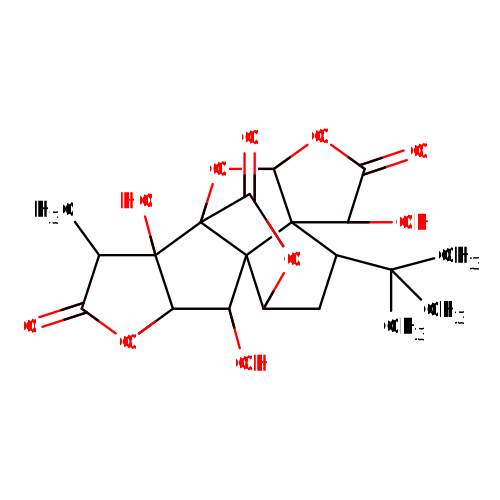
| Record Information |
|---|
| Version | 2.0 |
|---|
| Created at | 2022-09-06 23:28:53 UTC |
|---|
| Updated at | 2022-09-06 23:28:53 UTC |
|---|
| NP-MRD ID | NP0239813 |
|---|
| Secondary Accession Numbers | None |
|---|
| Natural Product Identification |
|---|
| Common Name | 8-tert-butyl-6,12,17-trihydroxy-16-methyl-2,4,14,19-tetraoxahexacyclo[8.7.2.0¹,¹¹.0³,⁷.0⁷,¹¹.0¹³,¹⁷]nonadecane-5,15,18-trione |
|---|
| Description | Ginkgolide B, also known as BN52021 or gingko lactone, belongs to the class of organic compounds known as ginkgolides and bilobalides. These are diterpene lactones with a structure based either on the gingkolide or the bilobalide skeleton. The ginkgolide skeleton is a very rigid structure consisting of hexacyclic C20 trilactone. The cis-fused F/A/D/C ring junction forms an empty semi-ball hole, the D ring contains a cage form tetrahydrofuran ring which occupies the center of the empty hole, and the oxygen atoms of the D,C and F ring and 10-hydroxyl group consist of an analogous crown ether structure. Ginkgolides are biologically active terpenic lactones present in Ginkgo biloba. Ginkgolide B is an extremely weak basic (essentially neutral) compound (based on its pKa). Ginkgolide B is also used in treatment for cerebrovascular disease. Ginkgolide B is a bitter tasting compound. Outside of the human body, ginkgolide b has been detected, but not quantified in, fats and oils and ginkgo nuts. This could make ginkgolide b a potential biomarker for the consumption of these foods. The molecular formulas were determined by high resolution mass spectrometry, and the overall structures by IR and NMR spectroscopic analysis and extensive derivitization techniques (g) This newly formed abietatriene undergoes a 1,2-alkyl shift to break the 6-membered ring into (7) with a five-membered ring (more favorable). When coupled together, they form one molecule of geranylgeranyl diphosphate with geranylgeranyl diphosphate synthase. 8-tert-butyl-6,12,17-trihydroxy-16-methyl-2,4,14,19-tetraoxahexacyclo[8.7.2.0¹,¹¹.0³,⁷.0⁷,¹¹.0¹³,¹⁷]nonadecane-5,15,18-trione is found in Ginkgo biloba and Machilus wangchiana. Structural elucidation was accomplished in 1967 by Maruyama et al. |
|---|
| Structure | CC1C(=O)OC2C(O)C34C5CC(C(C)(C)C)C33C(O)C(=O)OC3OC4(C(=O)O5)C12O InChI=1S/C20H24O10/c1-6-12(23)28-11-9(21)18-8-5-7(16(2,3)4)17(18)10(22)13(24)29-15(17)30-20(18,14(25)27-8)19(6,11)26/h6-11,15,21-22,26H,5H2,1-4H3 |
|---|
| Synonyms | | Value | Source |
|---|
| 1-Hydroxy-(1beta)-ginkgolide a | HMDB | | BN52021 | HMDB | | Gingko lactone | HMDB | | Ginkolide b | HMDB | | Ginkgolide b, (1beta)-isomer | HMDB | | Ginkgolide b | MeSH |
|
|---|
| Chemical Formula | C20H24O10 |
|---|
| Average Mass | 424.3986 Da |
|---|
| Monoisotopic Mass | 424.13695 Da |
|---|
| IUPAC Name | 8-tert-butyl-6,12,17-trihydroxy-16-methyl-2,4,14,19-tetraoxahexacyclo[8.7.2.0¹,¹¹.0³,⁷.0⁷,¹¹.0¹³,¹⁷]nonadecane-5,15,18-trione |
|---|
| Traditional Name | 8-tert-butyl-6,12,17-trihydroxy-16-methyl-2,4,14,19-tetraoxahexacyclo[8.7.2.0¹,¹¹.0³,⁷.0⁷,¹¹.0¹³,¹⁷]nonadecane-5,15,18-trione |
|---|
| CAS Registry Number | Not Available |
|---|
| SMILES | CC1C(=O)OC2C(O)C34C5CC(C(C)(C)C)C33C(O)C(=O)OC3OC4(C(=O)O5)C12O |
|---|
| InChI Identifier | InChI=1S/C20H24O10/c1-6-12(23)28-11-9(21)18-8-5-7(16(2,3)4)17(18)10(22)13(24)29-15(17)30-20(18,14(25)27-8)19(6,11)26/h6-11,15,21-22,26H,5H2,1-4H3 |
|---|
| InChI Key | SQOJOAFXDQDRGF-UHFFFAOYSA-N |
|---|
| Experimental Spectra |
|---|
|
| Not Available | | Predicted Spectra |
|---|
|
| | Spectrum Type | Description | Depositor ID | Depositor Organization | Depositor | Deposition Date | View |
|---|
| 1D NMR | 13C NMR Spectrum (1D, 25 MHz, H2O, predicted) | Wishart Lab | Wishart Lab | David Wishart | 2021-06-20 | View Spectrum | | 1D NMR | 1H NMR Spectrum (1D, 100 MHz, H2O, predicted) | Wishart Lab | Wishart Lab | David Wishart | 2021-06-20 | View Spectrum | | 1D NMR | 13C NMR Spectrum (1D, 252 MHz, H2O, predicted) | Wishart Lab | Wishart Lab | David Wishart | 2021-06-20 | View Spectrum | | 1D NMR | 1H NMR Spectrum (1D, 1000 MHz, H2O, predicted) | Wishart Lab | Wishart Lab | David Wishart | 2021-06-20 | View Spectrum | | 1D NMR | 13C NMR Spectrum (1D, 50 MHz, H2O, predicted) | Wishart Lab | Wishart Lab | David Wishart | 2021-06-20 | View Spectrum | | 1D NMR | 1H NMR Spectrum (1D, 200 MHz, H2O, predicted) | Wishart Lab | Wishart Lab | David Wishart | 2021-06-20 | View Spectrum | | 1D NMR | 13C NMR Spectrum (1D, 75 MHz, H2O, predicted) | Wishart Lab | Wishart Lab | David Wishart | 2021-06-20 | View Spectrum | | 1D NMR | 1H NMR Spectrum (1D, 300 MHz, H2O, predicted) | Wishart Lab | Wishart Lab | David Wishart | 2021-06-20 | View Spectrum | | 1D NMR | 13C NMR Spectrum (1D, 101 MHz, H2O, predicted) | Wishart Lab | Wishart Lab | David Wishart | 2021-06-20 | View Spectrum | | 1D NMR | 1H NMR Spectrum (1D, 400 MHz, H2O, predicted) | Wishart Lab | Wishart Lab | David Wishart | 2021-06-20 | View Spectrum | | 1D NMR | 13C NMR Spectrum (1D, 126 MHz, H2O, predicted) | Wishart Lab | Wishart Lab | David Wishart | 2021-06-20 | View Spectrum | | 1D NMR | 1H NMR Spectrum (1D, 500 MHz, H2O, predicted) | Wishart Lab | Wishart Lab | David Wishart | 2021-06-20 | View Spectrum | | 1D NMR | 13C NMR Spectrum (1D, 151 MHz, H2O, predicted) | Wishart Lab | Wishart Lab | David Wishart | 2021-06-20 | View Spectrum | | 1D NMR | 1H NMR Spectrum (1D, 600 MHz, H2O, predicted) | Wishart Lab | Wishart Lab | David Wishart | 2021-06-20 | View Spectrum | | 1D NMR | 13C NMR Spectrum (1D, 176 MHz, H2O, predicted) | Wishart Lab | Wishart Lab | David Wishart | 2021-06-20 | View Spectrum | | 1D NMR | 1H NMR Spectrum (1D, 700 MHz, H2O, predicted) | Wishart Lab | Wishart Lab | David Wishart | 2021-06-20 | View Spectrum | | 1D NMR | 13C NMR Spectrum (1D, 201 MHz, H2O, predicted) | Wishart Lab | Wishart Lab | David Wishart | 2021-06-20 | View Spectrum | | 1D NMR | 1H NMR Spectrum (1D, 800 MHz, H2O, predicted) | Wishart Lab | Wishart Lab | David Wishart | 2021-06-20 | View Spectrum | | 1D NMR | 13C NMR Spectrum (1D, 226 MHz, H2O, predicted) | Wishart Lab | Wishart Lab | David Wishart | 2021-06-20 | View Spectrum | | 1D NMR | 1H NMR Spectrum (1D, 900 MHz, H2O, predicted) | Wishart Lab | Wishart Lab | David Wishart | 2021-06-20 | View Spectrum |
| | Chemical Shift Submissions |
|---|
|
| Not Available | | Species |
|---|
| Species of Origin | |
|---|
| Chemical Taxonomy |
|---|
| Description | Belongs to the class of organic compounds known as ginkgolides and bilobalides. These are diterpene lactones with a structure based either on the gingkolide or the bilobalide skeleton. The ginkgolide skeleton is a very rigid structure consisting of hexacyclic C20 trilactone. The cis-fused F/A/D/C ring junction forms an empty semi-ball hole, the D ring contains a cage form tetrahydrofuran ring which occupies the center of the empty hole, and the oxygen atoms of the D,C and F ring and 10-hydroxyl group consist of an analogous crown ether structure. |
|---|
| Kingdom | Organic compounds |
|---|
| Super Class | Lipids and lipid-like molecules |
|---|
| Class | Prenol lipids |
|---|
| Sub Class | Terpene lactones |
|---|
| Direct Parent | Ginkgolides and bilobalides |
|---|
| Alternative Parents | |
|---|
| Substituents | - Ginkgolide-skeleton
- Diterpenoid
- Tricarboxylic acid or derivatives
- Furofuran
- Gamma butyrolactone
- Cyclic alcohol
- Tetrahydrofuran
- Tertiary alcohol
- Carboxylic acid ester
- Lactone
- Secondary alcohol
- Organoheterocyclic compound
- Oxacycle
- Acetal
- Carboxylic acid derivative
- Polyol
- Alcohol
- Hydrocarbon derivative
- Organic oxide
- Organic oxygen compound
- Carbonyl group
- Organooxygen compound
- Aliphatic heteropolycyclic compound
|
|---|
| Molecular Framework | Aliphatic heteropolycyclic compounds |
|---|
| External Descriptors | Not Available |
|---|
| Physical Properties |
|---|
| State | Not Available |
|---|
| Experimental Properties | | Property | Value | Reference |
|---|
| Melting Point | Not Available | Not Available | | Boiling Point | Not Available | Not Available | | Water Solubility | Not Available | Not Available | | LogP | Not Available | Not Available |
|
|---|
| Predicted Properties | |
|---|