| Record Information |
|---|
| Version | 2.0 |
|---|
| Created at | 2022-09-06 21:28:31 UTC |
|---|
| Updated at | 2022-09-06 21:28:31 UTC |
|---|
| NP-MRD ID | NP0238138 |
|---|
| Secondary Accession Numbers | None |
|---|
| Natural Product Identification |
|---|
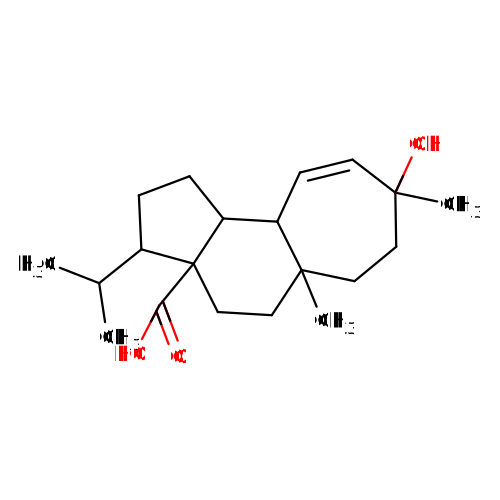
| Common Name | 8-hydroxy-3-isopropyl-5a,8-dimethyl-1h,2h,3h,4h,5h,6h,7h,10ah,10bh-cyclohepta[e]indene-3a-carboxylic acid |
|---|
| Description | 8-Hydroxy-5a,8-dimethyl-3-(propan-2-yl)-1H,2H,3H,3aH,4H,5H,5aH,6H,7H,8H,10aH,10bH-cyclohepta[e]indene-3a-carboxylic acid belongs to the class of organic compounds known as valparane and mulinane diterpenoids. These are diterpenoids with a structure based on either the valparane or mulinane skeleton. Valparane and mulinane are tricyclic compounds containing a tetradecahydrocyclohepta[e]indene skeleton. Valparane carries a 1-methylethyl at the 3-position, as well as three methyl groups at the 5a-, 8-, and 10b-position of the ring system. Mulinane carries a 1-methylethyl at the 3-position, as well as three methyl groups at the 3a-, 5a-, and 8-position of the ring system. 8-hydroxy-3-isopropyl-5a,8-dimethyl-1h,2h,3h,4h,5h,6h,7h,10ah,10bh-cyclohepta[e]indene-3a-carboxylic acid is found in Azorella madreporica and Azorella prolifera. 8-Hydroxy-5a,8-dimethyl-3-(propan-2-yl)-1H,2H,3H,3aH,4H,5H,5aH,6H,7H,8H,10aH,10bH-cyclohepta[e]indene-3a-carboxylic acid is an extremely weak basic (essentially neutral) compound (based on its pKa). |
|---|
| Structure | CC(C)C1CCC2C3C=CC(C)(O)CCC3(C)CCC12C(O)=O InChI=1S/C20H32O3/c1-13(2)14-5-6-16-15-7-8-19(4,23)11-9-18(15,3)10-12-20(14,16)17(21)22/h7-8,13-16,23H,5-6,9-12H2,1-4H3,(H,21,22) |
|---|
| Synonyms | | Value | Source |
|---|
| 8-Hydroxy-5a,8-dimethyl-3-(propan-2-yl)-1H,2H,3H,3ah,4H,5H,5ah,6H,7H,8H,10ah,10BH-cyclohepta[e]indene-3a-carboxylate | Generator |
|
|---|
| Chemical Formula | C20H32O3 |
|---|
| Average Mass | 320.4730 Da |
|---|
| Monoisotopic Mass | 320.23514 Da |
|---|
| IUPAC Name | 8-hydroxy-5a,8-dimethyl-3-(propan-2-yl)-1H,2H,3H,3aH,4H,5H,5aH,6H,7H,8H,10aH,10bH-cyclohepta[e]indene-3a-carboxylic acid |
|---|
| Traditional Name | 8-hydroxy-3-isopropyl-5a,8-dimethyl-1H,2H,3H,4H,5H,6H,7H,10aH,10bH-cyclohepta[e]indene-3a-carboxylic acid |
|---|
| CAS Registry Number | Not Available |
|---|
| SMILES | CC(C)C1CCC2C3C=CC(C)(O)CCC3(C)CCC12C(O)=O |
|---|
| InChI Identifier | InChI=1S/C20H32O3/c1-13(2)14-5-6-16-15-7-8-19(4,23)11-9-18(15,3)10-12-20(14,16)17(21)22/h7-8,13-16,23H,5-6,9-12H2,1-4H3,(H,21,22) |
|---|
| InChI Key | LRZJASNGRXSNCR-UHFFFAOYSA-N |
|---|
| Experimental Spectra |
|---|
|
| Not Available | | Predicted Spectra |
|---|
|
| | Spectrum Type | Description | Depositor ID | Depositor Organization | Depositor | Deposition Date | View |
|---|
| 1D NMR | 13C NMR Spectrum (1D, 25 MHz, H2O, predicted) | Wishart Lab | Wishart Lab | David Wishart | 2021-06-20 | View Spectrum | | 1D NMR | 1H NMR Spectrum (1D, 100 MHz, H2O, predicted) | Wishart Lab | Wishart Lab | David Wishart | 2021-06-20 | View Spectrum | | 1D NMR | 13C NMR Spectrum (1D, 252 MHz, H2O, predicted) | Wishart Lab | Wishart Lab | David Wishart | 2021-06-20 | View Spectrum | | 1D NMR | 1H NMR Spectrum (1D, 1000 MHz, H2O, predicted) | Wishart Lab | Wishart Lab | David Wishart | 2021-06-20 | View Spectrum | | 1D NMR | 13C NMR Spectrum (1D, 50 MHz, H2O, predicted) | Wishart Lab | Wishart Lab | David Wishart | 2021-06-20 | View Spectrum | | 1D NMR | 1H NMR Spectrum (1D, 200 MHz, H2O, predicted) | Wishart Lab | Wishart Lab | David Wishart | 2021-06-20 | View Spectrum | | 1D NMR | 13C NMR Spectrum (1D, 75 MHz, H2O, predicted) | Wishart Lab | Wishart Lab | David Wishart | 2021-06-20 | View Spectrum | | 1D NMR | 1H NMR Spectrum (1D, 300 MHz, H2O, predicted) | Wishart Lab | Wishart Lab | David Wishart | 2021-06-20 | View Spectrum | | 1D NMR | 13C NMR Spectrum (1D, 101 MHz, H2O, predicted) | Wishart Lab | Wishart Lab | David Wishart | 2021-06-20 | View Spectrum | | 1D NMR | 1H NMR Spectrum (1D, 400 MHz, H2O, predicted) | Wishart Lab | Wishart Lab | David Wishart | 2021-06-20 | View Spectrum | | 1D NMR | 13C NMR Spectrum (1D, 126 MHz, H2O, predicted) | Wishart Lab | Wishart Lab | David Wishart | 2021-06-20 | View Spectrum | | 1D NMR | 1H NMR Spectrum (1D, 500 MHz, H2O, predicted) | Wishart Lab | Wishart Lab | David Wishart | 2021-06-20 | View Spectrum | | 1D NMR | 13C NMR Spectrum (1D, 151 MHz, H2O, predicted) | Wishart Lab | Wishart Lab | David Wishart | 2021-06-20 | View Spectrum | | 1D NMR | 1H NMR Spectrum (1D, 600 MHz, H2O, predicted) | Wishart Lab | Wishart Lab | David Wishart | 2021-06-20 | View Spectrum | | 1D NMR | 13C NMR Spectrum (1D, 176 MHz, H2O, predicted) | Wishart Lab | Wishart Lab | David Wishart | 2021-06-20 | View Spectrum | | 1D NMR | 1H NMR Spectrum (1D, 700 MHz, H2O, predicted) | Wishart Lab | Wishart Lab | David Wishart | 2021-06-20 | View Spectrum | | 1D NMR | 13C NMR Spectrum (1D, 201 MHz, H2O, predicted) | Wishart Lab | Wishart Lab | David Wishart | 2021-06-20 | View Spectrum | | 1D NMR | 1H NMR Spectrum (1D, 800 MHz, H2O, predicted) | Wishart Lab | Wishart Lab | David Wishart | 2021-06-20 | View Spectrum | | 1D NMR | 13C NMR Spectrum (1D, 226 MHz, H2O, predicted) | Wishart Lab | Wishart Lab | David Wishart | 2021-06-20 | View Spectrum | | 1D NMR | 1H NMR Spectrum (1D, 900 MHz, H2O, predicted) | Wishart Lab | Wishart Lab | David Wishart | 2021-06-20 | View Spectrum |
| | Chemical Shift Submissions |
|---|
|
| Not Available | | Species |
|---|
| Species of Origin | |
|---|
| Chemical Taxonomy |
|---|
| Description | Belongs to the class of organic compounds known as valparane and mulinane diterpenoids. These are diterpenoids with a structure based on either the valparane or mulinane skeleton. Valparane and mulinane are tricyclic compounds containing a tetradecahydrocyclohepta[e]indene skeleton. Valparane carries a 1-methylethyl at the 3-position, as well as three methyl groups at the 5a-, 8-, and 10b-position of the ring system. Mulinane carries a 1-methylethyl at the 3-position, as well as three methyl groups at the 3a-, 5a-, and 8-position of the ring system. |
|---|
| Kingdom | Organic compounds |
|---|
| Super Class | Lipids and lipid-like molecules |
|---|
| Class | Prenol lipids |
|---|
| Sub Class | Diterpenoids |
|---|
| Direct Parent | Valparane and mulinane diterpenoids |
|---|
| Alternative Parents | |
|---|
| Substituents | - Valparane or mulinane diterpenoid
- Tertiary alcohol
- Monocarboxylic acid or derivatives
- Carboxylic acid
- Carboxylic acid derivative
- Organic oxygen compound
- Organic oxide
- Hydrocarbon derivative
- Organooxygen compound
- Carbonyl group
- Alcohol
- Aliphatic homopolycyclic compound
|
|---|
| Molecular Framework | Aliphatic homopolycyclic compounds |
|---|
| External Descriptors | Not Available |
|---|
| Physical Properties |
|---|
| State | Not Available |
|---|
| Experimental Properties | | Property | Value | Reference |
|---|
| Melting Point | Not Available | Not Available | | Boiling Point | Not Available | Not Available | | Water Solubility | Not Available | Not Available | | LogP | Not Available | Not Available |
|
|---|
| Predicted Properties | |
|---|