| Record Information |
|---|
| Version | 2.0 |
|---|
| Created at | 2022-09-06 20:11:24 UTC |
|---|
| Updated at | 2022-09-06 20:11:25 UTC |
|---|
| NP-MRD ID | NP0237132 |
|---|
| Secondary Accession Numbers | None |
|---|
| Natural Product Identification |
|---|
| Common Name | terpineols |
|---|
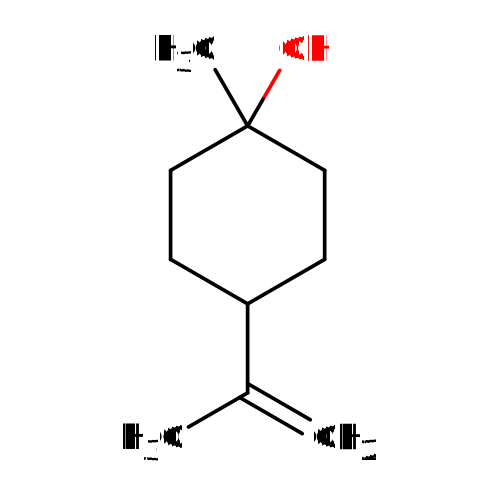
| Description | Beta-Terpineol, also known as p-menth-8-en-1-ol or β-terpineol, belongs to the class of organic compounds known as menthane monoterpenoids. These are monoterpenoids with a structure based on the o-, m-, or p-menthane backbone. P-menthane consists of the cyclohexane ring with a methyl group and a (2-methyl)-propyl group at the 1 and 4 ring position, respectively. The o- and m- menthanes are much rarer, and presumably arise by alkyl migration of p-menthanes. Beta-Terpineol is an extremely weak basic (essentially neutral) compound (based on its pKa). Beta-Terpineol is an earthy, must, and pungent tasting compound. Outside of the human body, beta-Terpineol is found, on average, in the highest concentration within a few different foods, such as common thymes, limes, and mandarin orange (clementine, tangerine) and in a lower concentration in pot marjorams. Beta-Terpineol has also been detected, but not quantified in, several different foods, such as cardamoms, nutmegs, cloves, herbs and spices, and dills. terpineols is found in Abies sibirica, Agathosma betulina, Artemisia arborescens, Artemisia herba-alba, Asarum megacalyx, Asarum simile, Aspalathus linearis, Atalantia buxifolia, Cannabis sativa, Cistus creticus, Citrus aurantiifolia, Citrus iyo, Citrus limon, Citrus sinensis, Cryptomeria japonica, Ephedra sinica, Helichrysum italicum, Lavandula stoechas, Liquidambar styraciflua, Pistacia integerrima, Santolina chamaecyparissus, Satureja cuneifolia, Thymus fedtschenkoi, Thymus revolutus, Thymus vulgaris, Vitex agnus-castus and Zingiber mioga. terpineols was first documented in 2006 (PMID: 16714091). This could make beta-terpineol a potential biomarker for the consumption of these foods (PMID: 18640203) (PMID: 23678820). |
|---|
| Structure | InChI=1S/C10H18O/c1-8(2)9-4-6-10(3,11)7-5-9/h9,11H,1,4-7H2,2-3H3 |
|---|
| Synonyms | | Value | Source |
|---|
| 1-Methyl-4-(1-methylethenyl)cyclohexanol | ChEBI | | 1-Methyl-4-(1-methylvinyl)cyclohexan-1-ol | ChEBI | | 1-Methyl-4-isopropenylcyclohexan-1-ol | ChEBI | | 4-Isopropenyl-1-methyl-1-cyclohexanol | ChEBI | | p-Menth-8-en-1-ol | ChEBI | | b-Terpineol | Generator | | Β-terpineol | Generator | | 1-Methyl-4-(1-methylethenyl)-cyclohexanol | HMDB | | 4-Isopropenyl-1-methylcyclohexanol | HMDB | | beta -Terpineol | HMDB | | FEMA 3564 | HMDB | | beta-Terpinol | MeSH | | 1-Methyl-4-(1-methylethenyl)cyclohexanal | MeSH |
|
|---|
| Chemical Formula | C10H18O |
|---|
| Average Mass | 154.2493 Da |
|---|
| Monoisotopic Mass | 154.13577 Da |
|---|
| IUPAC Name | 1-methyl-4-(prop-1-en-2-yl)cyclohexan-1-ol |
|---|
| Traditional Name | β-terpineol |
|---|
| CAS Registry Number | Not Available |
|---|
| SMILES | CC(=C)C1CCC(C)(O)CC1 |
|---|
| InChI Identifier | InChI=1S/C10H18O/c1-8(2)9-4-6-10(3,11)7-5-9/h9,11H,1,4-7H2,2-3H3 |
|---|
| InChI Key | RUJPNZNXGCHGID-UHFFFAOYSA-N |
|---|
| Experimental Spectra |
|---|
|
| Not Available | | Predicted Spectra |
|---|
|
| | Spectrum Type | Description | Depositor ID | Depositor Organization | Depositor | Deposition Date | View |
|---|
| 1D NMR | 13C NMR Spectrum (1D, 25 MHz, H2O, predicted) | Wishart Lab | Wishart Lab | David Wishart | 2021-06-20 | View Spectrum | | 1D NMR | 1H NMR Spectrum (1D, 100 MHz, H2O, predicted) | Wishart Lab | Wishart Lab | David Wishart | 2021-06-20 | View Spectrum | | 1D NMR | 13C NMR Spectrum (1D, 252 MHz, H2O, predicted) | Wishart Lab | Wishart Lab | David Wishart | 2021-06-20 | View Spectrum | | 1D NMR | 1H NMR Spectrum (1D, 1000 MHz, H2O, predicted) | Wishart Lab | Wishart Lab | David Wishart | 2021-06-20 | View Spectrum | | 1D NMR | 13C NMR Spectrum (1D, 50 MHz, H2O, predicted) | Wishart Lab | Wishart Lab | David Wishart | 2021-06-20 | View Spectrum | | 1D NMR | 1H NMR Spectrum (1D, 200 MHz, H2O, predicted) | Wishart Lab | Wishart Lab | David Wishart | 2021-06-20 | View Spectrum | | 1D NMR | 13C NMR Spectrum (1D, 75 MHz, H2O, predicted) | Wishart Lab | Wishart Lab | David Wishart | 2021-06-20 | View Spectrum | | 1D NMR | 1H NMR Spectrum (1D, 300 MHz, H2O, predicted) | Wishart Lab | Wishart Lab | David Wishart | 2021-06-20 | View Spectrum | | 1D NMR | 13C NMR Spectrum (1D, 101 MHz, H2O, predicted) | Wishart Lab | Wishart Lab | David Wishart | 2021-06-20 | View Spectrum | | 1D NMR | 1H NMR Spectrum (1D, 400 MHz, H2O, predicted) | Wishart Lab | Wishart Lab | David Wishart | 2021-06-20 | View Spectrum | | 1D NMR | 13C NMR Spectrum (1D, 126 MHz, H2O, predicted) | Wishart Lab | Wishart Lab | David Wishart | 2021-06-20 | View Spectrum | | 1D NMR | 1H NMR Spectrum (1D, 500 MHz, H2O, predicted) | Wishart Lab | Wishart Lab | David Wishart | 2021-06-20 | View Spectrum | | 1D NMR | 13C NMR Spectrum (1D, 151 MHz, H2O, predicted) | Wishart Lab | Wishart Lab | David Wishart | 2021-06-20 | View Spectrum | | 1D NMR | 1H NMR Spectrum (1D, 600 MHz, H2O, predicted) | Wishart Lab | Wishart Lab | David Wishart | 2021-06-20 | View Spectrum | | 1D NMR | 13C NMR Spectrum (1D, 176 MHz, H2O, predicted) | Wishart Lab | Wishart Lab | David Wishart | 2021-06-20 | View Spectrum | | 1D NMR | 1H NMR Spectrum (1D, 700 MHz, H2O, predicted) | Wishart Lab | Wishart Lab | David Wishart | 2021-06-20 | View Spectrum | | 1D NMR | 13C NMR Spectrum (1D, 201 MHz, H2O, predicted) | Wishart Lab | Wishart Lab | David Wishart | 2021-06-20 | View Spectrum | | 1D NMR | 1H NMR Spectrum (1D, 800 MHz, H2O, predicted) | Wishart Lab | Wishart Lab | David Wishart | 2021-06-20 | View Spectrum | | 1D NMR | 13C NMR Spectrum (1D, 226 MHz, H2O, predicted) | Wishart Lab | Wishart Lab | David Wishart | 2021-06-20 | View Spectrum | | 1D NMR | 1H NMR Spectrum (1D, 900 MHz, H2O, predicted) | Wishart Lab | Wishart Lab | David Wishart | 2021-06-20 | View Spectrum |
| | Chemical Shift Submissions |
|---|
|
| Not Available | | Species |
|---|
| Species of Origin | |
|---|
| Chemical Taxonomy |
|---|
| Description | Belongs to the class of organic compounds known as menthane monoterpenoids. These are monoterpenoids with a structure based on the o-, m-, or p-menthane backbone. P-menthane consists of the cyclohexane ring with a methyl group and a (2-methyl)-propyl group at the 1 and 4 ring position, respectively. The o- and m- menthanes are much rarer, and presumably arise by alkyl migration of p-menthanes. |
|---|
| Kingdom | Organic compounds |
|---|
| Super Class | Lipids and lipid-like molecules |
|---|
| Class | Prenol lipids |
|---|
| Sub Class | Monoterpenoids |
|---|
| Direct Parent | Menthane monoterpenoids |
|---|
| Alternative Parents | |
|---|
| Substituents | - P-menthane monoterpenoid
- Monocyclic monoterpenoid
- Cyclohexanol
- Tertiary alcohol
- Cyclic alcohol
- Organic oxygen compound
- Hydrocarbon derivative
- Organooxygen compound
- Alcohol
- Aliphatic homomonocyclic compound
|
|---|
| Molecular Framework | Aliphatic homomonocyclic compounds |
|---|
| External Descriptors | - Menthane monoterpenoids (C17517 )
|
|---|
| Physical Properties |
|---|
| State | Not Available |
|---|
| Experimental Properties | | Property | Value | Reference |
|---|
| Melting Point | Not Available | Not Available | | Boiling Point | Not Available | Not Available | | Water Solubility | Not Available | Not Available | | LogP | Not Available | Not Available |
|
|---|
| Predicted Properties | |
|---|