| Record Information |
|---|
| Version | 2.0 |
|---|
| Created at | 2022-09-06 19:53:37 UTC |
|---|
| Updated at | 2022-09-06 19:53:37 UTC |
|---|
| NP-MRD ID | NP0236891 |
|---|
| Secondary Accession Numbers | None |
|---|
| Natural Product Identification |
|---|
| Common Name | 19-hydroxy-4,5,24,24-tetramethyl-11-(3-methylbut-2-en-1-yl)-25,26-dioxa-7-azaheptacyclo[21.2.1.0¹,²⁰.0⁴,¹⁹.0⁵,¹⁶.0⁶,¹⁴.0⁸,¹³]hexacosa-6(14),8,10,12,20-pentaen-22-one |
|---|
| Description | Paspalitrem A belongs to the class of organic compounds known as naphthopyrans. Naphthopyrans are compounds containing a pyran ring fused to a naphthalene moiety. Furan is a 6 membered-ring non-aromatic ring with five carbon and one oxygen atoms. Naphthalene is a polycyclic aromatic hydrocarbon made up of two fused benzene rings. Paspalitrem A is an extremely weak basic (essentially neutral) compound (based on its pKa). Paspalitrem A is a potentially toxic compound. They cause a neurological disease of cattle known as "staggers syndrome". Gastric lavage should be performed and activated charcoal administered to limit further absorption of toxins. In addition, paspalitrem A inhibits presynaptic high-conductance Ca+2 activated maxi-K+ channels in the smooth muscle. This would initially increase neurotransmitter levels, potentiating the GABA-induced chloride current, then lead to decreased levels of neurotransmitter in the synapse. They are thought to inhibit gamma-aminobutyric acid (GABA) receptors, both pre- and postsynaptic, as well as inhibit transmitter breakdown at the GABA-T receptors. Tremorgenic mycotoxins affect central nervous system activity and have been implicated in a number of neurologic diseases of cattle collectively known as "staggers syndromes". Tremorgenic mycotoxins affect central nervous system activity. It may be found in contaminated cereal crops such as oats, barley, millet, corn and rice. Paspalitrem A is a tremorgenic mycotoxin that has been found in fungi of the genera Penicillium and Aspergillus. |
|---|
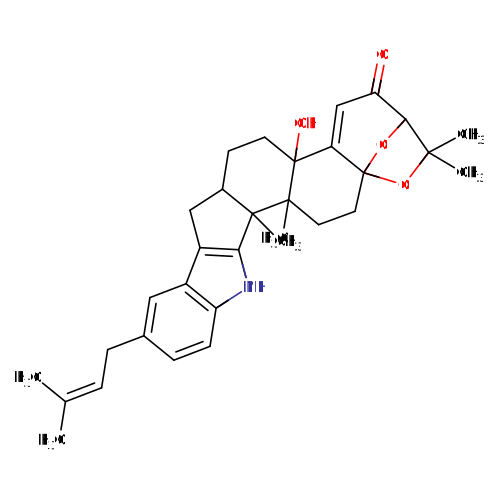
| Structure | CC(C)=CCC1=CC2=C(NC3=C2CC2CCC4(O)C5=CC(=O)C6OC5(CCC4(C)C32C)OC6(C)C)C=C1 InChI=1S/C32H39NO4/c1-18(2)7-8-19-9-10-23-21(15-19)22-16-20-11-12-31(35)25-17-24(34)27-28(3,4)37-32(25,36-27)14-13-29(31,5)30(20,6)26(22)33-23/h7,9-10,15,17,20,27,33,35H,8,11-14,16H2,1-6H3 |
|---|
| Synonyms | Not Available |
|---|
| Chemical Formula | C32H39NO4 |
|---|
| Average Mass | 501.6564 Da |
|---|
| Monoisotopic Mass | 501.28791 Da |
|---|
| IUPAC Name | 19-hydroxy-4,5,24,24-tetramethyl-11-(3-methylbut-2-en-1-yl)-25,26-dioxa-7-azaheptacyclo[21.2.1.0¹,²⁰.0⁴,¹⁹.0⁵,¹⁶.0⁶,¹⁴.0⁸,¹³]hexacosa-6(14),8(13),9,11,20-pentaen-22-one |
|---|
| Traditional Name | 19-hydroxy-4,5,24,24-tetramethyl-11-(3-methylbut-2-en-1-yl)-25,26-dioxa-7-azaheptacyclo[21.2.1.0¹,²⁰.0⁴,¹⁹.0⁵,¹⁶.0⁶,¹⁴.0⁸,¹³]hexacosa-6(14),8(13),9,11,20-pentaen-22-one |
|---|
| CAS Registry Number | Not Available |
|---|
| SMILES | CC(C)=CCC1=CC2=C(NC3=C2CC2CCC4(O)C5=CC(=O)C6OC5(CCC4(C)C32C)OC6(C)C)C=C1 |
|---|
| InChI Identifier | InChI=1S/C32H39NO4/c1-18(2)7-8-19-9-10-23-21(15-19)22-16-20-11-12-31(35)25-17-24(34)27-28(3,4)37-32(25,36-27)14-13-29(31,5)30(20,6)26(22)33-23/h7,9-10,15,17,20,27,33,35H,8,11-14,16H2,1-6H3 |
|---|
| InChI Key | WCISYVSWAOUFIY-UHFFFAOYSA-N |
|---|
| Experimental Spectra |
|---|
|
| Not Available | | Predicted Spectra |
|---|
|
| | Spectrum Type | Description | Depositor ID | Depositor Organization | Depositor | Deposition Date | View |
|---|
| 1D NMR | 13C NMR Spectrum (1D, 25 MHz, H2O, predicted) | Wishart Lab | Wishart Lab | David Wishart | 2021-06-20 | View Spectrum | | 1D NMR | 1H NMR Spectrum (1D, 100 MHz, H2O, predicted) | Wishart Lab | Wishart Lab | David Wishart | 2021-06-20 | View Spectrum | | 1D NMR | 13C NMR Spectrum (1D, 252 MHz, H2O, predicted) | Wishart Lab | Wishart Lab | David Wishart | 2021-06-20 | View Spectrum | | 1D NMR | 1H NMR Spectrum (1D, 1000 MHz, H2O, predicted) | Wishart Lab | Wishart Lab | David Wishart | 2021-06-20 | View Spectrum | | 1D NMR | 13C NMR Spectrum (1D, 50 MHz, H2O, predicted) | Wishart Lab | Wishart Lab | David Wishart | 2021-06-20 | View Spectrum | | 1D NMR | 1H NMR Spectrum (1D, 200 MHz, H2O, predicted) | Wishart Lab | Wishart Lab | David Wishart | 2021-06-20 | View Spectrum | | 1D NMR | 13C NMR Spectrum (1D, 75 MHz, H2O, predicted) | Wishart Lab | Wishart Lab | David Wishart | 2021-06-20 | View Spectrum | | 1D NMR | 1H NMR Spectrum (1D, 300 MHz, H2O, predicted) | Wishart Lab | Wishart Lab | David Wishart | 2021-06-20 | View Spectrum | | 1D NMR | 13C NMR Spectrum (1D, 101 MHz, H2O, predicted) | Wishart Lab | Wishart Lab | David Wishart | 2021-06-20 | View Spectrum | | 1D NMR | 1H NMR Spectrum (1D, 400 MHz, H2O, predicted) | Wishart Lab | Wishart Lab | David Wishart | 2021-06-20 | View Spectrum | | 1D NMR | 13C NMR Spectrum (1D, 126 MHz, H2O, predicted) | Wishart Lab | Wishart Lab | David Wishart | 2021-06-20 | View Spectrum | | 1D NMR | 1H NMR Spectrum (1D, 500 MHz, H2O, predicted) | Wishart Lab | Wishart Lab | David Wishart | 2021-06-20 | View Spectrum | | 1D NMR | 13C NMR Spectrum (1D, 151 MHz, H2O, predicted) | Wishart Lab | Wishart Lab | David Wishart | 2021-06-20 | View Spectrum | | 1D NMR | 1H NMR Spectrum (1D, 600 MHz, H2O, predicted) | Wishart Lab | Wishart Lab | David Wishart | 2021-06-20 | View Spectrum | | 1D NMR | 13C NMR Spectrum (1D, 176 MHz, H2O, predicted) | Wishart Lab | Wishart Lab | David Wishart | 2021-06-20 | View Spectrum | | 1D NMR | 1H NMR Spectrum (1D, 700 MHz, H2O, predicted) | Wishart Lab | Wishart Lab | David Wishart | 2021-06-20 | View Spectrum | | 1D NMR | 13C NMR Spectrum (1D, 201 MHz, H2O, predicted) | Wishart Lab | Wishart Lab | David Wishart | 2021-06-20 | View Spectrum | | 1D NMR | 1H NMR Spectrum (1D, 800 MHz, H2O, predicted) | Wishart Lab | Wishart Lab | David Wishart | 2021-06-20 | View Spectrum | | 1D NMR | 13C NMR Spectrum (1D, 226 MHz, H2O, predicted) | Wishart Lab | Wishart Lab | David Wishart | 2021-06-20 | View Spectrum | | 1D NMR | 1H NMR Spectrum (1D, 900 MHz, H2O, predicted) | Wishart Lab | Wishart Lab | David Wishart | 2021-06-20 | View Spectrum |
| | Chemical Shift Submissions |
|---|
|
| Not Available | | Species |
|---|
| Species of Origin | Not Available |
|---|
| Chemical Taxonomy |
|---|
| Description | Belongs to the class of organic compounds known as naphthopyrans. Naphthopyrans are compounds containing a pyran ring fused to a naphthalene moiety. Furan is a 6 membered-ring non-aromatic ring with five carbon and one oxygen atoms. Naphthalene is a polycyclic aromatic hydrocarbon made up of two fused benzene rings. |
|---|
| Kingdom | Organic compounds |
|---|
| Super Class | Organoheterocyclic compounds |
|---|
| Class | Naphthopyrans |
|---|
| Sub Class | Not Available |
|---|
| Direct Parent | Naphthopyrans |
|---|
| Alternative Parents | |
|---|
| Substituents | - Naphthopyran
- Naphthalene
- 3-alkylindole
- Indole
- Indole or derivatives
- Dihydropyranone
- Ketal
- Pyran
- Benzenoid
- Heteroaromatic compound
- Tertiary alcohol
- Pyrrole
- Meta-dioxolane
- Cyclic alcohol
- Ketone
- Acetal
- Oxacycle
- Azacycle
- Organooxygen compound
- Organic oxide
- Organopnictogen compound
- Organic oxygen compound
- Organic nitrogen compound
- Hydrocarbon derivative
- Carbonyl group
- Alcohol
- Organonitrogen compound
- Aromatic heteropolycyclic compound
|
|---|
| Molecular Framework | Aromatic heteropolycyclic compounds |
|---|
| External Descriptors | Not Available |
|---|
| Physical Properties |
|---|
| State | Not Available |
|---|
| Experimental Properties | | Property | Value | Reference |
|---|
| Melting Point | Not Available | Not Available | | Boiling Point | Not Available | Not Available | | Water Solubility | Not Available | Not Available | | LogP | Not Available | Not Available |
|
|---|
| Predicted Properties | |
|---|